
On this page
A load can look profitable when you quote it on Monday and barely pay its way by Friday. Use a truck trip cost sheet to count the kilometres you didn’t invoice and the costs nobody added to the job record.
Count the full operating cycle
Measure from the time the truck leaves base until it is available for the next job. Record loaded and empty kilometres separately. Divide total kilometres by actual kilometres per litre to estimate litres used, then multiply by the fuel price. Add tolls, trip allowances, parking and a maintenance reserve where you use one.
A worked Gauteng–Durban trip
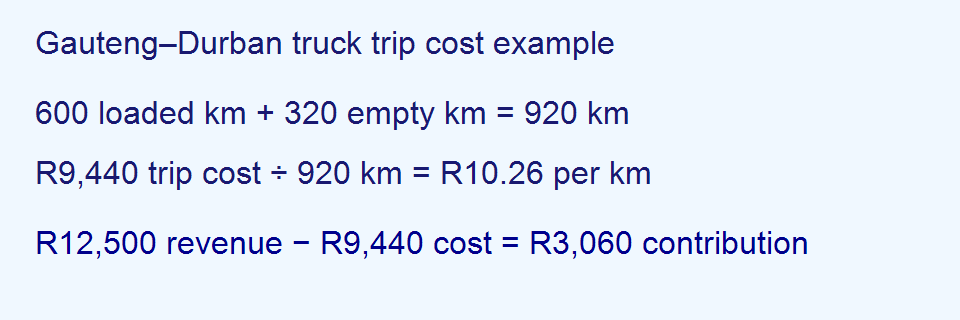
Suppose you bill R12,500. The truck runs 600 loaded kilometres and 320 empty or repositioning kilometres. At 2.5 km/L and an illustrative R20/L, fuel costs R7,360. Tolls add R900, driver and parking costs add R720, and a maintenance reserve of R0.50/km adds R460. The trip costs R9,440, or R10.26 per total kilometre. The remaining R3,060 is contribution before overheads and tax.
- Fuel: R7,360
- Tolls: R900
- Driver and parking: R720
- Maintenance reserve: R460
Fuel accounted for about 78% of the illustrative trip cost.
Copy this trip cost sheet
| Line item | Estimate | Actual |
|---|---|---|
| Loaded kilometres | 600 | |
| Empty kilometres | 320 | |
| Fuel | R7,360 | |
| Tolls | R900 | |
| Driver and parking | R720 | |
| Maintenance reserve | R460 | |
| Total trip cost | R8,700 | R9,440 |
Use the difference to improve the next quote
This example ran R740 over budget. Start with the largest variance in rand. An unexpectedly long empty leg changes how you plan the return. Higher fuel consumption on the same route calls for a closer look at receipts and the operating conditions. Keep revenue and costs on a consistent VAT basis.
Give each trip a job reference and keep the route, kilometres and reasons for any exception together. See how ATLAS supports Synesys transport partners and bring one completed trip to your next workflow review.
Further reading From truck CPK to a freight quote (Kweli Corridor Network).
Related Synesys guide How to set up a weekly freight operations review.
Truck trip cost sheet checklist
Track total kilometres, fuel, tolls and truck time on the same trip reference. Check whether overhead is already included in a kilometre rate before adding it separately.
Worked example
A 600 km trip uses 180 litres at an illustrative R22/litre, or R3,960. Add R650 tolls and R1,600 in other non-overlapping trip costs for R6,210 before any margin or tax.
When designing shared job records, capture what happened, the time and location, and the business context. See the GS1 EPCIS visibility standard.
Cover photo by Peter Black under CC BY-SA 2.0. Cropped and branded.
“An EPCIS event records what was involved in a business process step, when the event took place, where it took place”
GS1 guidance on visibility events
Record each leg against the job reference with its departure and arrival points. This lets accounts match the fuel, tolls and repositioning to the same trip.
Truck trip cost sheet FAQs
Should I include empty kilometres?
Yes. Include empty and repositioning kilometres in total trip distance. Keep them in a separate column so you can see which leg drives the cost.
How do I calculate the cost per kilometre?
Divide total trip cost by total kilometres. In the Gauteng–Durban example, R9,440 divided by 920 km is about R10.26/km.
Is the R3,060 balance the trip profit?
It is contribution before overheads and tax. Check which fixed costs your business still needs to cover before using the figure to assess profitability.