
A SADC certificate of origin needs an evidence chain from the producer to the shipment. Confirm the applicable origin rule, exporter process and goods identification before applying. A sales invoice or a certificate from an earlier load is not enough to establish the current claim.
Last verified: . South African guidance; destination-country rules must be checked separately.
In this guide
Build the SADC certificate of origin file before applying
The SADC certificate of origin is the visible output. The supporting manufacturing and shipment records are the work behind it. When the exporter is a distributor, that work crosses company boundaries: the producer knows how the goods were made, the exporter sells them and the importer uses the preference claim.
The SARS-hosted SADC producer declaration expressly refers to evidence that the listed goods comply with origin criteria. It is not merely an assurance that the producer has a local address. Obtain the appropriate supporting evidence for the goods being shipped, then confirm the current application process with the responsible authority or adviser.
Do not ask a supplier to sign a blank form or copy a product description the supplier cannot verify. A completed-looking file with an unexplained evidence gap creates a more difficult question later. State which products, batches and quantities the producer’s evidence actually covers.
SADC certificate of origin: application worksheet
| Part of the file | Check | Owner |
|---|---|---|
| Product identity | Description and classification match the actual goods | Exporter and customs adviser |
| Origin basis | Applicable product-specific rule and supporting assessment | Producer and responsible origin specialist |
| Producer evidence | Records relate to the shipped batch or product scope | Producer |
| Shipment identity | Invoice, package list and quantities are consistent | Exporter |
| Issuance and use | Current certificate process and destination acceptance confirmed | Exporter and importer’s representative |
Download this article’s main table (CSV)
Treat the description as an identifier, not a marketing line. “Industrial spares” may be meaningful to the sales team but insufficient to connect a certificate to a technical product. Use the goods description accepted for the actual commercial and customs documents, with product codes where they help establish the match.
The SADC e-certificate explanation describes an electronic process involving exporter registration, product registration and certificate applications. That does not establish that every border or country pair accepts the same operational workflow. Verify the process applicable to the intended shipment before committing to a document format.
Worked example: evidence coverage is not shipment coverage
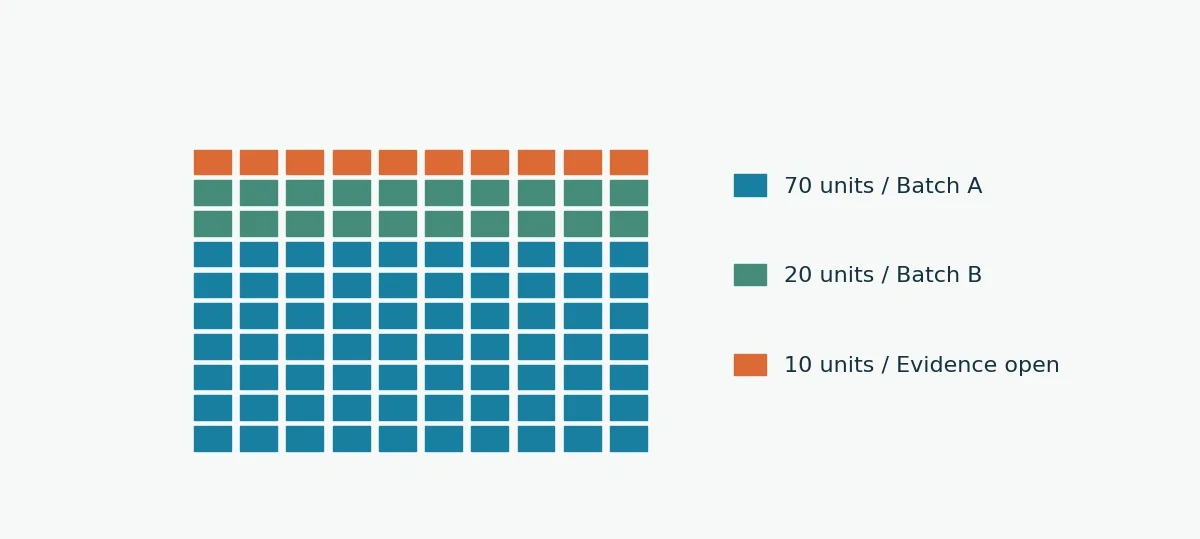
Illustrative documentation scenario. An exporter plans 100 units of one product. Producer evidence covers 70 units from batch A and 20 from batch B. Ten units are from a newly sourced batch C whose origin evidence has not been obtained. These invented counts describe evidence availability, not an actual origin decision.
| Status | Units |
|---|---|
| Batch A | 70 |
| Batch B | 20 |
| Evidence open | 10 |
The correct response is to investigate batch C before making a claim covering all 100 units. A generic producer letter for the product family may or may not cover that batch; the scope must be established. Do not silently apply the older batch evidence because the packaging looks identical.
In the second figure, the consignment identity is traced through producer batch, exporter invoice and certificate reference. The lines show documentary relationships. They are not a claim that a certificate can be issued solely from an invoice or that a file with three references is legally complete.
Keep batch, invoice and consignment identities connected
- Producer batch leads to the exporter invoice.
- The exporter invoice leads to the certificate and to the consignment.
- The certificate leads to the consignment.
If only the evidenced units are to ship, the exporter and adviser must assess the actual revised consignment and certificate scope. The commercial team should not promise the same duty outcome for an undocumented balance. Keep the remaining units visible as a separate decision rather than hiding them in a total.
Review the whole document set together
Review the commercial invoice, package list, producer evidence and SADC certificate of origin application side by side. A file can contain individually plausible documents that refer to different quantities or product versions. The purpose of the review is a consistent chain, not a large attachment count.
Check spelling and references, but do not stop at presentation. The important question is whether the production evidence supports the origin criterion being claimed. If the supplier cannot explain a manufacturing statement, ask for the responsible technical or compliance contact rather than asking a sales representative to improvise.
Confirm who can answer the importer’s follow-up after dispatch. A certificate question that reaches the driver at the border should lead to a named exporter or declarant contact. Use Who Owns Each Handoff on a Freight Job? to assign the evidence handoff before the truck leaves.
The broader SADC rules of origin guide explains why buying locally does not prove origin. If the product uses overseas parts, Imported Components and SADC Origin helps frame the production question without inventing a universal content threshold.
When a certificate file needs a fresh review
A changed manufacturer, imported component, recipe or production operation can matter even when the finished product keeps the same sales code. Put these changes into the exporter’s review process. The person preparing the certificate should not be the last person told that the factory changed its input source.
Keep the old and new evidence versions. A reviewer must be able to establish which assessment supported which shipment. Overwriting a shared file called “origin letter” removes that history and makes a later verification harder, even if the current document is correct.
For an already questioned claim, use Rejected SADC Preference. If the issue is instead a discrepancy between invoice and physical cargo, Customs Document Mismatches keeps the response focused on the actual error. Do not resubmit an identical certificate as the answer to every type of query.
Make “ready to apply” a defined internal status: product rule confirmed, evidence scope established, shipment references checked and process owner assigned. It is a management gate, not a new legal certification. The file should show who made each check and the issue still open, if any.
Questions shippers ask
Can a distributor obtain a SADC certificate of origin?
The exporter process and evidence requirements must be confirmed for the jurisdiction and arrangement. Where the exporter is not the producer, the evidence chain must reach the actual producer rather than relying solely on the distributor’s address or sales invoice.
Can I reuse a certificate from the previous shipment?
Do not assume so. A SADC certificate of origin relates to its own goods and consignment. Previous production evidence may help if still applicable, but shipment-specific documentation and the current application must be correctly prepared.
Does electronic issuance mean no supporting records are needed?
No. Electronic issuance changes the document workflow; it does not remove the need for an origin basis and matching evidence. Confirm current registration, application and destination-use requirements with the relevant authority or adviser.
Sources and verification notes
- SADC declaration by the producer, hosted by SARS
- SADC: What is the e-Certificate of Origin?
- SARS: SADC Treaty and Protocols
Sources checked on 17 November 2026. Charts and worked scenarios are original Synesys educational models; invented quantities, times and amounts are labelled illustrative. They are not customer results, published market prices or regulatory limits.
Continue with this topic
Forklifts at a HUDORA warehouse in Germany, December 2007. International archive photograph, not a Synesys facility. Photo: Mdornseif / CC BY-SA 4.0. Cropped and resized. This is documentary stock imagery, not a claim that Synesys owns the pictured facility, vehicle or shipment.