
On this page
A proof of delivery to invoice process connects the receiver’s signed count to the agreed freight charges. Give accounts the signed note, the accepted quote and evidence for any exception before they release the invoice.
A signed delivery note is useful only when accounts can match it to the job and explain any difference. Agree the evidence with the receiver before dispatch.
Check the invoice pack
- Match the POD to the job and delivery date.
- Check the receiver’s acknowledgement and record shortages or damage.
- Reconcile the agreed rate and written approval for extras.
- Give accounts the POD, rate confirmation and exception notes together.
- Match the POD
Check the job reference, date and signed count. - Resolve exceptions
Keep the signed note and record the agreed resolution separately. - Reconcile the charges
Match the rate and extras to written approvals before releasing the pack.
Example: one pallet short
The receiver signs for 19 of 20 pallets. Keep the signed POD, ask the driver and warehouse to reconcile the count, and record the outcome separately. Agree how to treat the shortage with the customer before releasing the invoice.
Explore ATLAS for Synesys transport partners.
Further reading Kweli Corridor Network’s related guide.
Related Synesys guide A 15 minute freight review after delivery.
Build a proof of delivery to invoice checklist
Before dispatch, agree what the receiver can sign, who can authorise a charge, and whether an electronic proof of delivery is acceptable. Give dispatch and accounts the same job reference. For a multi-stop job, add a stop number so that a signed note from the first stop cannot be mistaken for evidence that the entire load was delivered.
- Driver: Capture the whole signed page, including the actual count, any exceptions and the delivery date. Check the image while you are still on site. Ask the receiver to clarify any ambiguous note before you leave.
- Dispatcher: Match the POD against the dispatch sheet. If the signed count is different, preserve the original evidence and ask the loading and receiving teams to reconcile their counts. Record any later confirmation as a separate entry.
- Accounts: Match the invoice lines against the accepted quote or purchase order. Attach the relevant written approval and the evidence behind each extra charge. Record who must clear any item still under dispute.
Worked example: R720 of waiting time
Suppose an agreed base trip rate is R8,400 excluding VAT, the first 60 minutes on site are included, and approved waiting time is billed at R480 per hour, prorated. The site log shows arrival at 08:00 and release at 10:30. If the contract measures waiting from arrival to release, that leaves 90 billable minutes. Multiply 1.5 hours by R480 to get R720. The supported total is R9,120 before VAT if the customer approved the charge and the site log matches the agreed time basis. These rates are illustrative.
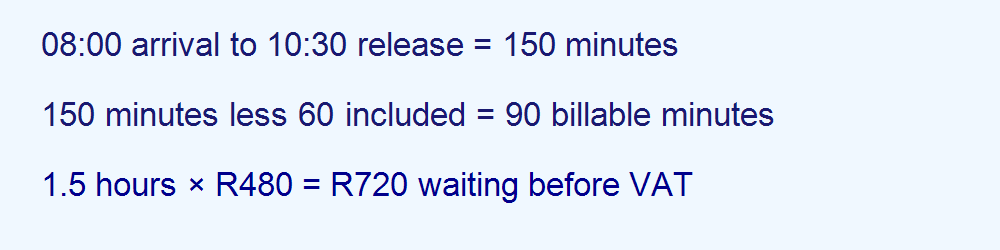
If the customer disputes the release time, keep the R720 on the exception record with its owner and a follow-up date. Check whether your agreement allows you to invoice the undisputed base amount first. Keep the operational record, the agreement on any extra charge and the tax invoice together so someone who was not on the job can follow the calculation.
For South African VAT vendors, check the SARS tax invoice requirements. Use the POD as evidence of delivery and prepare the tax invoice with the applicable SARS particulars. If the receiver accepts part of the shipment, follow the partial freight delivery checklist before closing the job.
Cover photograph. Independent archival illustration: BLM Regional Seed Warehouse, Boise, Idaho, United States; 16 May 2016. An aisle between tall stacks of bagged goods in a warehouse. Photograph by BLMIdaho under Public domain. Cropped and resized; no added text or logos.
“Serial number and date of issue of invoice”
Keep the invoice number and issue date alongside the freight job reference. That gives accounts a way to find the invoice and dispatch a way to find the delivery evidence.
Proof of delivery to invoice FAQs
What goes in the invoice pack?
Include the signed proof of delivery, accepted quote or purchase order, and the approval and evidence for any additional charge. Use the same job reference across the pack.
What if the receiver signs for fewer pallets?
Keep the original signed count. Record the difference separately and agree how the shortage affects billing before releasing the invoice.
What if waiting time is disputed?
Compare the site log with the agreed waiting-time rules. Record the disputed amount and ask the booking owner whether the undisputed base rate can be invoiced separately.