
Demurrage, detention and storage describe different uses of container equipment or terminal space. Identify the applicable contract, start event, stop event and free-time rule for each charge before booking the truck. Unloading the goods does not necessarily close the container’s cost exposure.
Last verified: 17 November 2026. Scope: South African shippers and their freight partners. Carrier notices are dated and may change. Confirm the container-specific terms and instructions before booking.
In this guide
Demurrage, detention and storage are not one clock
A Durban import can be commercially ready for the inland truck while the container still has unresolved terminal or equipment obligations. The words on the invoice matter because the service and charging period may differ. Begin with the issuer and contract, then identify the physical event the charge follows. Do not use “demurrage” as a catch-all label for every delay.
Under Maersk: Terms for Detention and Demurrage, demurrage concerns carrier equipment inside a terminal, detention concerns it outside, and storage concerns terminal or depot space. The terms also allow combined charging structures. This article uses that carrier’s definitions as an identified example, not a declaration that every South African contract uses identical clocks.
| Concept | What to identify in the actual agreement | Operational question |
|---|---|---|
| Demurrage | Equipment inside the terminal and applicable free-time calculation | When can the full box actually be collected? |
| Detention | Equipment outside, or an agreed combined period | When will the empty be accepted back? |
| Storage | Use of terminal or depot facilities | Who invoices the space and under which tariff? |
| Truck waiting | The road carrier’s separately agreed site-time condition | Which arrival and departure events are evidenced? |
Download this article’s main table (CSV)
Truck waiting is included in the worksheet because it is easy to confuse with container charges. A truck can wait at a receiver while equipment time also continues. That does not automatically mean duplicate billing: the resources and contracts may be different. Ask what each amount pays for before deciding whether it overlaps.
Real-world evidence: two Durban notices, two scopes
Maersk’s 2 November 2026 notice temporarily increases Durban import detention free time from 4 to 5 days through 31 December 2026, with a return to 4 days from 1 January 2027. It attributes the measure to “the congestion being experienced in Durban”. Single-sourced carrier advisory, checked 17 November 2026: Maersk: Durban import detention advisory, 2 November 2026.
A separate 1 October 2026 notice concerns Durban Gateway Terminal demurrage for GP DRY and NOR containers: 3 to 5 calendar days, until further notice. That is a different scope and clock. Single-sourced carrier advisory: Maersk: Durban Gateway Terminal demurrage advisory, 1 October 2026. Neither notice should be copied as a universal free-time promise for every carrier, terminal, container type or booking.
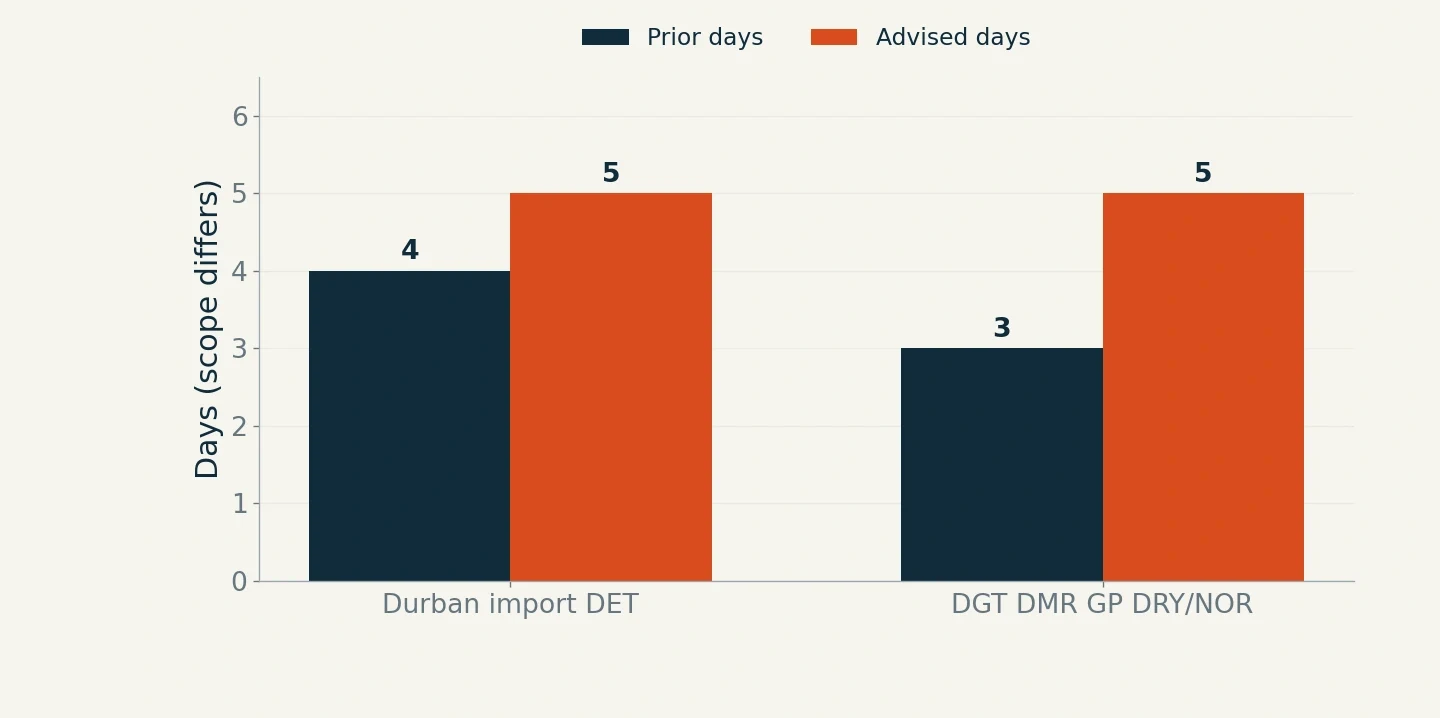
| Notice scope | Prior days | Advised days |
|---|---|---|
| Durban import DET | 4 | 5 |
| DGT DMR GP DRY/NOR | 3 | 5 |
The educational value of those notices is not simply the additional time. It is the need to store the effective date, eligible equipment and ending condition with the booking. A spreadsheet column labelled “five free days” cannot explain which notice applies when a later invoice arrives.
Map discharge, gate-out, unloading and gate-in
Build a container event record that stays with the job. Use timestamps from the party responsible for each event, identify the time zone, and retain the container number. A driver message that cargo was delivered is not necessarily evidence that the empty was returned. The job needs both the goods-delivery handoff and the equipment-closeout handoff.
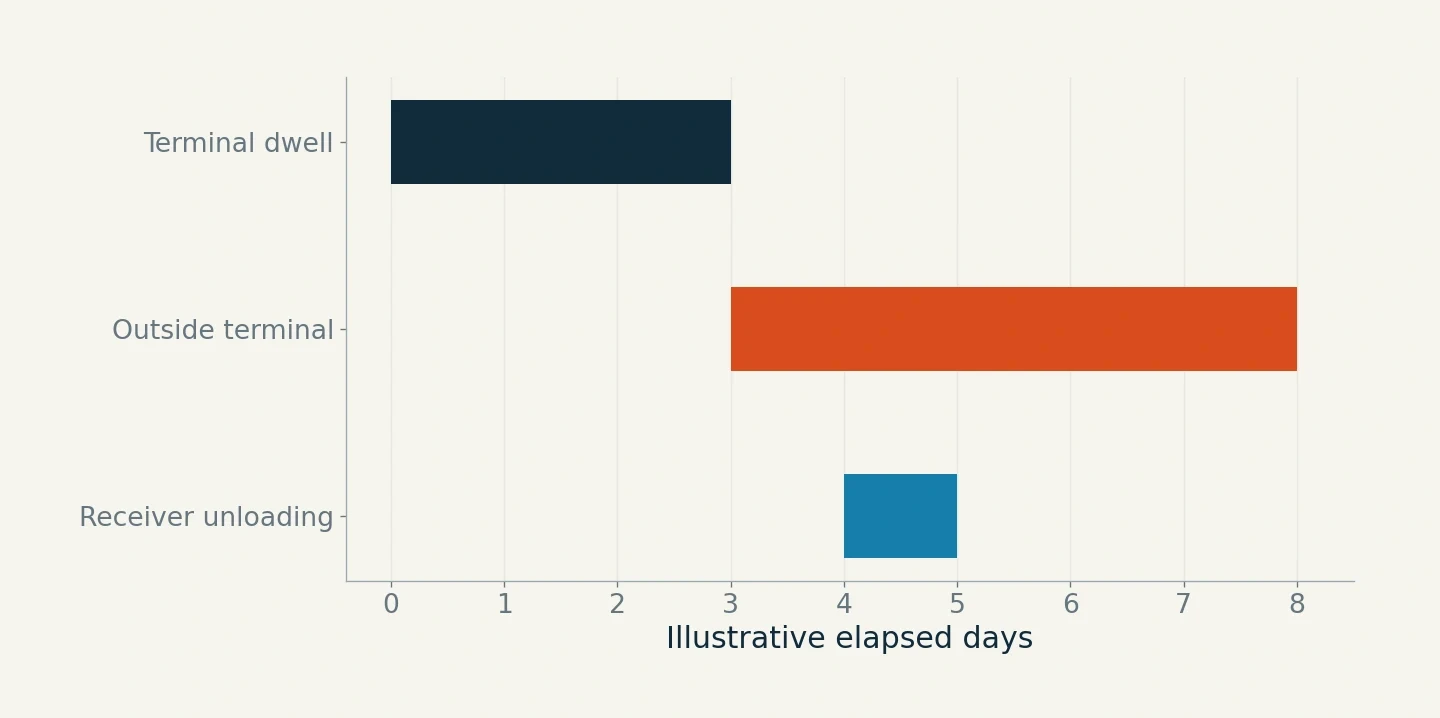
| Period | From day | To day |
|---|---|---|
| Terminal dwell | 0 | 3 |
| Outside terminal | 3 | 8 |
| Receiver unloading | 4 | 5 |
For Maersk shipments, the Maersk: Finding the empty return location guidance explains where to find the shipment’s empty return location online. Capture the current instruction as well as the depot’s name. The Maersk: South Africa import and turn-in instructions page publishes dated South African turn-in information; the version visible when this article was checked covers Week 47 through 23 November 2026. Do not use that dated file as a permanent instruction.
If the empty is rejected, preserve the rejection event and contact the equipment owner. Driving to a more convenient depot without approval can leave the movement unresolved. The right decision depends on the carrier instruction, the depot acceptance and the actual booking, not a generic map pin.
Worked example: show the exposure without inventing a tariff
Illustrative costing method. Assume an agreement allows 3 free chargeable days under a defined counting convention, followed by R800 per additional day. If 2 additional days are accepted as chargeable, the example charge is R1,600. If 4 additional days are chargeable, it is R3,200. These are assumed terms to explain arithmetic, not a published Durban tariff.
| Illustrative scenario | Additional chargeable days | Assumed rate (ZAR/day) | Amount (ZAR) |
|---|---|---|---|
| Earlier closeout | 2 | 800 | 1600 |
| Later closeout | 4 | 800 | 3200 |
A tiered tariff needs a line for each band. Do not multiply every day by the highest band if that is not how the tariff works. Equally, do not apply a free-time extension to storage or truck waiting just because it changes a carrier-equipment clock. Rebuild the calculation using the charge’s own terms.
Separate an avoidable operating cost from the legal question of liability. The person coordinating the delivery can reduce risk by organising a timely return, while the contractual payer may be a different party. Record both rather than making the driver decide who should ultimately pay.
Four controls that make the charges easier to manage
First, obtain a container-level last-free-date confirmation and identify the charge it covers. Second, verify cargo and payment release before committing the road movement. Third, make the receiver’s unloading ability part of the plan. Fourth, close the job with an accepted empty-return record. These are proposed operating controls, not a promise that they remove every charge.
Assign a person to each control. A clearing owner may confirm release; the receiver confirms a suitable bay and equipment; the road carrier provides movement evidence; the equipment owner confirms the return instruction. The coordinator joins those facts into a decision. A dashboard that shows only the truck’s GPS location cannot prove all of them.
Keep the customer updated before the next commitment becomes irreversible. If unloading is unlikely to finish in time for the instructed depot, tell the relevant parties and ask for the approved alternative. A late explanation is less useful than an early, bounded decision.
Copy the container control record
| Field | Record for each container |
|---|---|
| Identity | Container number, shipment and bill of lading reference |
| Charge scope | Issuer, term, equipment type and applicable notice |
| Clock | Start, stop, counting convention, time zone and free period |
| Readiness | Customs/carrier release and payment dependencies |
| Delivery | Receiving slot, unloading owner and actual completion |
| Return | Authorised depot, instruction version and acceptance |
| Evidence | Event records, invoice calculation and dispute reference if needed |
For planning, use the free-time calculation article. For a questionable bill, use the dispute evidence guide. For execution after unloading, use the empty-return article. The pillar explains how the pieces fit, while those supporting guides address the actual decision in front of the shipper.
When a bill is correct, retain the lesson as well as the invoice. A recurring late return caused by an unrealistic receiving window is a delivery design problem. A wrong timestamp is an evidence problem. Fixing the right one is more valuable than repeatedly asking for a goodwill waiver.
Questions shippers ask
Are demurrage and detention the same charge?
Not necessarily. Check the agreement for separate or combined periods. Identify the equipment location and start/stop events rather than relying on the invoice nickname.
Does a Customs hold automatically stop all charges?
Do not assume so. Confirm the applicable local contract and any written relief. Different resources and charge types can follow different rules.
Does free time mean a terminal guarantees collection within that time?
No. A charging allowance is not, by itself, a guaranteed operating service time. Plan release, appointments, truck and receiver readiness separately.
Does delivery stop detention?
The relevant contract determines the stop event. In the carrier example discussed here, accepted empty gate-in matters; unloading alone is not the equipment closeout.
Use this with the rest of the library
Follow the practical next step: Container Free Time: Calculate the Last Free Day Before Booking a Truck; Demurrage Invoice Dispute: Build an Evidence Pack Before You Escalate; Empty Container Return: Plan the Depot Handoff and Stop the Clock.
For the transporter’s collection brief, Kweli: Durban port trucking and collection readiness discusses terminal identity, readiness and the return task. This Synesys cluster concentrates on the shipper’s charge evidence and equipment closeout.
For the operating handoff, also use Durban container collection checklist; Cape Town container delivery and empty return. If you need help scoping a shipment, send Synesys the collection, delivery and cargo details.
Sources and method
The external sources below support the rules or carrier terms cited in this article. The worksheets, decision methods and labelled examples are original Synesys educational analysis. They are not measured customer outcomes or market price benchmarks. Confirm the actual declaration, contract and shipment dates before relying on a numerical example.
- Maersk: Terms for Detention and Demurrage
- Maersk: Durban import detention advisory, 2 November 2026
- Maersk: Durban Gateway Terminal demurrage advisory, 1 October 2026
- Maersk: Finding the empty return location
- Maersk: South Africa import and turn-in instructions
- Kweli: Durban port trucking and collection readiness
Carrier notices are dated and may change. Confirm the container-specific terms and instructions before booking.
Continue with this topic
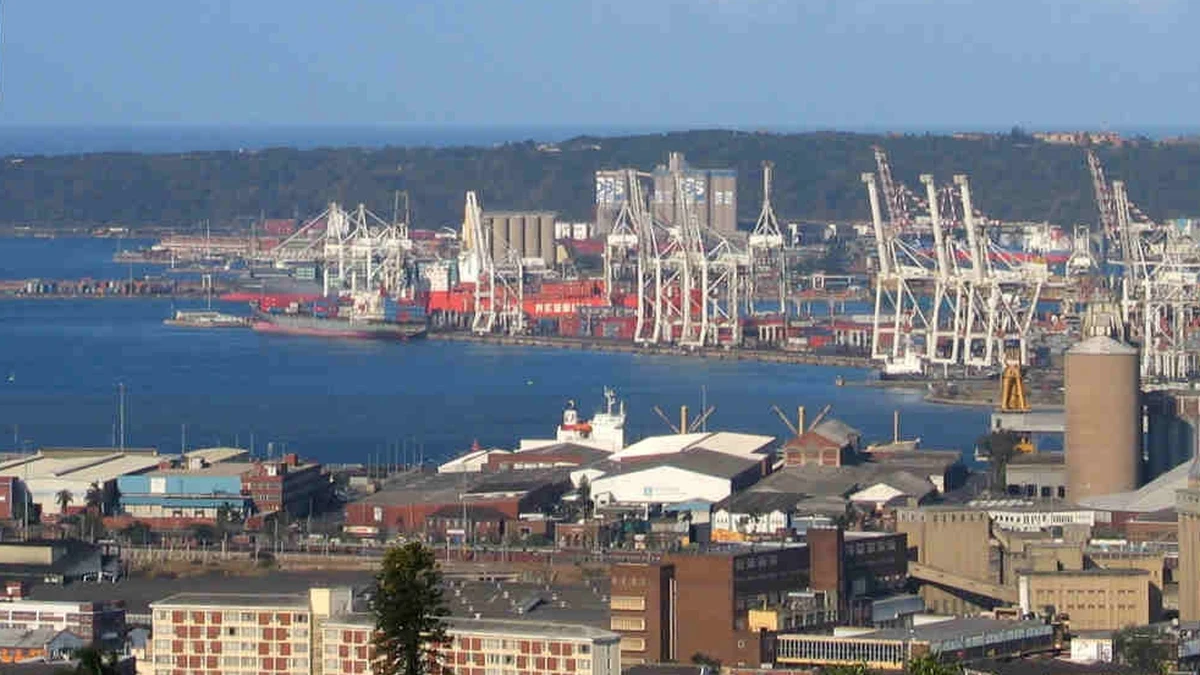
Durban harbour, August 2006. Archive photograph, not a current congestion report. Photo: User:PhilippN / CC BY-SA 3.0. Cropped and resized. This is documentary stock imagery, not a claim that Synesys owns the pictured facility, vehicle or shipment.