
Container free time can only be calculated after you identify the charge, its start and stop events, the counting convention and the booking’s allowance. Write down the last free date for each container; do not infer it from a vessel arrival estimate.
Last verified: 17 November 2026. Scope: South African shippers and their freight partners.
In this guide
Confirm container free time terms before counting days
For a Durban container, the phrase “five days” is incomplete. Five days of which charge, starting from which event, counted in which way, and for which equipment? Container free time is a contract-and-event calculation. A public notice can help identify a change, but the shipment still needs an applicable booking and confirmed event record.
The Maersk: Terms for Detention and Demurrage terms describe separate and combined charging structures. Use the structure that applies to the shipment. A calculation built around full gate-out will be wrong if the relevant charge follows a combined period with another start event.
| Input | What to capture |
|---|---|
| Charge identity | Demurrage, detention, combined period or storage |
| Applicable agreement | Booking/contract and local tariff version |
| Start event | Actual event and whether its day counts |
| Free allowance | Confirmed eligible days and any extension |
| Calendar rule | Calendar/working days, holidays and cutoff treatment |
| Stop event | Relevant gate-out or accepted return record |
| Result | Last free date and first potential charged day |
Download this article’s main table (CSV)
Keep the container free time result specific to each box. If boxes discharge or return on different dates, one spreadsheet date for the whole bill of lading may conceal an individual late movement. Retain the event evidence used in the calculation.
Worked example: state the counting convention explicitly
Illustrative convention, not a carrier rule. Suppose Day 1 is counted as the first day of a 5-calendar-day allowance. Days 1 through 5 are free. Day 6 is the first potential charged day. A stop event on Day 8 therefore falls after 3 potentially chargeable days under this assumed inclusive convention. The real contract may count start and stop days differently.
| Day | Status |
|---|---|
| Days 1 to 5 | Free |
| Days 6 to 8 | Potentially charged |
If a spreadsheet simply subtracts a discharge date from a return date, it can hide the inclusive/exclusive choice. Test the formula against a short example the carrier confirms. In the worksheet, keep “last free date” separate from “planned truck date”; they are different pieces of information.
| Illustrative day | Status under assumed convention | Running potentially charged days |
|---|---|---|
| 1–5 | Within allowance | 0 |
| 6 | First day after allowance | 1 |
| 7 | Second day after allowance | 2 |
| 8 | Third day after allowance | 3 |
The planning benefit comes from knowing the first expensive event before it happens. If a receiver cannot unload until the last free day, a return task may already have too little margin. Rework the physical plan rather than changing the spreadsheet’s label.
Do not flatten a tiered charge into one daily rate
Illustrative tariff only. Assume the first 2 additional chargeable days cost R500 per day and the next 2 cost R900 per day. Four additional days then cost R2,800: R1,000 in the first band plus R1,800 in the next. Neither R500 × 4 nor R900 × 4 reproduces that assumed tariff.
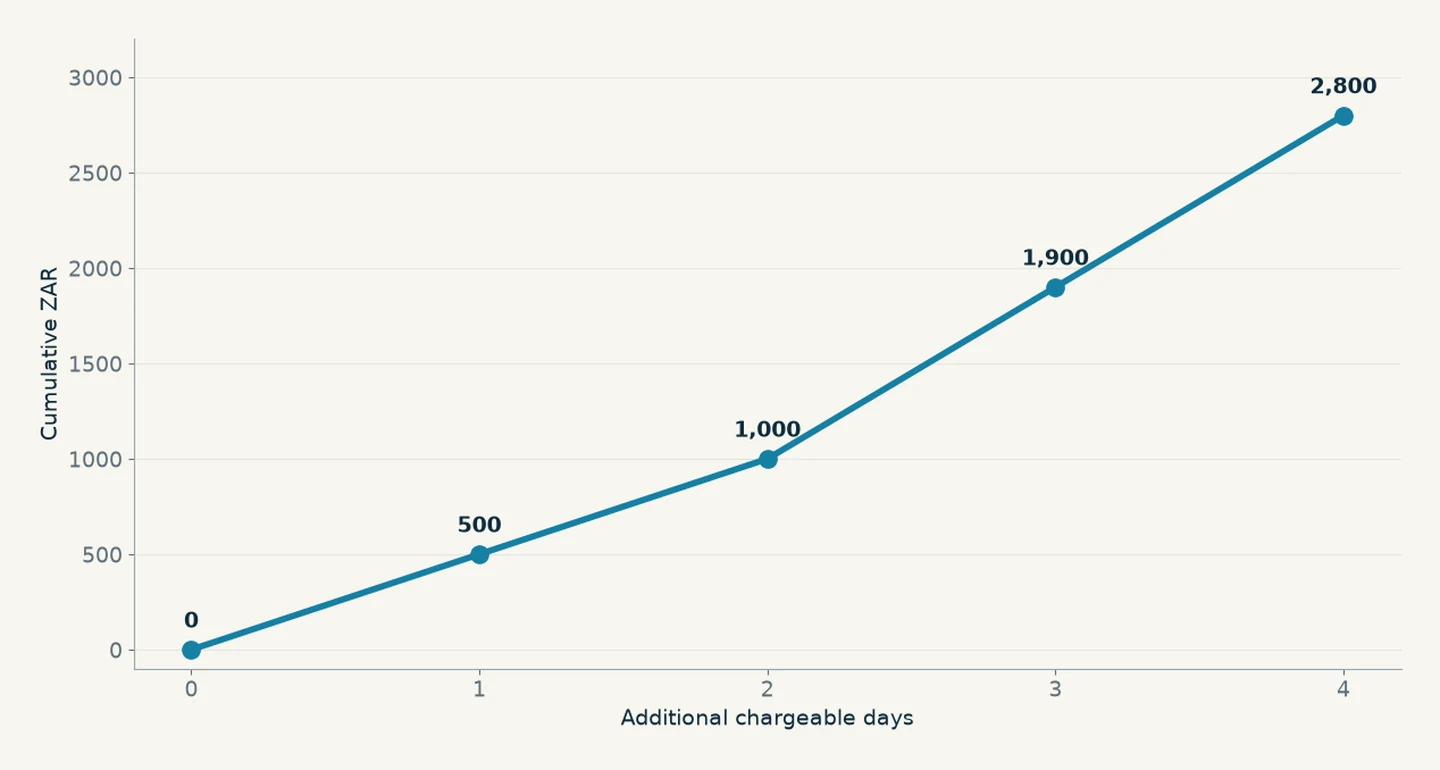
| Additional chargeable days | 0 | 1 | 2 | 3 | 4 |
|---|---|---|---|---|---|
| Cumulative cost (ZAR) | 0 | 500 | 1,000 | 1,900 | 2,800 |
For a real bill, keep equipment size/type, currency, effective date and each slab next to the daily count. A correct number of days multiplied by the wrong equipment tariff is still a wrong calculation. Ask for the calculation detail if the invoice only shows a total.
Use a current notice without stretching its scope
On 17 November 2026, Maersk’s Maersk: Durban import detention advisory, 2 November 2026 describes a temporary Durban import DET allowance of 5 days through 31 December 2026, reverting to 4 days from 1 January 2027. This is a single-sourced carrier notice, not an allowance for every shipping line or a statement about every charge.
The separate Maersk: Durban Gateway Terminal demurrage advisory, 1 October 2026 deals with DGT demurrage for GP DRY/NOR equipment. Keep the notices in separate worksheet fields. The fact that both mention five days does not merge their scope or prove that the same start event applies.
Record when the container free time term was last verified and ask the carrier which notice applies to your container. If a later invoice uses a different allowance, you now have a dated evidence trail to discuss rather than a remembered number.
Turn the last free date into an operating decision
Plan around container free time by working backwards from the required stop event. An empty return needs unloading, a suitable truck movement, the correct depot instruction and depot acceptance. A full-box collection needs actual release and a collection opportunity. Ask the responsible parties for their constraints instead of treating free days as a pool of spare time.
| Planning field | Enter the real shipment answer |
|---|---|
| Last free event/date | Carrier-confirmed charge and deadline |
| Planned physical completion | Gate-out or accepted gate-in, as relevant |
| Unloading/return dependency | Receiver and carrier confirmation |
| Margin | Time left under the stated plan |
| Exception trigger | When the coordinator must escalate |
If the date cannot be confirmed, state that limitation to the customer. A container free time calculation becomes useful when another person can reproduce it and the operating team can act on it. An unsupported date is just an optimistic appointment.
Questions shippers ask
Does free time start when the vessel arrives?
Not necessarily. Identify the actual contractual start event, which can differ from vessel arrival or an estimated arrival date.
Do weekends count?
Use the specific calendar or working-day convention for the applicable charge. Do not assume one rule across carriers, ports and equipment types.
Can a free-time extension be applied to all charges?
Only if the relevant agreement or issuer confirms it. An extension for one equipment clock does not automatically change storage or truck waiting.
Use this with the rest of the library
Follow the practical next step: Demurrage, Detention and Storage: A South African Shipper’s Guide; Demurrage Invoice Dispute: Build an Evidence Pack Before You Escalate; Empty Container Return: Plan the Depot Handoff and Stop the Clock.
For the operating handoff, also use Durban container collection checklist; What to do when a delivery slot will be missed. If you need help scoping a shipment, send Synesys the collection, delivery and cargo details.
Sources and method
The external sources below support the rules or carrier terms cited in this article. The worksheets, decision methods and labelled examples are original Synesys educational analysis. They are not measured customer outcomes or market price benchmarks. Confirm the actual declaration, contract and shipment dates before relying on a numerical example.
- Maersk: Terms for Detention and Demurrage
- Maersk: Durban import detention advisory, 2 November 2026
- Maersk: Durban Gateway Terminal demurrage advisory, 1 October 2026
Continue with this topic
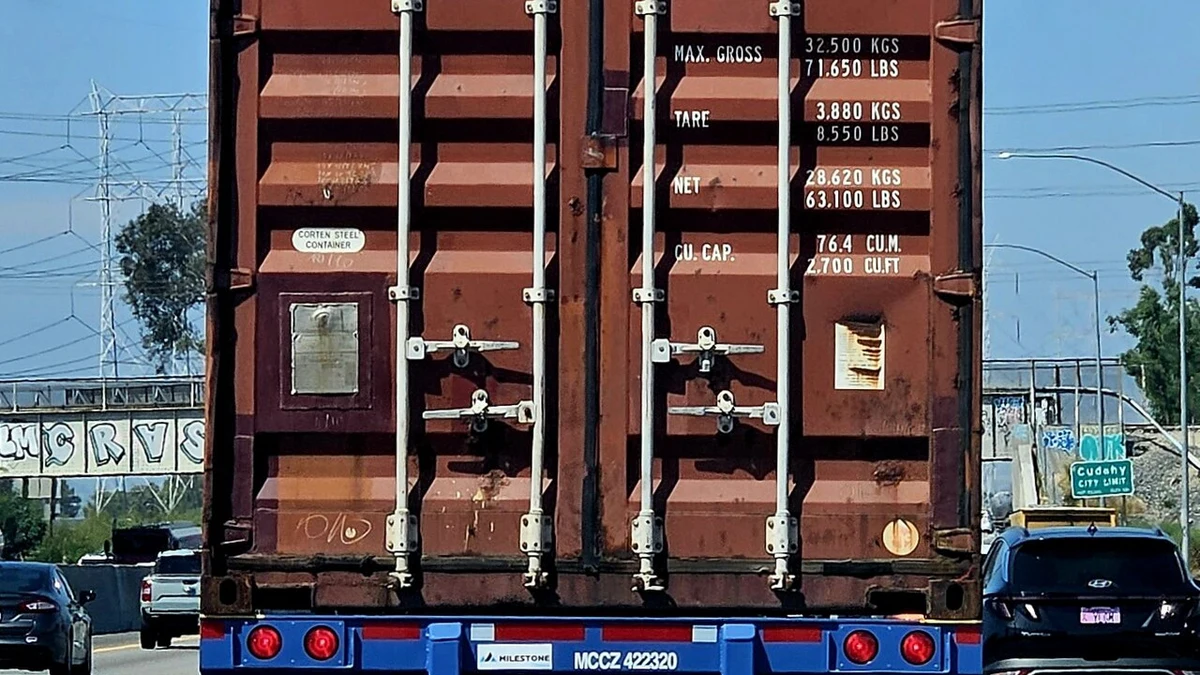
The rear of a container on a road vehicle, photographed in August 2023. The image illustrates equipment identification, not an approved loading arrangement. Photo: Epolk / CC BY-SA 4.0. Cropped and resized. This is documentary stock imagery, not a claim that Synesys owns the pictured facility, vehicle or shipment.