

An empty container return is complete only when the equipment has reached the authorised return point and the relevant acceptance is recorded. Plan the depot instruction, unloading completion, truck movement and gate-in evidence together; “cargo delivered” does not prove the box is closed.
Last verified: 17 November 2026. Scope: South African shippers and their freight partners.
In this guide
Get the empty container return instruction before booking the truck
A Durban container delivered to Gauteng creates two handoffs: goods to the receiver and equipment back under the carrier’s instruction. Empty container return planning should therefore begin before collection. Confirm whether the accepted scope includes the return movement, which party controls the instruction, and how a change will be approved.
Maersk’s Maersk: Finding the empty return location explains how customers can find the shipment’s return location. Its Maersk: South Africa import and turn-in instructions page warns that non-allocated depots can reject turn-ins. Treat the actual current instruction as shipment evidence, not a suggestion to choose whichever depot is nearest.
When this guide was checked on 17 November 2026, that South Africa page displayed a Week 47 return file valid through 23 November 2026. This is a single-sourced, dated observation showing why instructions need a validity check. It is not a permanent recommendation to use a particular depot.
The empty container return brief
| Before the movement | What to confirm |
|---|---|
| Equipment identity | Container number, size/type and shipment |
| Authorised return point | Carrier instruction and its current version |
| Acceptance conditions | Required references, appointment or other confirmed conditions |
| Receiver readiness | Unloading method, people and completion estimate |
| Road movement | Who books and pays for the empty leg |
| Deadline | Relevant last free event/date and operating cutoff |
| Closure evidence | Accepted gate-in or other applicable equipment record |
Download this article’s main table (CSV)
A receiving-site promise that “we unload quickly” is too vague for a time-bound return. Ask what cargo must be removed, what equipment will be available and whether the box can be released immediately after unloading. If the receiver wants to use it for storage, escalate that commercial change before the truck arrives.
The Maersk: Terms for Detention and Demurrage terms explain the importance of the return stop event under the identified carrier agreement. Check the real contract, especially where combined periods or special arrangements apply. The delivery note and the equipment record should remain separate.
Worked example: one hour of margin is easily lost
Illustrative operating plan, not depot hours or travel advice. Assume unloading is planned from 09:00 to 12:00, the empty movement takes 3 hours, and the confirmed acceptance cutoff for this hypothetical job is 16:00. Planned arrival is 15:00, leaving 1 hour before the assumed cutoff. A 2-hour unloading delay moves the planned arrival to 17:00, beyond that cutoff.
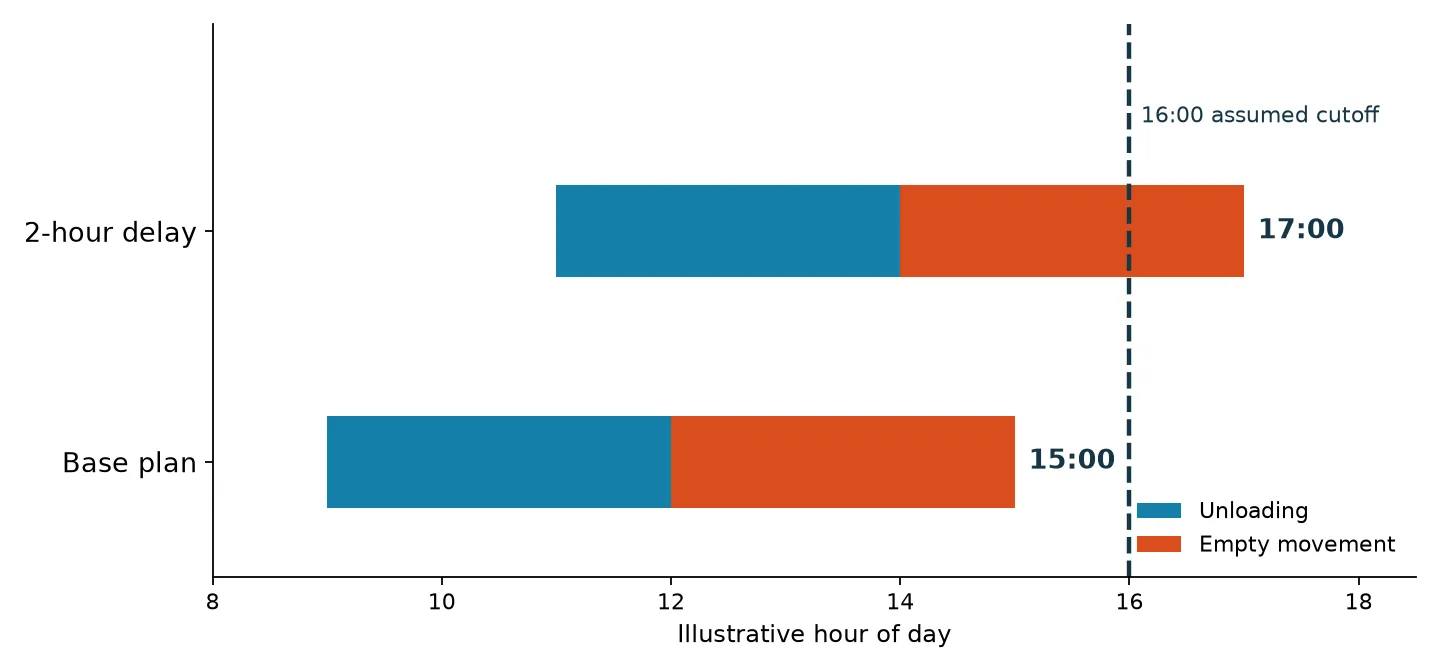
| Illustrative event | Base plan | Delayed unloading |
|---|---|---|
| Unloading begins | 09:00 | 11:00 |
| Unloading finishes | 12:00 | 14:00 |
| Assumed empty movement | 3 hours | 3 hours |
| Planned return arrival | 15:00 | 17:00 |
| Against assumed 16:00 cutoff | 1 hour before | 1 hour after |
The useful decision is made when the delay becomes visible, not at 17:00. Ask whether unloading can be changed safely, whether the approved return arrangement can be revised, or whether another authorised plan is needed. Do not instruct the driver to rush or bypass safety controls to preserve an unrealistic schedule.
A different depot needs an authorised change
Maersk’s Maersk: Requesting a different return depot guidance says a different return depot should be requested through its Customer Experience case process. Other equipment owners have their own methods. The principle for the shipper is to obtain and retain the actual approval before treating an alternative as accepted.
If a depot rejects the box, record arrival, container identity, instruction shown and reason given. Ask for the rejection reference where available and notify the carrier/equipment owner. An unresolved return should stay open in the job record even if the goods receiver has already signed for the cargo.
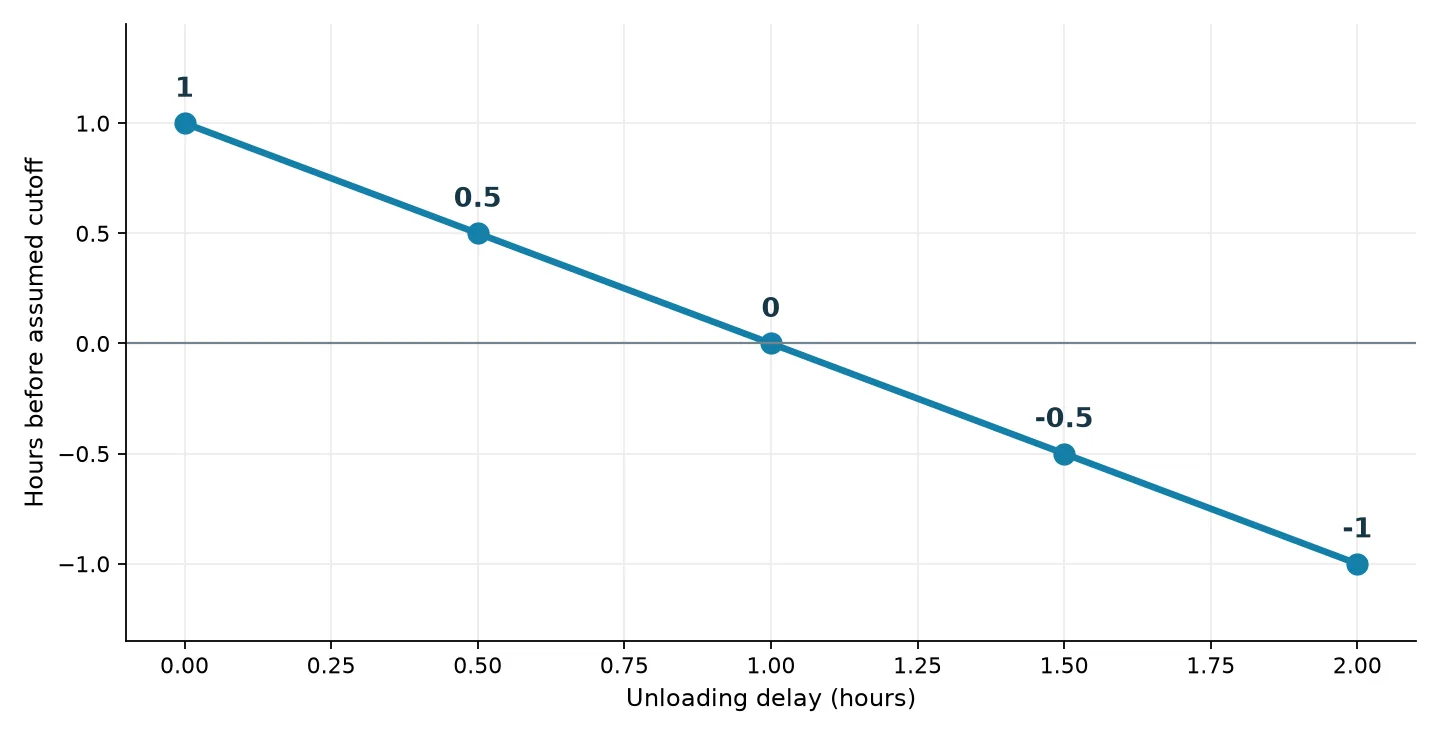
| Unloading delay (hours) | Hours before assumed cutoff |
|---|---|
| 0 | 1 |
| 0.5 | 0.5 |
| 1 | 0 |
| 1.5 | -0.5 |
| 2 | -1 |
A changed depot can also change the road task and commercial cost. Keep the equipment approval and road-carrier variation aligned. Otherwise the container may be authorised to go somewhere the appointed truck has not agreed to serve.
Close with evidence, then reconcile the cost
| Closeout record | Why retain it |
|---|---|
| Accepted return event | Shows what happened to the equipment |
| Container and shipment reference | Links the event to the correct box |
| Instruction/approval version | Explains why that depot was used |
| Condition or exception note | Preserves any issue recorded at handover |
| Final cost reconciliation | Checks charges against scope and event evidence |
Compare the actual empty container return to the plan while the people involved can explain the difference. Was the delay caused by a receiver bay, missing instruction, road disruption or depot rejection? Each points to a different next-shipment action. A generic “driver late” note can send the business toward the wrong fix.
If the final charge appears inconsistent, use the dispute guide to reconstruct it from the accepted event and actual terms. If it is correct, preserve the lesson in the next booking brief. Empty container return is a complete operating task, and it deserves the same ownership as collection and delivery.
Questions shippers ask
Can I return an empty to the nearest depot?
Use the authorised instruction for that container. Obtain approval for a different depot rather than assuming proximity establishes acceptance.
Does the signed delivery note close the container?
It records the goods handoff. Keep the separate equipment-return evidence required by the agreement.
What should the driver record if the return is rejected?
Container identity, arrival, instruction presented, reason and any available rejection reference. The coordinator should obtain the approved next step from the responsible party.
Use this with the rest of the library
Follow the practical next step: Demurrage, Detention and Storage: A South African Shipper’s Guide; Container Free Time: Calculate the Last Free Day Before Booking a Truck; Demurrage Invoice Dispute: Build an Evidence Pack Before You Escalate.
For the operating handoff, also use Cape Town container delivery and empty return checklist; Truck access and delivery-site checklist. If you need help scoping a shipment, send Synesys the collection, delivery and cargo details.
Sources and method
The external sources below support the rules or carrier terms cited in this article. The worksheets, decision methods and labelled examples are original Synesys educational analysis. They are not measured customer outcomes or market price benchmarks. Confirm the actual declaration, contract and shipment dates before relying on a numerical example.
- Maersk: Finding the empty return location
- Maersk: South Africa import and turn-in instructions
- Maersk: Terms for Detention and Demurrage
- Maersk: Requesting a different return depot
Continue with this topic
A sealed container door, October 2017. Archive photograph; seal integrity must be checked against the actual shipment record. Photo: YWAM Orlando / CC BY 2.0. Cropped and resized. This is documentary stock imagery, not a claim that Synesys owns the pictured facility, vehicle or shipment.