
Alternative port routing should compare the full delivered movement: vessel arrival, release, inland transport, receiver access and equipment return. A shorter queue at another port is not enough. The alternative must be feasible for the cargo, customs procedure and final delivery commitment.
Last verified: 17 November 2026. The financial examples are illustrative rand budgets excluding VAT. They are not quotations, current tariffs, measured port delays or advice to divert a particular shipment.
In this guide
Alternative port routing changes more than the discharge point
A cargo owner comparing Durban, Ngqura and Cape Town must identify what can still change. Cargo already discharged presents a different choice from a shipment not yet booked on a vessel. Ask the shipping line what service and discharge options are actually available before asking a road operator to price an imagined alternative.
Then check the receiving side. A Gauteng warehouse may accept the same cargo through another gateway, but the revised inland distance, equipment and return depot can change the commercial scope. Do not assume that a shipping line will permit an empty container to return at the destination most convenient for the road operator.
Separate a vessel-level contingency from a shipper-selected change. The line’s instructions, cargo availability and charges may differ. Save the written decision, identify who has accepted the revised movement and ask the declarant whether any customs arrangements must change. A route comparison is not permission to move uncleared goods.
Put both gateways into one comparison sheet
| Scope item | Gateway A | Gateway B | Evidence needed for a real booking |
|---|---|---|---|
| Marine and booking scope | R15,000 | R16,000 | Line’s written service quotation |
| Port and handling scope | R3,000 | R4,000 | Applicable current charges and inclusions |
| Inland movement | R8,000 | R6,000 | Operator’s shipment-specific quote |
| Empty equipment return | R1,000 | R2,000 | Confirmed depot and return terms |
| Base total | R27,000 | R28,000 | Comparable commercial boundary |
| Delay allowance in this scenario | R2,000 | R0 | Explicit assumption, not a fee claim |
| Scenario total | R29,000 | R28,000 | Decision owner approves assumptions |
Download this article’s main table (CSV)
Gateway A’s base quotation is R1,000 lower, yet the stated scenario makes Gateway B R1,000 lower overall. This does not prove that B is the better choice. It shows why an unexplained “contingency allowance” can determine the answer. The cargo owner must know who supplied the R2,000 assumption and what event would actually incur it.
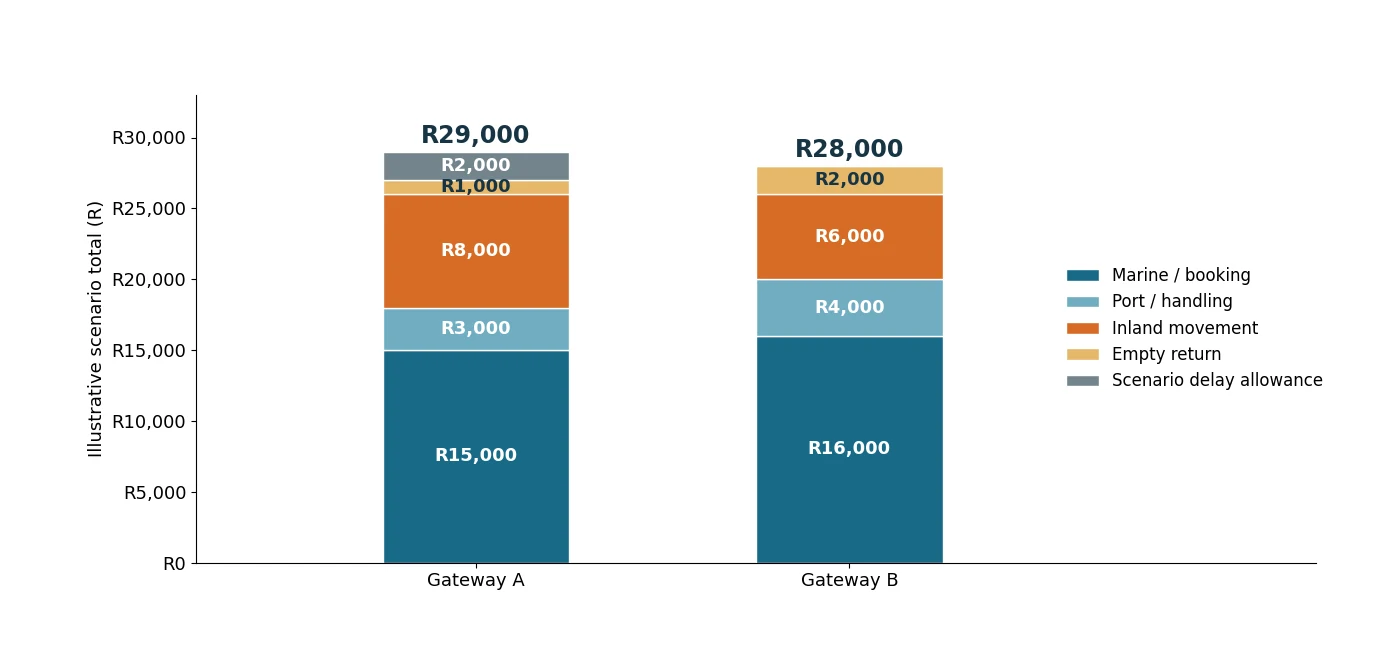
| Component | Gateway A | Gateway B |
|---|---|---|
| Marine / booking | R15,000 | R16,000 |
| Port / handling | R3,000 | R4,000 |
| Inland movement | R8,000 | R6,000 |
| Empty return | R1,000 | R2,000 |
| Scenario delay allowance | R2,000 | not applicable |
| Total | R29,000 | R28,000 |
Test the decision against a range of delays
Alternative port routing becomes more useful when the reader can see what changes the answer. Take the same base totals, then assume additional exposure of R1,500 per day for A and R400 per day for B. These daily amounts are hypothetical budget inputs, not demurrage or detention tariffs. They could represent a negotiated waiting arrangement in a training example.
The cost difference is R1,000 divided by R1,100 per day, giving a mathematical crossover at about 0.91 day. At one illustrative day, A totals R28,500 and B R28,400. This calculation assumes the same delay measure affects both options, charges accrue linearly and there are no fixed penalties. Real free-time bands and facility cutoffs can invalidate those assumptions.
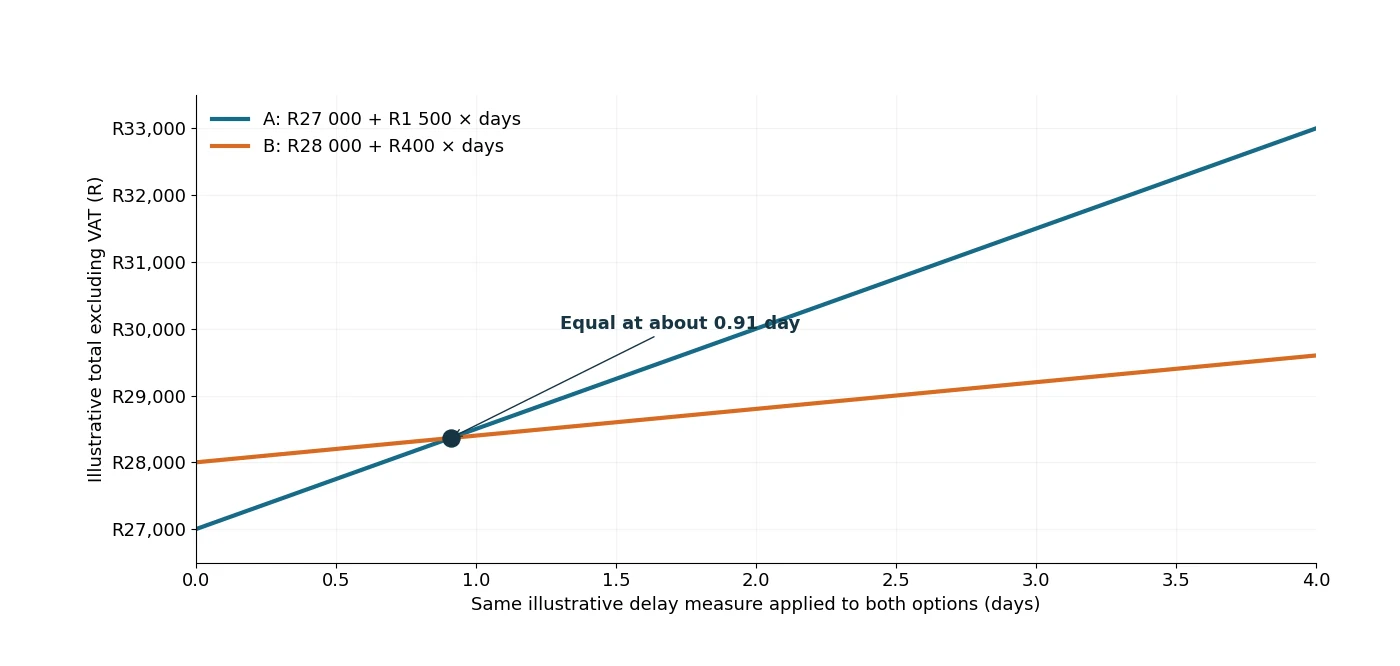
| Delay measure (days) | A: R27 000 + R1 500 × days | B: R28 000 + R400 × days |
|---|---|---|
| 0 | R27,000 | R28,000 |
| 0.91 (equal) | about R28,360 | about R28,360 |
| 1 | R28,500 | R28,400 |
| 2 | R30,000 | R28,800 |
| 4 | R33,000 | R29,600 |
Ask what happens just beyond the deadline. A receiver that closes on Friday could add a weekend to one plan while leaving the other unchanged. A step change of that kind belongs in the comparison explicitly. It should not be hidden inside a smooth average daily charge.
Use weather evidence for the decision it supports
The CSIR’s August 2026 account of PortOps describes wind-related constraints at Cape Town and a platform intended to combine forecasts with operating information. That is evidence for checking the terminal’s likely operating window. It is not a reason to assume another port will be faster for a particular container.
The World Bank’s 2023 logistics discussion also treats reliability as a supply-chain issue. Apply that perspective across the entire movement. Moving the discharge point may exchange one uncertainty for another at the inland or customs handoff.
Questions to resolve before approving a change
Ask the line to confirm the cargo’s revised availability and the party responsible for charges arising from the change. Ask the declarant what must be amended and who can confirm release. Ask the operator about vehicle suitability, safe stopping arrangements and the revised receiving appointment. These confirmations should refer to the same shipment and quote version.
For equipment return, obtain the current authorised depot instruction and any validity period. Keep the source email or published instruction with the job. The empty container return guide explains how to close that handoff; the demurrage, detention and storage pillar explains the commercial clocks to distinguish.
Make one person own the decision record. State the selected route, the assumptions that made it preferable, the point beyond which it cannot be changed and the next review trigger. A list of possible ports without a decision owner leaves dispatch carrying a commercial choice it may not be authorised to make.
Use corridor guides after the gateway choice is credible
Kweli’s Beira versus Nacala comparison offers operator-oriented questions about gateways and inland handoffs. It concerns different ports and jurisdictions from the illustrative A/B model here. Use its route context as a starting point, then verify the actual shipment’s permissions and availability.
Return to SADC freight route planning for the wider decision sheet. Pair the route with freight ETA confidence and a disruption contingency plan. Existing Synesys guides on Cape Town container delivery and Ngqura versus Port Elizabeth truck booking help identify site-specific questions.
Alternative port routing questions
Can a transporter decide to change the discharge port?
A road quotation alone cannot change a shipping booking or customs instruction. Obtain the line’s confirmed option and the responsible parties’ approvals. Then price the full onward movement against the same receiving requirement.
Should I compare only the extra inland kilometres?
No. Include the marine scope, handling, clearance arrangements, delivery appointment, empty return and any agreed disruption exposure. Use kilometres as one cost input, not the entire decision.
Is the lowest scenario total always the best route?
No. First pass the safety, cargo, permission and delivery feasibility checks. Then compare approved commercial assumptions. A low total based on an unconfirmed depot or unavailable appointment is not a bookable plan.
Sources and verification
- CSIR: PortOps tool to aid Port of Cape Town’s wind woes, 12 August 2026 — checked 17 November 2026.
- World Bank: Logistics Performance Index 2023 release, 21 April 2023 — checked 17 November 2026.
- Beira versus Nacala comparison — checked 17 November 2026.
Continue with this topic
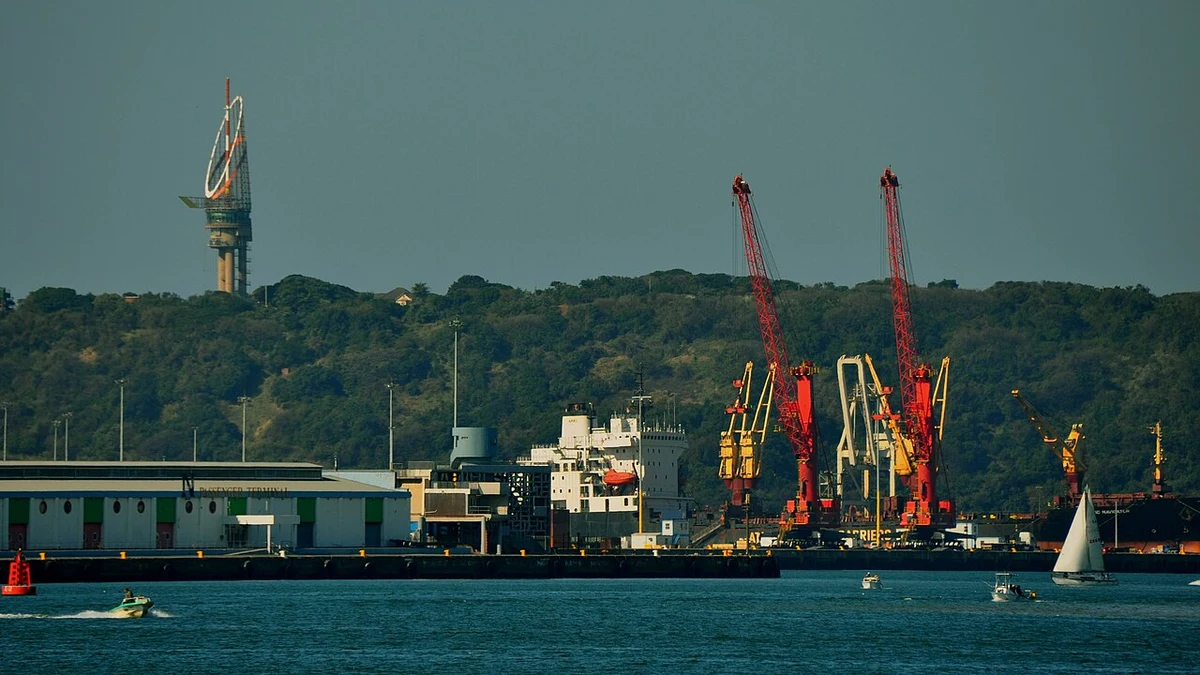
Durban harbour with cranes and port facilities, July 2015. Archive photograph, not a live operating-status report. Photo: Pechristener / CC BY-SA 3.0. Cropped and resized. This is documentary stock imagery, not a claim that Synesys owns the pictured facility, vehicle or shipment.