
SADC freight route planning means choosing a feasible border, port and road sequence, then testing its total cost and delivery window. The shortest distance is only one input. A route that misses clearance or unloading cutoffs can be the more expensive choice.
Last verified: 17 November 2026. Prepared for cargo owners planning South African and SADC shipments. The numerical planning examples below are illustrative, not observed journey times, market rates or route permissions.
In this guide
SADC freight route planning starts with the delivery decision
Start at the receiving site. A Johannesburg consignee that can unload only during a booked morning window has a different problem from a warehouse accepting trucks throughout the day. Write down the delivery commitment, cargo condition required on arrival, vehicle restrictions and person who can approve a revised appointment. Then work backwards to collection readiness.
For a shipment through Botswana to Namibia, name every country the vehicle will enter. A line drawn between Johannesburg and Windhoek does not establish that the operator, goods and vehicle can use the proposed movement. Ask the operator and declarant to check the route against their actual permissions and customs procedure. The C-BRTA permit overview distinguishes goods permits and cabotage permits; permission for one movement should never be inferred from a familiar truck registration.
The route brief should also identify the delivery consequence. Missing a routine replenishment slot may allow a rebooking. Missing a production input could stop work. Ask the cargo owner to put an approved value on the consequence, or record that it has not been quantified. Dispatch should not invent a stockout cost to make one route look attractive.
Six checks before a route becomes a booking
| Check | Evidence to obtain | Who confirms it | Stop condition |
|---|---|---|---|
| Collection readiness | Loaded dimensions, gross mass, packing list and release time | Shipper and collection site | Goods or loading equipment unavailable |
| Vehicle and access fit | Vehicle configuration, site survey and loading plan | Operator and receiving site | Unresolved mass, height or unloading constraint |
| Border and customs feasibility | Agreed procedure, crossing, documents and permitted movement | Declarant and authorised operator | Release or permissions unresolved |
| Service windows | Current terminal, depot, agent and receiver cutoffs | Each facility’s booking contact | Plan depends on an unavailable handoff |
| Total commercial exposure | Comparable quote scope and approved delay assumptions | Cargo owner and commercial lead | Unpriced material exclusions |
| Contingency authority | Decision deadline, fallback and named approver | Shipment owner | No authority to act before the cutoff |
Download this article’s main table (CSV)
These checks are an original planning framework, not an official clearance checklist. Use the cross-border freight documents guide for the document pack and the truck load planning guide for equipment fit. Resolve those questions before comparing quoted prices. An impossible route does not belong in a weighted shortlist.
Compare the same shipment, not three different promises
Give each operator the same brief: cargo, sites, release assumptions, delivery window, loading and unloading arrangements, border sequence and equipment return. Ask which charges are fixed, conditional or excluded. A quote including a cross-border handoff cannot be compared directly with a domestic linehaul price that leaves clearance coordination to someone else.
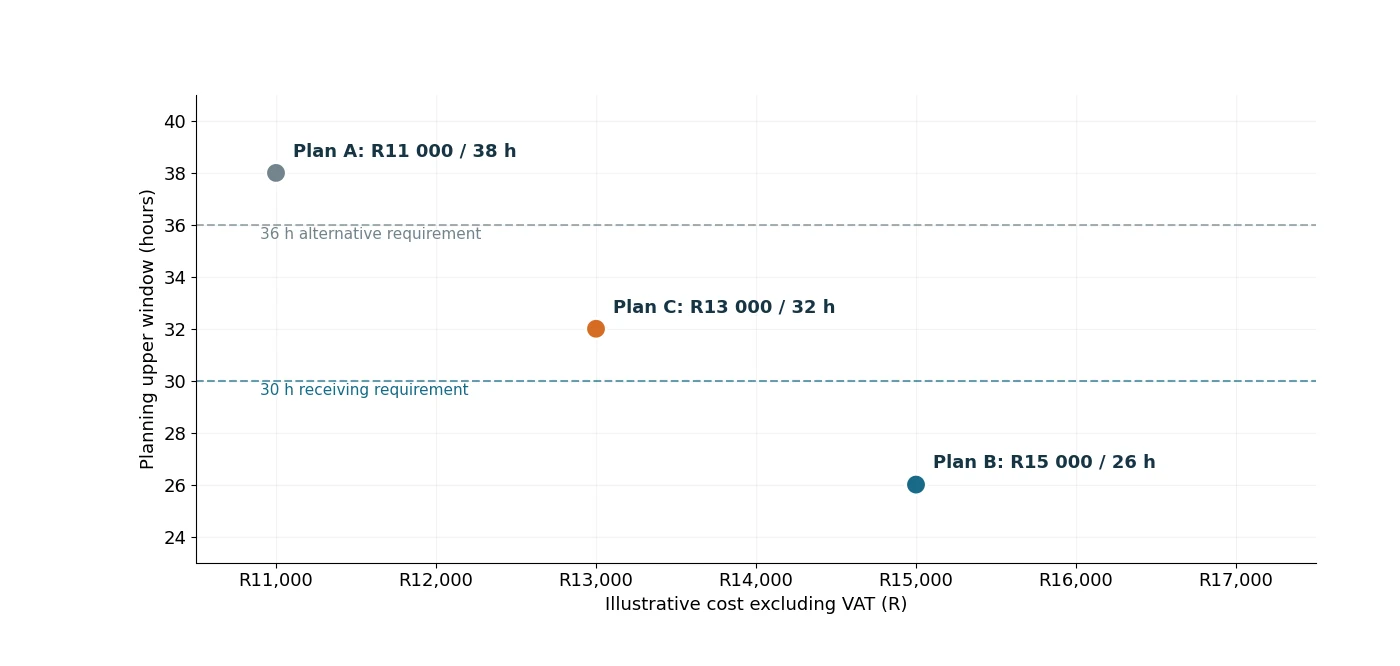
In the illustrative chart, Plan A costs R11,000 with a planning upper window of 38 hours. Plan B costs R15,000 with 26 hours; Plan C costs R13,000 with 32 hours. These are invented comparison inputs, excluding VAT, not prices or transit commitments for any named corridor. If the receiver requires arrival within 30 hours, only Plan B meets the stated scenario. If the limit is 36 hours, Plan C re-enters the discussion.
| Plan | Cost excluding VAT | Planning upper window |
|---|---|---|
| Plan A | R11,000 | 38 h |
| Plan B | R15,000 | 26 h |
| Plan C | R13,000 | 32 h |
| Requirements shown | 30 h receiving requirement | 36 h alternative requirement |
Price and time are not interchangeable. A plan below the cost ceiling can still fail a mandatory vehicle-access check. Treat safety, legal feasibility and cargo preservation as gates. Use the remaining trade-offs only after those gates are satisfied. The landed cost guide explains how to put comparable costs into the same budget.
Make waiting and handoffs visible
SADC freight route planning should separate driving from the events that permit the next leg. Customs release, terminal availability, a safe authorised stopping point and a receiver appointment are different states. A truck location alone does not prove any of them. Record the source, timestamp and next confirmation for each material handoff.
The World Bank’s 2023 Logistics Performance Index release states that the “biggest delays occur at seaports, airports, and multimodal facilities.” That is global context from a dated report, not a measured delay for Durban, Beitbridge or your shipment. The practical lesson is to measure facility time separately from road travel.
| Stage | Plan A (h) | Plan C (h) |
|---|---|---|
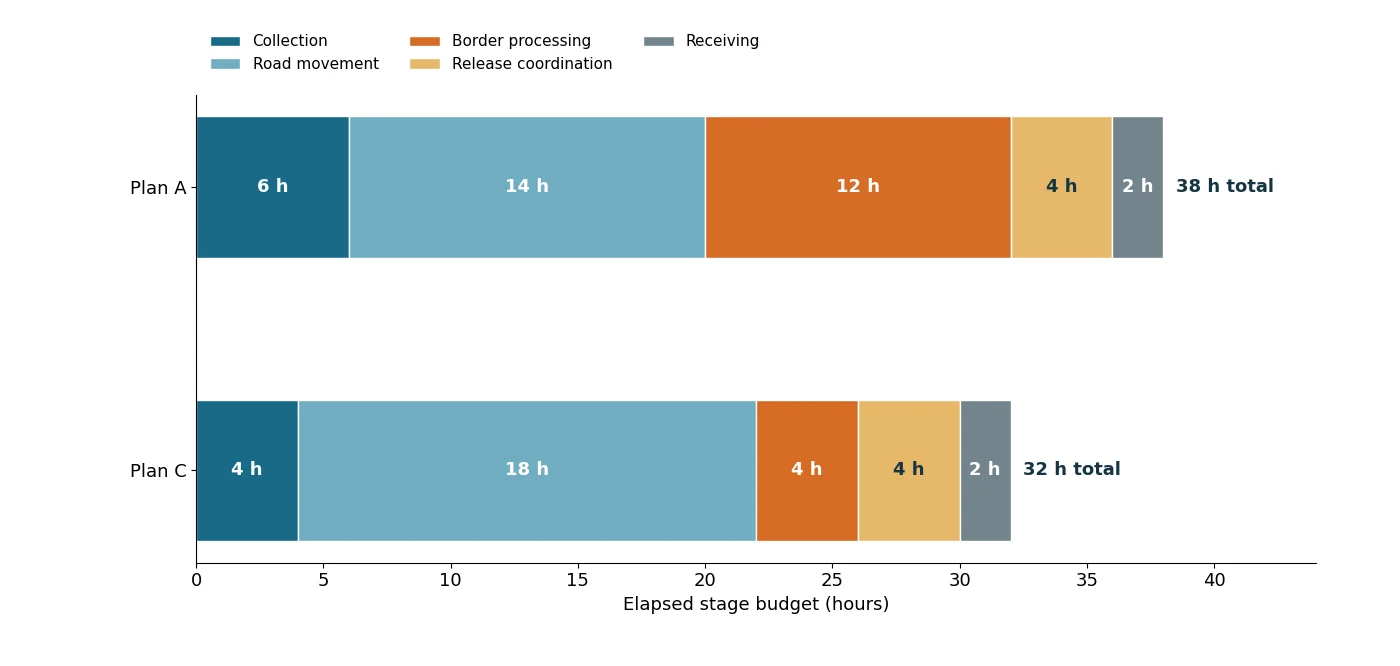
| Collection | 6 | 4 |
| Road movement | 14 | 18 |
| Border processing | 12 | 4 |
| Release coordination | 4 | 4 |
| Receiving | 2 | 2 |
| Total | 38 | 32 |
For example, Plan A’s 38 hours comprise collection 6, road movement 14, border processing 12, release coordination 4 and receiving 2 hours. Plan C budgets 4, 18, 4, 4 and 2 hours respectively. The second plan drives longer but finishes earlier in the scenario. Those totals demonstrate the method; they are not a claim that a particular crossing takes four or twelve hours.
Use real evidence without turning it into a guarantee
Weather is a specific planning input at Cape Town. In an August 2026 PortOps report, the CSIR describes combining wind forecasts with terminal operating information. That supports checking weather and facility readiness together. It does not establish that the tool is available to every shipper, or that a forecast guarantees a loading slot.
For a local corridor starting point, read Kweli’s Johannesburg–Windhoek planning guide. Kweli provides operator-oriented corridor context. Synesys’s purpose here is the cargo owner’s decision: the agreed delivery outcome, comparable scope and evidence needed to release the booking. Verify current restrictions with the responsible operator and authorities.
Keep a route decision record you can defend
Save the chosen plan, rejected alternatives, current quote versions and the reason for the choice. For each assumption, record its owner and expiry. A terminal notice read on Monday should not silently support a Friday booking after conditions change. The shipment owner needs to know what new fact would invalidate the decision.
Set the escalation point before departure. “Review at 12:00 if release remains unconfirmed” is more useful than “monitor delays.” Name the person who will ask for a new receiver slot and the person who can approve additional cost. Use the freight disruption contingency guide to define the trigger, and the freight ETA confidence guide to communicate a delivery window honestly.
For port alternatives, use alternative port routing to include the inland and empty-equipment legs. For a repeat lane, link this decision to your freight lane pilot and comparison of two road freight routes. Keep the same event definitions between trials so differences reflect the journeys rather than different recording habits.
Keep route assumptions current enough to act on
A route brief needs an evidence register as well as a cost column. For every critical assumption, record what was confirmed, who supplied it, when it was obtained and what would make it stale. A receiver appointment from yesterday can remain valid; a terminal release estimate from the same time may already have changed. Do not give both inputs the same status simply because they share a date.
Separate confirmations from forecasts and scenarios. A facility booking acknowledgement can confirm a reserved slot subject to its terms. An operator’s arrival estimate predicts a future event under stated assumptions. The invented stage budgets in this guide test a method. Labelling these three categories prevents a planning allowance from being repeated later as a promise made by a terminal or carrier.
Build the review around the first option that will expire. If the receiving team needs a decision before it releases an unloading crew, that cutoff may matter more than the next scheduled tracking message. Ask for the evidence needed to make that decision before the cutoff, then leave time for authorisation and communication. The supporting contingency guide provides a backward-planning example.
After delivery, compare actual events with the saved assumptions. Keep a missed connection in the record even if the customer accepted a later delivery. Ask whether the next booking should change the collection release rule, the appointment request or the route itself. Repeating the same road sequence is not the same as repeating the same service conditions.
Questions cargo owners ask about route planning
Should I always choose the shortest road distance?
No. Compare feasible plans against the receiving deadline and complete cost scope. In the illustrative stage budget above, the plan with more driving hours has less waiting and finishes sooner. That result depends entirely on the stated assumptions.
Can a country ranking tell me how long my truck will take?
No. A national or global logistics indicator describes a broader system. Your estimate needs shipment-level facts: release, crossing, vehicle, road conditions and receiving access. A ranking is context, not an ETA model.
What should I send Synesys before asking for route advice?
Send the cargo description, loaded dimensions and gross mass, collection and delivery sites, readiness time, required delivery window and known customs arrangements. Use the Synesys freight enquiry to start a shipment-specific discussion.
Sources and verification
- CSIR: PortOps tool to aid Port of Cape Town’s wind woes, 12 August 2026 — checked 17 November 2026.
- World Bank: Logistics Performance Index 2023 release, 21 April 2023 — checked 17 November 2026.
- C-BRTA: permit overview — checked 17 November 2026.
- Kweli’s Johannesburg–Windhoek planning guide — checked 17 November 2026.
Continue with this topic
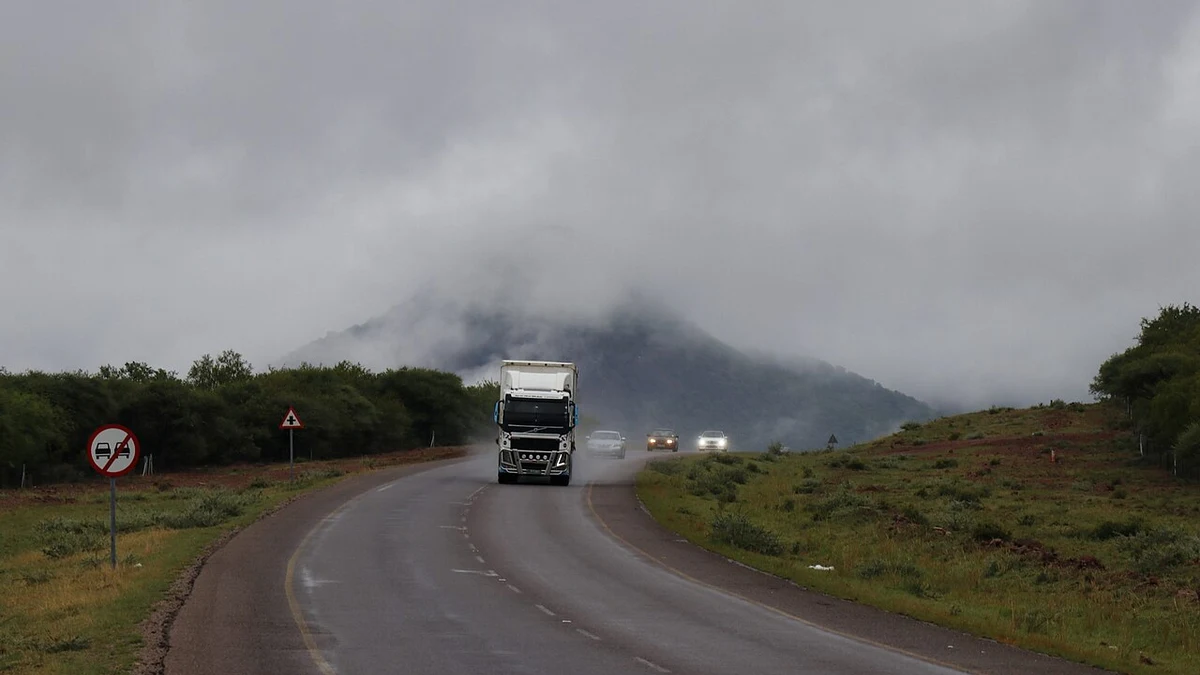
A truck travelling in fog, December 2019. Archive photograph, not a current weather warning. Photo: Thuso Ramatu / CC BY-SA 4.0. Cropped and resized. This is documentary stock imagery, not a claim that Synesys owns the pictured facility, vehicle or shipment.