
A customs seal discrepancy needs controlled escalation, not a quick replacement. Record observed seal and document details without interfering with the cargo, notify the responsible operator and declarant, and obtain the applicable customs instruction before continuing a customs-controlled movement.
Last verified: . South African guidance; destination-country rules must be checked separately.
In this guide
Customs seal discrepancy: describe what you actually see
“Seal problem” is too vague to describe a customs seal discrepancy. Does the visible identifier differ from the manifest? Is the number unreadable? Does the seal appear damaged? Was there a documented examination? These are different observations. The first report should not collapse them into a conclusion about theft or tampering.
A driver must first follow the operator’s safety and security procedures. An unsafe location is not the place for an improvised investigation. This guide concerns the information handoff once it is safe to record observations. It does not authorise opening a vehicle, breaking a seal or handling a suspected dangerous load.
South Africa’s SARS goods-declaration policy requires the licensed remover to notify Customs of specified unforeseen events and obtain prior permission for certain customs-controlled activities. Apply the process through the remover and declarant. A shipper’s request to continue is not equivalent to customs authorisation.
Customs seal discrepancy: separate facts from explanations
| Record | Example wording | Avoid |
|---|---|---|
| Expected identifier | Manifest field reads S-4102 | “The correct seal is probably 4102.” |
| Observed identifier | Visible seal reads S-4107 in the attached original photograph | “Wrong seal proves the cargo was opened.” |
| Time and place | Recorded observation time and receiving point | A guessed time reconstructed as fact. |
| Document context | Manifest version, declaration and any examination reference | A screenshot with no consignment identity. |
| Instruction | Name, role, reference and time of authorised instruction | “Office approved” without an identified authority. |
Download this article’s main table (CSV)
Photograph only when safe, lawful and permitted by the facility. Preserve the original and identify the observer. A copied number can lose a character. An original image can help the authorised reviewer assess transcription, document-version problems or an issue needing investigation.
Check whether an official intervention explains the change. If Customs examined the cargo, authorised records may explain a replacement seal. Ask for the record. Do not assume every changed seal is unauthorised; an intact-looking seal also does not prove that the paperwork is correct.
Worked example: one character changes the decision
Illustrative scenario, not an actual incident. A receiving team expects seal S-4102 but observes S-4107. The manifest lists 12 packages, and no authorised opening record has yet been supplied. The initial status should be “identifier discrepancy under review”, not “cargo stolen” or “safe to unload”.
| Manifest reference | Observed identifier |
|---|---|
| S-4102 | S-4107 |
For this customs seal discrepancy, the coordinator assembles the manifest version, declaration reference, original image and operator handoff record. The declarant can then establish what customs action is required. An incorrect transcription still needs an appropriate correction trail. A lawful seal change needs its authority and custody record linked to the consignment.
The invented timeline records observation at 08:00, notification at 08:10, document comparison at 08:35 and an authorised next-step instruction at 09:00. These are educational timestamps, not a response-time promise. Measure the gap between observation and a clear authorised instruction, rather than assuming the first message resolved the issue.
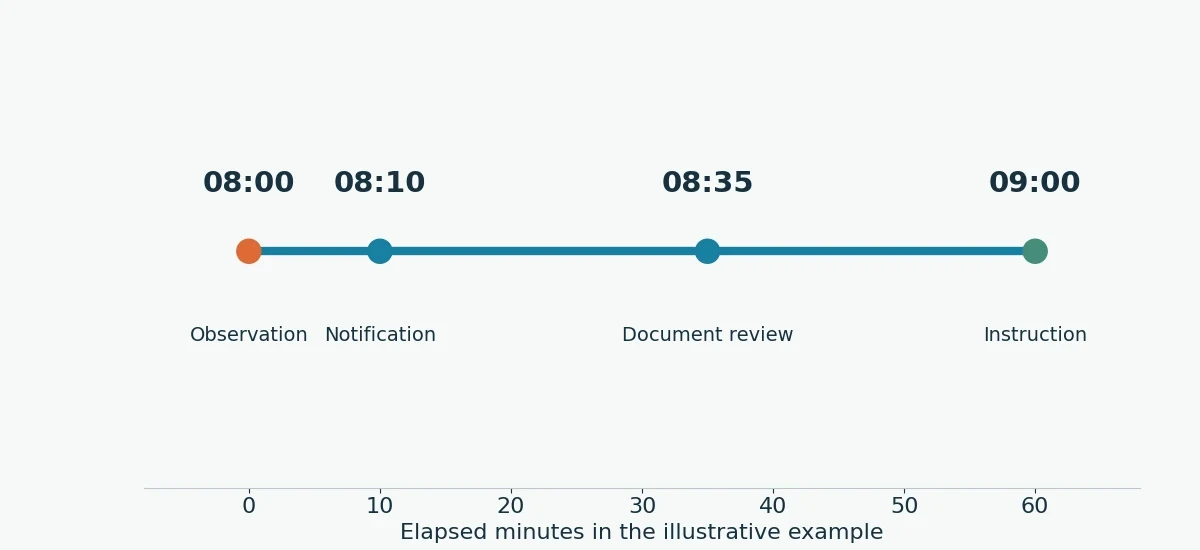
| Time | Event | Elapsed minutes |
|---|---|---|
| 08:00 | Observation | 0 |
| 08:10 | Notification | 10 |
| 08:35 | Document review | 35 |
| 09:00 | Instruction | 60 |
Use the timeline to improve the company process. Was the correct contact available? Could the declarant identify the job without repeated messages? Was the relevant document version recoverable? Those questions reduce avoidable delay without pressuring anyone to bypass customs control.
Escalate without losing the custody trail
- Keep the affected consignment identifiable under the operator’s safe holding instruction.
- Inform the operator and declarant with declaration and manifest references.
- Separate observations from suspected explanations.
- Ask which customs notification, permission or examination is required.
- Record the authorised next step and its owner.
- Preserve original records, lawful changes and the final custody handoff.
Do not use an article as an emergency-action source. If a leak, dangerous goods or an immediate safety threat is suspected, follow the operator’s approved emergency process and appropriate emergency services. Classification and emergency information belong with the shipment, not a generic checklist.
Make the customer update factual. Say that a seal-reference discrepancy is being assessed, identify the authorised decision owner and give the next update time. Do not accuse someone of tampering before an investigation establishes facts. The freight exception update guide helps structure that message.
Where the procedure is unclear, use Removal in Bond vs Removal in Transit. Where the load is held, use the held-load guide. The narrow purpose here is to preserve evidence and obtain a controlled decision about the discrepancy.
What a resolved discrepancy should leave behind
A resolved customs seal discrepancy file explains what was observed, what was checked, who authorised the next step and how the record now matches the goods. “New seal fitted” is incomplete. Show the authority for the change and relationship between old and new identifying records where applicable.
Review recurring errors at their source. If identifiers are repeatedly copied incorrectly, change capture and verification. If receiving teams use old manifests, fix version distribution. A discrepancy should teach the business something more specific than “be careful next time”. Keep that learning separate from unsupported conclusions about fault.
Carry resolved evidence into customs transit acquittal. Otherwise the team may solve the physical handoff and rediscover the unexplained identifier during customs closeout. The bonded cargo guide puts that evidence handoff into the wider movement plan.
For a shift handover, use a concise status entry: the discrepancy observed, controlling reference, current instruction, next permitted action and responsible contact. The person taking over should not have to infer authority from a long message thread. That reduces the chance of an unresolved hold becoming an accidental instruction to move.
Questions shippers ask
Should a driver replace a seal that does not match?
Not on the authority of this article or an informal commercial request. The operator and declarant must obtain the applicable customs instruction. Preserve observations and follow approved safety and control procedures.
Does a changed seal prove theft?
No. A customs seal discrepancy can reflect a documented authorised intervention, an incorrect record or another issue. Describe the observation and obtain evidence before assigning cause or responsibility.
What if the customer wants immediate unloading?
A customer’s delivery preference does not resolve customs control. Escalate through the operator and declarant, record the appropriate instruction and follow it. Commercial urgency is not permission to bypass the process.
Sources and verification notes
- SARS SC-CF-55, Revision 14, effective 14 August 2026
- SARS: Customs Endorsement Documents Requirements
- SARS: Remover of Goods
Sources checked on 17 November 2026. Charts and worked scenarios are original Synesys educational models; invented quantities, times and amounts are labelled illustrative. They are not customer results, published market prices or regulatory limits.
Continue with this topic
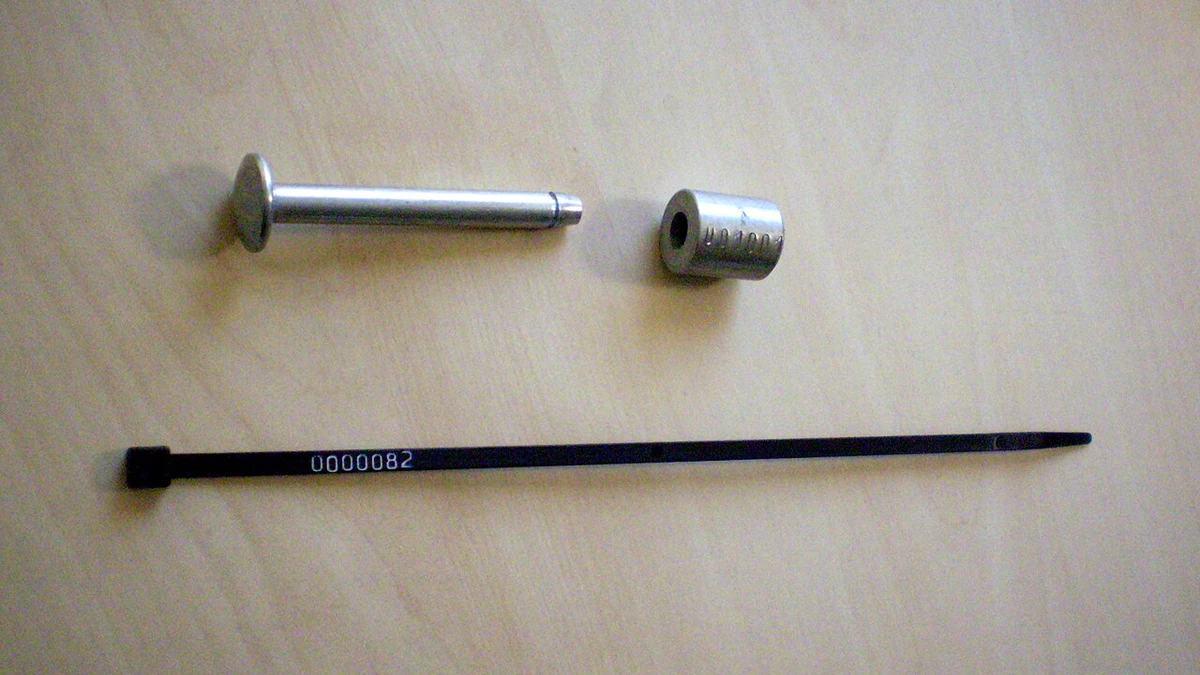
Examples of container seals, September 2007. Archive photograph; these examples do not establish suitability for any specific customs movement. Photo: Claudio Elias / Public domain. Cropped and resized. This is documentary stock imagery, not a claim that Synesys owns the pictured facility, vehicle or shipment.