
Removal in bond vs transit is a customs-procedure question, not a choice of truck. Establish the goods’ status, authorised destination and whether the movement remains within or passes beyond the common customs area, then have the declarant confirm the correct treatment.
Last verified: . South African guidance; destination-country rules must be checked separately.
In this guide
Removal in bond vs transit: begin with the destination
A buyer in Lusaka asks for a Durban collection. A buyer in Johannesburg asks for the same collection. The trucks may use the same first stretch of road, but the customs destination and final treatment can differ. “Cross-border” and “bonded” are not interchangeable descriptions of a shipment.
The SARS transit page describes national transit as bonded movement within South Africa and SACU between customs-controlled areas, and international transit as imported goods passing through South Africa to a foreign destination. Those descriptions frame the question. The declarant must still confirm the procedure for the actual goods.
When comparing removal in bond vs transit, describe the movement before using RIB or RIT. State where the cargo landed, where it is now, the final destination and whether it has been entered for home use, warehousing or another procedure. If the status is unknown, ask the clearing agent for the declaration reference before confirming the movement.
Removal in bond vs transit: destination comparison
| Planning scenario | Question for the declarant | Operational implication |
|---|---|---|
| Landed cargo to an authorised Johannesburg customs warehouse | Which bonded and receiving procedures apply? | Confirm receiving authority and warehouse-handoff evidence. |
| Landed cargo through South Africa to Zambia | Which transit procedure and designated exit apply? | Link the declared destination and exit evidence to the consignment. |
| Cargo already entered for home use | Is a bonded movement appropriate at all? | Do not label released cargo bonded merely because a border is involved. |
| Imported cargo to a destination inside SACU | Which customs-area and destination requirements apply? | Do not classify solely by crossing a national border. |
Download this article’s main table (CSV)
A national boundary and a customs-area boundary are different concepts. A booking template that asks only “local or cross-border?” loses information. Add separate fields for physical destination, customs procedure and receiving customs office or facility. The place where the buyer pays the invoice is not necessarily the customs destination.
The SARS endorsement requirements distinguish documents used for bonded and transit circumstances. Do not turn a form name into a universal checklist. A SAD 502 or SAD 505 reference must be matched to the applicable procedure and route. Confirm that match with the declarant.
Worked example: the same landing point, different files
Illustrative model. Imagine 24 identically packed crates landed in Durban. Consignment Acontains 10 crates destined for an authorised warehouse in South Africa; consignmentBcontains 14 crates destined for Zambia. These invented counts demonstrate file separation, not a rule about splitting shipments.
| Consignment | Crates | Destination |
|---|---|---|
| A | 10 | South African customs warehouse |
| B | 14 | Foreign destination |
The planner should tie each crate mark to its invoice and declaration. A manifest can connect two consignments to a truck, but it must not erase their different destinations. Release of one consignment does not authorise release of the other. Confirm the position of each before instructing departure.
Now suppose the Zambian buyer changes its delivery destination after loading. Do not simply replace “Lusaka” in the transport instruction. Ask the declarant whether the change affects the procedure, route, destination or permission needed. The decision depends on the goods and current customs status, not how quickly the commercial system can be edited.
| From | Possible destination |
|---|---|
| Landing point | Customs warehouse |
| Landing point | Foreign destination |
Retain the original instruction, reason for change, revised instruction and relevant approval when a plan changes lawfully. Otherwise the final file may look consistent while failing to explain what the driver was authorised to do at departure. A visible version history is more valuable than a retrospectively perfect-looking instruction.
The brief to send your declarant
- Goods: precise description, package identification and invoice reference.
- Current customs position: entry reference, facility and any release or stop message.
- Destination: physical address, country, receiving facility and intended customs treatment.
- Route proposal: carrier, border points and any planned transfer.
- Completion: what evidence closes this movement, and who must obtain it?
Ask the declarant to explain removal in bond vs transit in an instruction the dispatch team can use: this consignment moves under this declaration reference to this authorised place, with these documents and escalation contacts. The team does not need an unsourced glossary. It needs a controlled instruction for the booked movement.
Check the actual remover, rather than only the trading name on the quotation. SARS remover guidance explains the licensing context. Where another carrier or vehicle is proposed, have the remover and declarant confirm the arrangement. A commercial subcontract does not automatically resolve the customs requirements.
For the wider plan, read Bonded Cargo and Transit in South Africa. Link the decision to Who Owns Each Handoff on a Freight Job? so the warehouse, carrier and declarant know who approves each step.
Spot a wrong assumption before dispatch
Watch for instructions that describe a customer rather than a customs destination: “deliver to the Zambia client”, “warehouse in Gauteng”, or “same as last time”. Replace each with a named place and current declaration reference. Last month’s procedure may have related to different goods or a different customs status.
Another warning is an agreement to “sort out the bond afterwards”. Resolving removal in bond vs transit before departure aligns the physical movement with an authorised procedure. A later document cannot be assumed to cure an unauthorised decision. Ask what remains unresolved and who has authority to resolve it.
If the truck is waiting while the team argues over documents, use the cross-border held-load guide. Record the disputed question, decision owner and next confirmed action. Do not offer an invented border turnaround time as reassurance. Recover the evidence needed to make the actual decision.
After the movement, use Customs Transit Acquittal to complete the evidence chain. If seal records conflict during the journey, the customs seal discrepancy guide covers factual escalation. Choosing the right label is only the beginning; the movement must remain explainable at every handoff.
Questions shippers ask
Can a movement to another SACU country involve bonded control?
Yes. Crossing a national border does not by itself determine whether goods are in free circulation or under bonded control. Have the declarant assess current status and the required destination procedure.
Should I select a customs code from this article?
No. This removal in bond vs transit comparison is a briefing tool. The declarant must apply the current procedure code to the actual consignment and supporting documents. Ask for the explanation and retain the resulting instruction.
Can different customs consignments share a truck?
That needs assessment by the carrier and declarant. If authorised, retain separate references and evidence for each consignment. A shared vehicle does not make several customs files one closure record.
Sources and verification notes
Sources checked on 17 November 2026. Charts and worked scenarios are original Synesys educational models; invented quantities, times and amounts are labelled illustrative. They are not customer results, published market prices or regulatory limits.
Continue with this topic
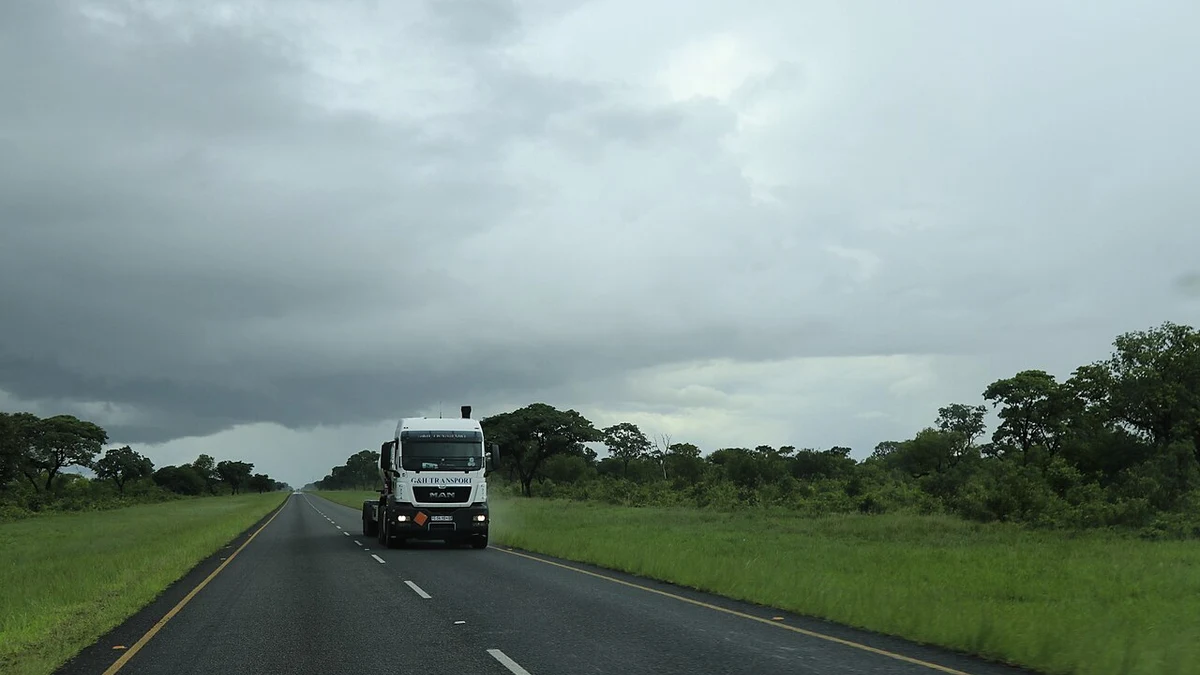
A freight truck on a Botswana road, January 2020. Archive photograph, not evidence of a particular customs movement. Photo: Thuso Ramatu / CC BY-SA 4.0. Cropped and resized. This is documentary stock imagery, not a claim that Synesys owns the pictured facility, vehicle or shipment.