
Dangerous goods road freight starts with correct product identification and a competent assessment of the shipment. Give the carrier the relevant classification, packaging and quantity information before booking. An ordinary freight quote, an SDS or available truck space is not transport approval.
Last verified: . South African guidance; destination-country rules must be checked separately.
In this guide
Dangerous goods road freight: identify the actual shipment
A booking described as “cleaning supplies” or “equipment batteries” leaves the carrier guessing. The transport question concerns the actual product, condition, packaging, quantity and route. A familiar brand name does not establish how a particular consignment must be carried.
The South African Department of Transport dangerous-goods portal describes dangerous goods as both “chemicals and articles”. Its framework connects UN model provisions to domestic road traffic legislation and national standards. Do not assume that an overseas road agreement automatically supplies South African legal requirements, or that workplace hazard labels are the whole transport assessment.
This guide helps shippers prepare information and controlled decisions. It is not a chemical compatibility table, packaging specification, emergency procedure or exemption calculation. A competent dangerous-goods specialist and the accepting carrier must determine the requirements for the particular load and jurisdictions.
If a product is leaking, damaged, overheating or otherwise unsafe, stop treating the work as a routine quotation exercise. Follow the site’s approved emergency and safety process and obtain qualified assistance. Do not use a generic article to decide whether a damaged package can be loaded or repaired.
The information a carrier needs before accepting the load
| Information | What to provide | Why a vague answer fails |
|---|---|---|
| Product identity | Exact product name, model or composition and current supplier record | “Chemicals” does not identify the transport risk. |
| Classification | Competently confirmed transport details for the actual goods | Workplace hazard pictograms are not a complete transport decision. |
| Condition | New, used, returned, damaged, defective or waste status as applicable | A return shipment may differ from the original outbound load. |
| Packaging and quantity | Package types, counts and relevant quantities | Truck capacity alone does not establish acceptability. |
| Route and handoffs | Countries, modes, collection and receiving facilities | Each applicable jurisdiction and mode must be considered. |
| Acceptance | Named carrier confirmation and any outstanding requirements | A rate indication is not an approval to collect. |
Download this article’s main table (CSV)
A current SDS can supply important product and transport information. South Africa’s published Hazardous Chemical Agents regulations, Regulation 14A set out SDS requirements in the workplace context. Keep that context separate from transport classification and carrier acceptance. A document may be necessary to review without being sufficient to approve a movement.
Check that the supplier’s document describes the product being shipped. A sheet for a concentrated product may not describe a different mixture. A sheet for one battery family may not establish a particular model’s transport test status. Ask the manufacturer or competent specialist to resolve a mismatch rather than extrapolating.
For lithium products, continue to Lithium Batteries by Road. For chemical transport information, use SDS Section 14. The separate guides help answer narrower questions; neither replaces the carrier’s acceptance process.
Worked example: an apparently simple collection with unresolved facts
Illustrative booking scenario, not a chemical assessment. A shipper offers eight product lines from a Johannesburg warehouse. Five have current supplier records and a competent classification review; two await an exact product match, and one is a returned item whose condition needs assessment. The figures are invented planning counts, not dangerous-goods incident statistics.
| Product lines | Status |
|---|---|
| 1 to 5 | Reviewed |
| 6 and 7 | Identity query |
| 8 | Return-condition query |
Do not call this shipment “mostly approved”. A single unresolved item may change the carrier’s decision about the proposed load. Keep each product line separate, identify the missing fact and obtain a decision on the actual consignment. A progress percentage would conceal the significance of the outstanding issue.
The team should ask whether the returned item is fit for ordinary carriage, requires a specialist arrangement or cannot be accepted as proposed. Only the responsible competent parties can answer that. A previous delivery note or the availability of the same truck type does not establish current acceptability.
- Product owner
- Competent review
- Carrier
- Receiver
A useful booking entry names the unresolved condition, its owner and the evidence needed to decide. “Awaiting manufacturer confirmation of product identity” is actionable. “DG paperwork pending” is not. The narrower description prevents a dispatcher from assuming that only an administrative signature remains.
Do not confuse the SDS, declaration and emergency information
The SDS is a product-information source. The transport declaration describes the consignment under the applicable requirements. Emergency information serves responders and the transport operation. These records are related, but they should not be treated as interchangeable documents with different headings.
Department of Transport dangerous-goods awareness material distinguishes documentation by transport mode and refers to the road dangerous-goods declaration and transport-emergency information framework. A form prepared for an air or sea leg should not be assumed to finish the road-leg requirements.
For a multimodal import, ask who owns the handoff from terminal to road carrier. The product may already have crossed an ocean, but the South African collection still needs an accepted road plan. The terminal release, commercial invoice and road dangerous-goods acceptance answer different questions.
Where the load crosses borders, check the applicable requirements for each country and carrier arrangement. Do not describe a single South African document as a regional permit. Use the cross-border document guide to organise the commercial and customs pack alongside the specialist dangerous-goods file.
Make changes trigger a fresh review
A change in product, quantity, package, vehicle, route or delivery facility can matter to the approved arrangement. Tell the carrier before the change is made. Reusing the original quote after the consignment changes may leave a gap between the load accepted and the load presented.
The same applies to mixed loads. Goods that fit together physically are not automatically acceptable together. A competent compatibility and loading review must consider the actual products and applicable rules. Our Dangerous Goods Mixed Loads guide explains the decision record without publishing an unsafe universal pairing table.
Delivery needs preparation too. Confirm that the receiver can accept the goods under the relevant site arrangements and that the booked contact is available. A carrier’s transport acceptance does not by itself establish the receiving facility’s unloading, storage or emergency arrangements.
If information changes after departure, notify the responsible operator promptly through its approved process. Do not ask the driver to improvise a repacking, transfer or disposal solution. The next movement must follow the applicable safe and authorised arrangement.
A useful shipper’s readiness record
- Product owner and current supplier contact.
- Exact goods identity and document revision.
- Competent transport-classification assessment for the actual shipment.
- Package, quantity and condition details.
- Countries, modes, collection and receiving points.
- Carrier acceptance reference and conditions.
- Receiver confirmation and responsible handoff contacts.
- Unresolved questions, decision owners and change-control instructions.
This record should show evidence, not award a compliance score. A missing acceptance reference is a missing decision; it is not merely a percentage deduction. Assign the question to the person who can resolve it and keep the collection conditional until the relevant parties confirm the proposed movement.
Use How to Qualify a Freight Enquiry Before Quoting to improve the initial request, and Who Owns Each Handoff on a Freight Job? to assign decisions. A good dangerous-goods brief saves the carrier from guessing and gives the shipper a clear explanation of what remains to be resolved.
Keep the public guide separate from the private shipment file. Product records may contain commercial details, and a real movement can involve security-sensitive route and cargo information. Share it with the authorised carrier, receiver and advisers through the agreed channels, rather than publishing an operational consignment as a case study without permission.
Questions shippers ask
Does an SDS mean the carrier must accept my goods?
No. An SDS is an information source. The actual classification, quantity, packaging, condition, route and carrier requirements still need assessment, and the carrier must accept the proposed shipment.
Is every hazardous workplace chemical dangerous goods for road transport?
Do not equate the two classifications. Workplace and transport systems serve different purposes. Have the competent assessor confirm transport status for the actual product and mode.
Can I use the same paperwork for road, sea and air?
Do not assume so. Each applicable mode has its own requirements. A multimodal shipment needs the handoffs and relevant documents checked by the responsible specialist and carriers.
Is this a guide for handling a damaged or leaking load?
No. Follow the operator’s and site’s approved emergency process, use appropriate emergency services when needed and obtain qualified assistance. A public preparation guide is not an incident-response instruction.
Sources and verification notes
- South African Department of Transport: Dangerous Goods Regulations
- Department of Employment and Labour: Regulations for Hazardous Chemical Agents,2021, Regulation 14A
- Department of Transport: Dangerous Goods awareness, packaging and labelling, October 2025
Sources checked on 17 November 2026. Charts and worked scenarios are original Synesys educational models; invented quantities, times and amounts are labelled illustrative. They are not customer results, published market prices or regulatory limits.
Continue with this topic
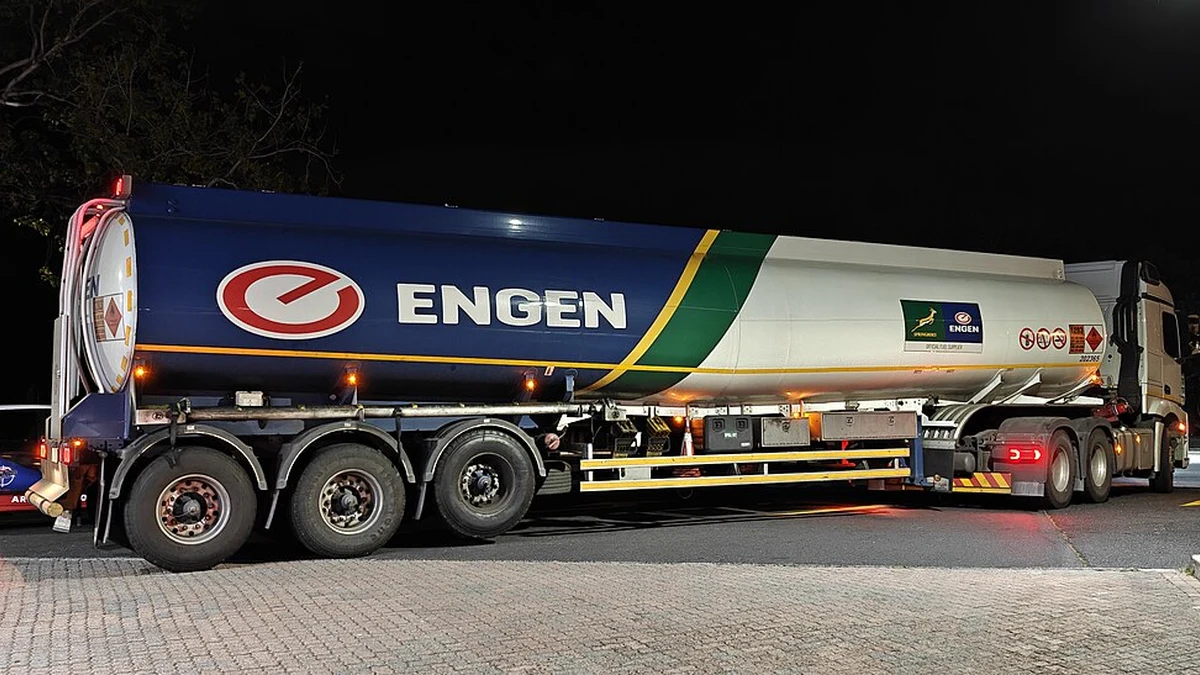
An Engen tanker in Meadowridge, Cape Town, October 2025. Archive photograph, not a dangerous-goods compliance certificate. Photo: Husskeyy / CC BY-SA 4.0. Cropped and resized. This is documentary stock imagery, not a claim that Synesys owns the pictured facility, vehicle or shipment.