

On this page
Compare freight rates per tonne by dividing each total charge by the same expected delivered tonnage. First check whether the carrier prices actual weight, applies a minimum, or offers a fixed trip rate.
Worked example: when a minimum changes the result
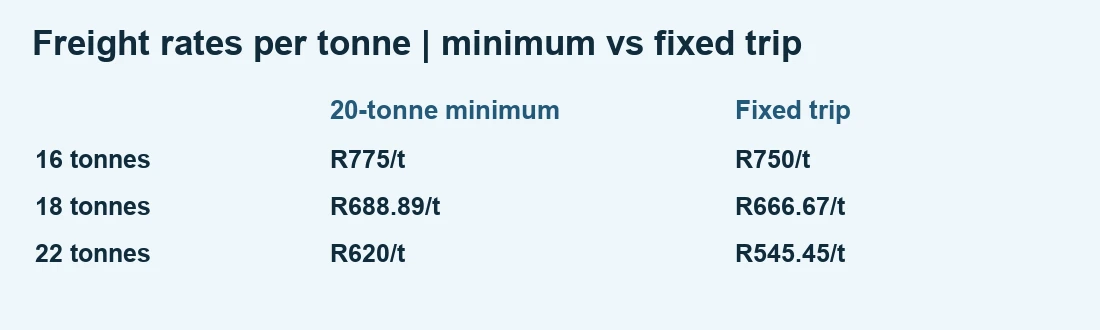
For an illustrative 18-tonne Gauteng shipment, Carrier A charges R620 per tonne with a 20-tonne minimum. The freight line is R12,400, or R688.89 per expected delivered tonne. Carrier B charges a flat R12,000 for the same work, or R666.67 per tonne. If the shipment rises to 22 tonnes and both carriers confirm suitable capacity and the same terms, A becomes R13,640 while B stays at R12,000. These are example figures, not market rates.
Agree which weight will be used
Ask whether the invoice uses dispatch weight, received weight or another agreed measurement. Record the evidence needed and how discrepancies will be resolved. Confirm whether packaging weight is included for billing, and separately give the operator the gross load weight and dimensions needed to assess vehicle suitability.
Compare the full scope
Include any stop, handling or waiting charges on the same VAT basis. Ask the carrier to reprice if the cargo or delivery scope changes. Share your shipment details with Synesys for help planning the movement.
Check freight rates per tonne at both ends of the weight range
Ask the shipper for a likely loading weight and a lower figure that could occur if some stock is held back. In the 20-tonne minimum example, a 16-tonne shipment still costs R12,400 with Carrier A. Its effective rate rises to R775 per delivered tonne. Carrier B’s R12,000 fixed trip price comes to R750 per tonne at that weight. The absolute difference remains R400 while both prices are flat. Recheck vehicle availability and capacity before assuming either rate still applies if the shipment grows.
For the eight-tonne example, the R5,000 minimum stops applying at about 8.93 billed tonnes, because R5,000 divided by R560 is about 8.93. This is the threshold for the minimum, not a point where the two offers tie. The R4,800 fixed offer stays lower as long as its price and scope hold. Ask the carrier to state how it rounds billed weight before relying on a threshold close to your expected load.
“An EPCIS event records what was involved in a business process step, when the event took place, where it took place”
Apply the same recordkeeping principle to a weighbridge ticket. Keep the job reference, weighbridge location and time with the ticket and agreed billing basis. If dispatch and receiving weights differ, keep both readings and ask the named approver which one the agreement calls for before reconciling the invoice.
Further reading Kweli’s freight rate checklist and worked example.
Related Synesys guide How to compare road freight quotes before you book.
Freight rates per tonne checklist
Record the delivered or chargeable weight basis, minimum invoice and all fixed extras. Divide the expected total by the same delivered tonnage for every offer.
Worked example
At 8 tonnes, R560 per tonne with a R5,000 minimum costs R5,000 or R625 per delivered tonne. A flat R4,800 trip costs R600 per delivered tonne.
When designing shared job records, capture what happened, the time and location, and the business context. See the GS1 EPCIS visibility standard.
Cover photo by U.S. Army. Cropped and branded.
Freight rate FAQs
How does a minimum billed weight work?
Multiply the rate by the higher of the chargeable weight and the minimum billed weight. Then divide the total by expected delivered tonnes to compare offers.
Should packaging weight be included?
Ask the carrier to confirm the billing basis. Give the operator the gross weight and dimensions including packaging for vehicle and loading decisions.
How should I compare a fixed trip price?
Divide it by the same expected delivered tonnes used for the other quotes. Check that stops, waiting allowances, equipment and tax treatment match.