

On this page
Compare road freight quotes by asking each carrier to price the same movement. Give them the same cargo, vehicle requirement, sites and time windows. Then compare the total for the work you expect, including any stops, waiting or handling.
Give every carrier the same brief
Start with the collection and delivery addresses, number of handling units, dimensions, gross weight and loading method. Add any access limits, intermediate stops and the agreed proof of delivery. A carrier cannot price a second stop that only appears in the warehouse team’s email.
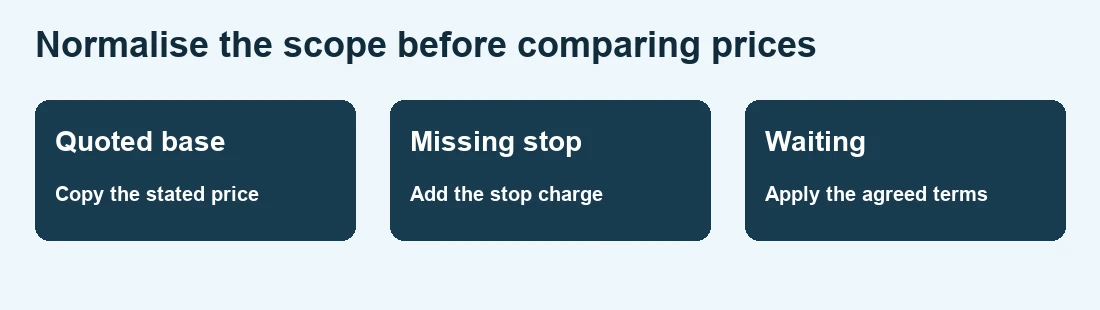
Worked example: two stops and 90 minutes of waiting
Consider an illustrative Johannesburg collection with two Gauteng deliveries. Use the same VAT basis for both offers. Confirm whether waiting is measured from arrival or the booked slot and which part of it is chargeable.
| Charge | Carrier A | Carrier B |
|---|---|---|
| Quoted rate | R8,900 | R9,750 |
| Second stop | R650 | Included |
| 90 minutes of waiting | R450 at R300 per hour | Included up to two hours |
| Comparable total | R10,000 | R9,750 |
Carrier B comes in R250 lower for this scenario. With the second stop and no waiting, Carrier A would cost R9,550. Test both scenarios if the loading time is uncertain, and ask who approves and records additional charges.
Check what the price cannot tell you
- Confirm equipment and availability for the actual date.
- Check who arranges loading, unloading and any special handling.
- Agree who receives delay updates and who can approve a change.
- Get the evidence and invoice requirements in writing.
Carry the final offer into dispatch
Record the agreed version, including the stops, time windows, waiting allowance and approval contact. Give dispatch that version so the team can work from the offer you accepted. If Synesys is coordinating the load, send us the cargo brief with those requirements.
Find the waiting-time break-even point
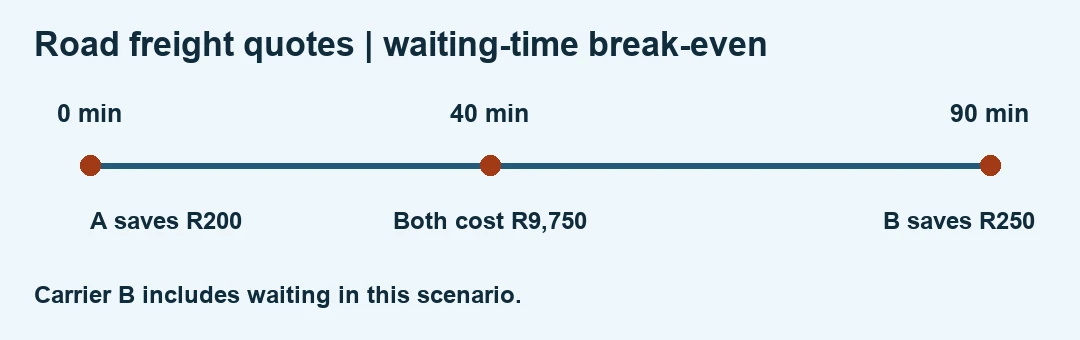
With the second stop included, Carrier A is R200 cheaper before waiting. Divide R200 by R300 per hour to get 40 minutes of billable waiting. At 40 minutes the two offers are equal. At 90 billable minutes, Carrier A costs R250 more. This assumes minute-by-minute billing and that Carrier B’s allowance still covers the stop. Ask whether either carrier rounds time up or applies a minimum charge.
When comparing road freight quotes for a new site, ask the shipper for a recent gate log. Use a typical visit and a delayed visit to test the two offers. If the rate is only valid for a particular collection date, put that date beside both scenarios. This gives the booking team a way to judge whether the difference is worth acting on.
“An EPCIS event records what was involved in a business process step, when the event took place, where it took place”
Use that approach for the records that support waiting charges. Keep the job reference, site and actual timestamps in the same file as the accepted quote. If a second stop is added later, record the approval separately and tell dispatch which version to use.
Copy this comparison into the booking brief
For road freight quotes, make one row per carrier with the quote reference, validity date, base rate, second-stop charge, waiting allowance and rate after the allowance. Keep separate columns for charges that are included and charges that need written approval. For the same 90-minute scenario, record Carrier A at R10,000 and Carrier B at R9,750. If dispatch expects only 20 billable minutes instead, Carrier A would cost R9,650 and Carrier B would still cost R9,750 under the example terms.
Put the reason for the selection beside the total. If you chose Carrier A because the site expected a quick unload, have dispatch check that assumption when confirming the slot. If the receiver warns of a longer queue before the vehicle is released, recalculate the two totals and confirm that the selected carrier can still meet the booking. Once the rate is accepted, give the driver the site instructions and tell accounts where to find the accepted quote and any later approvals.
Check the waiting terms in road freight quotes
Before accepting either offer, ask the carrier to show how the charge would work if the driver arrived 20 minutes early and the bay opened at the booked time. One carrier might measure waiting from gate arrival while the other starts at the appointment. Record both triggers and the evidence each carrier accepts. If the first quote charges in half-hour blocks, request a written total for the exact scenario instead of using the prorated example.
Further reading The Cheapest Truck Quote May Cover a Different Job (Kweli Corridor Network).
Related Synesys guide How to compare freight rates per tonne.
Road freight quotes checklist
Give both carriers the same route, weight and loading window. Put exclusions, free waiting time and approval requirements side by side before booking.
Worked example
Quote A is R7,900 with 30 minutes free, while B is R8,200 with 90 minutes free. At 90 minutes on site and R450 per extra hour on A, A totals R8,350 and B remains R8,200 before other charges.
When designing shared job records, capture what happened, the time and location, and the business context. See the GS1 EPCIS visibility standard.
Cover photo by Peter Black under CC BY-SA 2.0. Cropped and branded.
Road freight quotes FAQs
When does the cheaper freight quote become more expensive?
In the worked example, Carrier A starts R200 cheaper after adding the second stop. At R300 per hour, the offers tie after 40 billable minutes. Beyond that, Carrier B is cheaper while its included allowance still applies.
What should I compare besides the base rate?
Compare the same stops, equipment, time windows and handling. Ask each carrier to confirm fuel, tolls, waiting allowances and the tax basis in writing.
What evidence should support a waiting charge?
Check the accepted quote for the billing trigger and free allowance. Keep the agreed slot and the actual timestamps required by those terms, plus any written approval.