
Cross-border freight documents must describe the same goods, parties and journey across the invoice, packing list, transport record and customs declaration. For a South African road shipment, appoint a clearing owner before dispatch and confirm the release evidence the driver needs.
Last verified: 17 November 2026. Scope: South African shippers and their freight partners. Country-specific licences and commodity controls require confirmation by the relevant authority; this is an operational preparation guide.
In this guide
Start with the movement, not a stack of forms
A Johannesburg exporter sending manufactured parts to a customer in Gaborone needs a different customs conversation from an importer moving uncleared cargo from Durban through South Africa. The collection address alone does not identify the customs procedure. Begin with the seller, buyer, importer, exporter, cargo description, destination and reason for moving the goods. Tell the clearing agent whether the goods are sold, returned, temporarily moved or transiting. That distinction is more useful than asking for a generic “border pack”.
SARS says importers and exporters generally lodge a Goods Declaration unless a specific exemption applies. It also describes documentary checks and release responses. A supplier’s invoice is therefore evidence for a declaration; it is not proof that Customs has released the truck. SARS: Goods Declaration.
For Synesys, the useful handoff is a shipment brief that can be acted on. Name the person who can correct product information at the seller, the person who can authorise the declaration, and the receiver who can answer questions about the destination. Avoid a contact list in which every name simply refers the driver to somebody else.
A working map of cross-border freight documents
| Record | What it establishes | Shipper’s matching check |
|---|---|---|
| Commercial invoice | The commercial transaction and line values | Seller, buyer, currency, product identity and totals |
| Packing list | How the goods are physically packed | Package marks, count, gross/net mass and dimensions |
| Transport document | The agreed movement and goods received | Collection/delivery parties, shipment reference and cargo |
| Customs declaration and response | The declared procedure and Customs status | Declaration reference, goods and actual release status |
| Origin evidence, where preference is claimed | Support for a particular origin claim | Product, producer and qualifying rule—not just dispatch country |
| Commodity approvals, when applicable | Permission specific to the goods or authority | Issuer, validity, product and destination |
| Operator/vehicle records | Carrier and vehicle authority for the movement | Responsible operator confirms its applicable route requirements |
Download this article’s main table (CSV)
The C-BRTA lists goods permits among its cross-border permit categories. That is an operator-authority question, separate from whether a particular invoice is correct. Do not tell the exporter that one customs form automatically settles the transporter’s authority. Ask the appointed carrier to confirm the applicable permit position. C-BRTA: Cross-border transport permits.
Where a controlled transit or export movement requires a road manifest and processed declaration, check the specific SARS instructions with the declarant. The SARS: Transit, updated 19 August 2026 page explicitly describes DA 187 accompanying the vehicle in the movements it addresses. Do not extend that statement into a claim that every domestic truck needs DA 187.
Make one cargo identity travel through the pack
Choose a shipment reference before the warehouse prints labels. Link each invoice line to its packing line, then to the packages loaded. If an invoice says “spares”, a packing list says “equipment” and the booking says “palletised goods”, the reader cannot confidently establish that the records describe the same consignment. A recognisable part number and plain description reduce the detective work.
Mass is a frequent source of apparent contradictions. Net mass describes the goods; gross mass includes relevant packaging. A weighbridge records a vehicle-related mass under its own measurement conditions. Write the unit and basis next to the figure. “1.8” without kilograms, tonnes or a description of what was weighed cannot support a useful comparison.
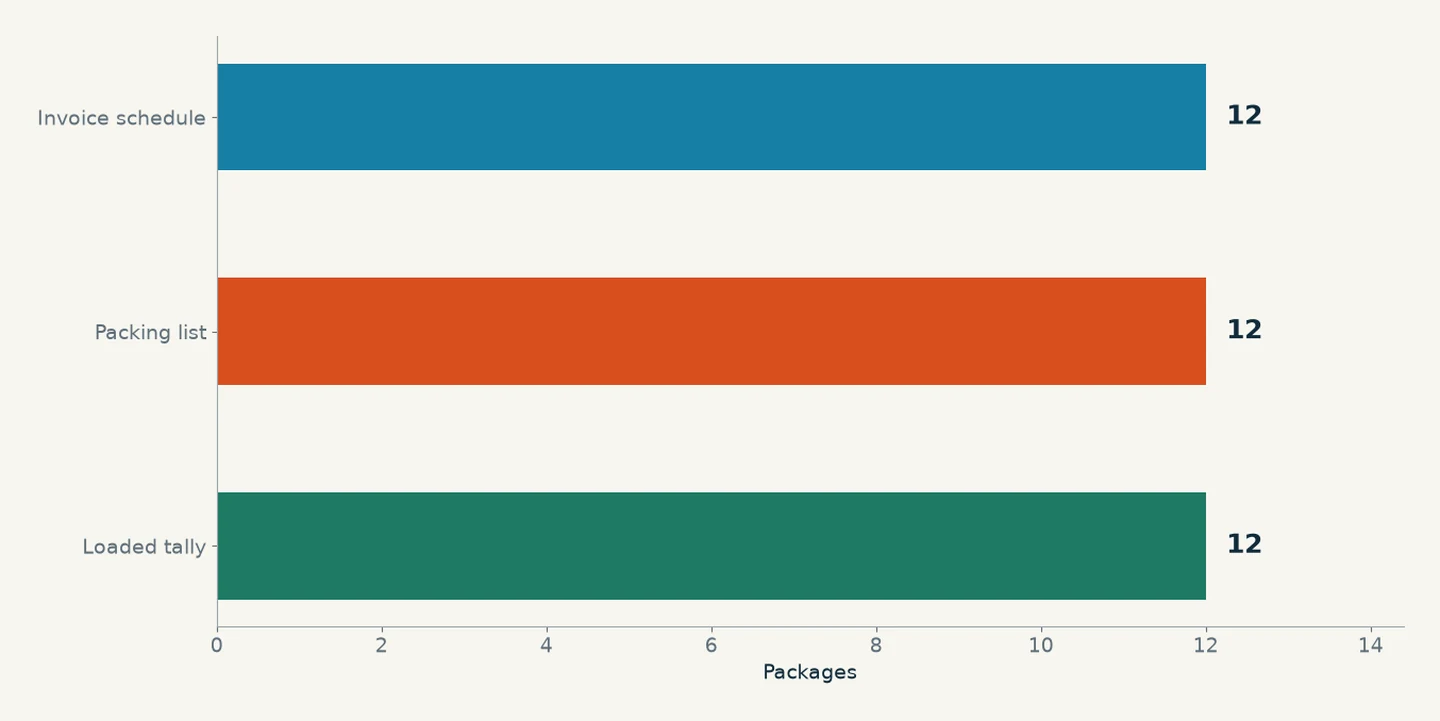
| Record | Packages |
|---|---|
| Invoice schedule | 12 |
| Packing list | 12 |
| Loaded tally | 12 |
Worked example: the invoice is right but the pack is wrong
Illustrative example. A Johannesburg supplier sells 120 identical components to a Botswana customer. The first packing instruction calls for 10 boxes with 12 components each. The warehouse changes to 12 boxes with 10 components each because the original packaging is unavailable. The commercial quantity remains 120 components, so the sales invoice may still show the correct sale. The physical package description no longer matches.
The solution is not to change the invoice quantity to 12. Ask the warehouse to issue the corrected packing list, link it to the same invoice and shipment, and give the declarant the actual package count before loading is confirmed. Record who approved the revision. The transport booking and package labels should then describe the same 12-box consignment.
| Measure | Original plan | Loaded reality | Control decision |
|---|---|---|---|
| Components | 120 units | 120 units | Commercial quantity unchanged |
| Outer boxes | 10 boxes | 12 boxes | Revise packing information |
| Units per box | 12 units | 10 units | Revise package allocation |
| Shipment reference | JHB-GAB-EXAMPLE | JHB-GAB-EXAMPLE | Retain traceable identity |
This example does not determine the correct tariff heading, origin or customs value. Those questions still require the real product and transaction records. It demonstrates a narrower point: two different numbers can both be correct when they refer to different quantities.
Set a dispatch gate that has an owner
Use a short release meeting before the truck is committed to a border arrival. The warehouse confirms what is loaded; the exporter confirms the commercial record; the declarant confirms the applicable status; the carrier confirms vehicle and route readiness. A dispatcher should be able to see which of those gates remains open without interpreting an entire email chain.
- Cargo tally
- Commercial pack
- Customs status
- Carrier ready
An email saying “submitted” should never be silently changed to “released” in the dispatch notes. SARS distinguishes declaration processing from the resulting responses. Ask the declarant to state the actual status in plain language and attach or identify the response on which the dispatch decision relies. When inspection or a restriction remains unresolved, assign the next action rather than promising a border time.
For a driver leaving Gauteng late in the day, an unreachable document owner is an operating risk. Agree how the current pack will be sent, how offline copies will be available if needed, and who can issue a corrected version after hours. Delete neither the old version nor the audit trail when a revision is approved.
Copy this pre-dispatch worksheet
| Question | Record to enter | Owner |
|---|---|---|
| What goods actually leave? | Product identity, package count, mass basis | Warehouse |
| What transaction is declared? | Invoice, currency, buyer/seller and purpose | Exporter/importer |
| What procedure and status apply? | Declarant confirmation and response reference | Clearing owner |
| What must accompany this vehicle? | Current approved pack and required originals/copies | Declarant + carrier |
| Who resolves an exception? | Named person, contact channel and cutoff | Shipment coordinator |
Give the worksheet a version date and retain it with the job. The result should be a small, usable index to the records, not a second declaration filled with copied fields. If someone changes the invoice, packing or route after approval, reopen the affected gate and ask the relevant owner whether the existing declaration remains usable.
Use the linked commercial-invoice guide for line-level checks, the pre-clearance checklist for timing, and the mismatch guide for correction control. These have different jobs. Reading all three is useful when a shipment is new; an established lane may only need the worksheet and a clear exception path.
Questions shippers ask
Is a commercial invoice the same as customs clearance?
No. The invoice supports the commercial and customs record. Obtain the actual Customs status from the appointed declarant before treating a South African shipment as released.
Does one document pack work for every SADC country?
No. Use the South African departure requirements and separately verify the destination and any transit-country requirements for the actual goods.
Should the invoice and packing list have the same weight?
Compare like with like: net goods mass, gross packed mass and vehicle mass are different measures. The records should identify the basis and reconcile without concealing genuine differences.
What if the truck or package count changes after clearance?
Tell the declarant and carrier before continuing. Record the change and ask which documents or declarations require formal revision; do not assume a handwritten note is sufficient.
Use this with the rest of the library
Follow the practical next step: Commercial Invoice for Customs: What a Shipper Must Check; Pre-Clearance Checklist: Prepare a Road Shipment Before the Border; Customs Document Mismatches: Fix Invoice, Weight and Packing Errors.
For a complementary operator-side view, read Kweli: Johannesburg to Gaborone loads and operating handoffs. It connects the actual sites and border brief to the return cycle; this Synesys guide focuses on the shipper’s document and dispatch decisions.
For the operating handoff, also use What to do when a cross-border load is held; The road freight quote checklist. If you need help scoping a shipment, send Synesys the collection, delivery and cargo details.
Sources and method
The external sources below support the rules or carrier terms cited in this article. The worksheets, decision methods and labelled examples are original Synesys educational analysis. They are not measured customer outcomes or market price benchmarks. Confirm the actual declaration, contract and shipment dates before relying on a numerical example.
- SARS: Goods Declaration
- SARS SC-CF-55, Revision 14, effective 14 August 2026
- SARS: Transit, updated 19 August 2026
- C-BRTA: Cross-border transport permits
- Kweli: Johannesburg to Gaborone loads and operating handoffs
Country-specific licences and commodity controls require confirmation by the relevant authority; this is an operational preparation guide.
Continue with this topic
Beitbridge border post between South Africa and Zimbabwe; archive photograph, uploaded in 2008. Photo: Macvivo at English Wikipedia / CC BY 3.0. Cropped and resized. This is documentary stock imagery, not a claim that Synesys owns the pictured facility, vehicle or shipment.