
A freight pre-clearance checklist should test whether the cargo, commercial records, declaration work and carrier instructions are ready before a truck approaches the border. “Documents sent” is a handoff event, not proof of Customs release or a guaranteed crossing time.
Last verified: 17 November 2026. Scope: South African shippers and their freight partners.
In this guide
Start the freight pre-clearance checklist before dispatch
For a Johannesburg–Gaborone movement, document readiness should be a dispatch condition, not a problem first discovered at the border. The freight pre-clearance checklist starts when the cargo becomes identifiable enough to prepare reliable records. Ask the warehouse when the final packing count will be known and the exporter when the invoice will be approved. Those are inputs to the clearing plan.
SARS separates declaration submission from the response Customs issues and any documentary or physical checks. Its SARS: Goods Declaration guidance is the reference for that distinction. A clearing agent can prepare and submit work while a shipment is being planned, but a shipper should not convert that activity into a promise that a specific truck will pass a border at a specific hour.
Give each checkpoint in the freight pre-clearance checklist an owner and an evidence reference. A green status with no named approver is just a colour. When an input remains provisional, mark exactly which one and agree the last useful time for replacing it.
The freight pre-clearance checklist
| Gate | Evidence to have ready | Who confirms |
|---|---|---|
| Cargo identity | Final product and package schedule, mass basis | Warehouse + exporter |
| Commercial record | Approved invoice, parties, currency and terms | Seller/importer |
| Special requirements | Product approvals or origin support where applicable | Specialist/declarant |
| Customs process | Procedure, declaration reference and actual response | Appointed declarant |
| Transport readiness | Vehicle, operator authority, route and driver pack | Carrier |
| Receiving handoff | Site contact, delivery window and exception channel | Receiver/coordinator |
Download this article’s main table (CSV)
The C-BRTA: Cross-border transport permits page helps identify the separate operator-permit conversation. For customs-controlled transit, consult the SARS: Transit, updated 19 August 2026 requirements with the clearing owner. Neither belongs in a generic “paperwork complete” box if the applicable route has not been specified.
Worked example: a missing packing count controls dispatch
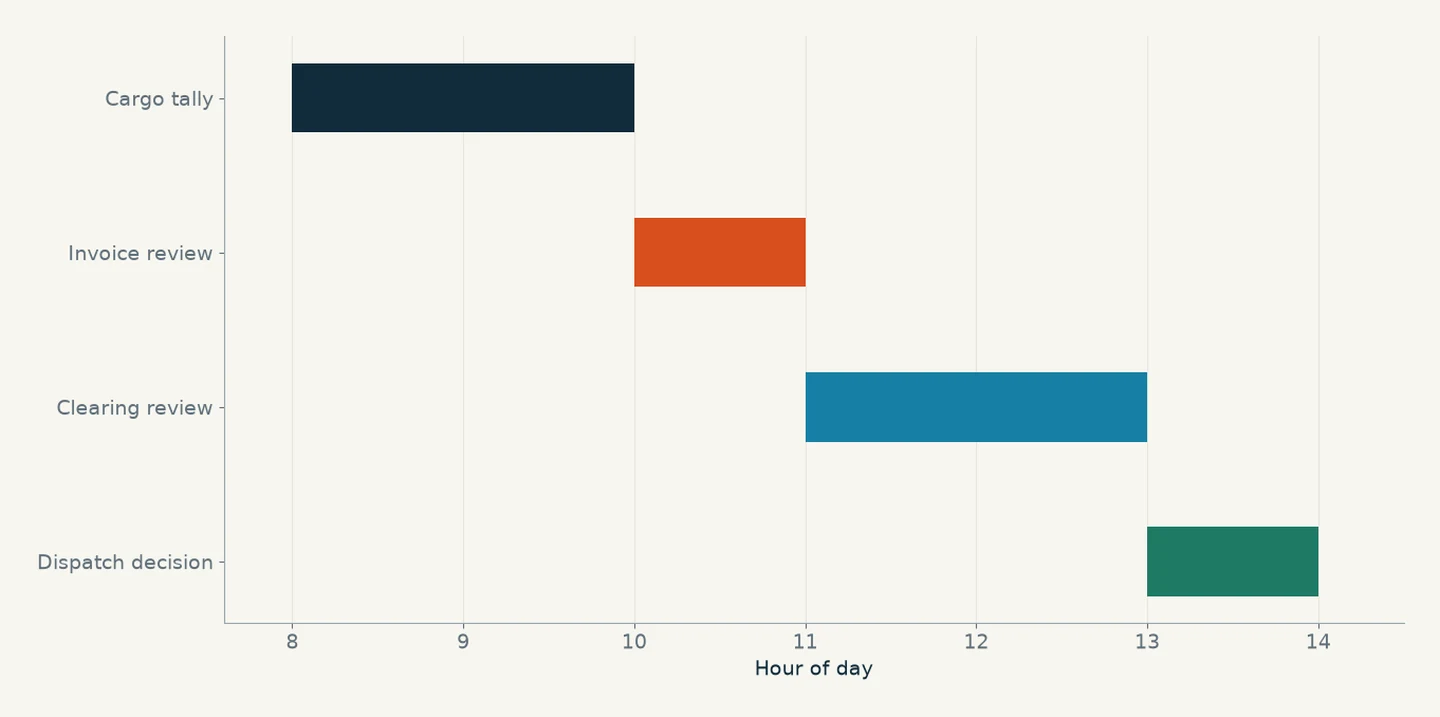
Illustrative planning exercise. A Gauteng dispatch team wants to release a truck at 14:00. The warehouse expects its loaded tally at 10:00. The exporter allows an hour to check the final commercial pack; the clearing owner needs the completed information before confirming the declaration position. These are assumed internal planning slots, not SARS processing standards.
| Step | Start | End |
|---|---|---|
| Cargo tally | 08:00 | 10:00 |
| Invoice review | 10:00 | 11:00 |
| Clearing review | 11:00 | 13:00 |
| Dispatch decision | 13:00 | 14:00 |
At 10:00 the warehouse reports that one pallet is still being rebuilt. The correct response is to flag a dependency and reset the dispatch decision time. It is not to send an old packing list as final and hope the package count stays the same. The revised plan should identify who will provide the actual tally and when the clearing owner can review it.
The dispatcher can still reserve a vehicle conditionally. Record the condition in the booking so that the carrier understands which commitment is confirmed and which one depends on document readiness. If a receiving slot will be lost, tell the receiver while there is time to rebook.
Control the last revision
Use the freight pre-clearance checklist to freeze the approved pack at a named version, then handle later changes deliberately. A substitute truck, a split load or a different border can affect more than the transport message. Ask the declarant whether the declaration or accompanying records need correction. Keep a small change log with the old value, new value, source and approver.
- Warehouse passes the cargo record to the exporter.
- Exporter passes the commercial pack to the declarant.
- Declarant informs the receiver and the carrier.
- Changed cargo reopens review, back at the warehouse.
Send the driver the current instructions through a channel the carrier can reliably use. A phone screenshot without the declaration reference is a poor substitute for an organised pack. Where originals or endorsements are required for the actual movement, the declarant should say so explicitly. Do not assume an emailed scan is acceptable simply because it is convenient.
Write a useful hold message
Use a message that lets another person act: “Dispatch waiting for final package count; warehouse owner is named; expected update at 11:30; clearing review reopens after receipt; delivery booking not yet confirmed.” The details matter more than the word “urgent”. The recipient can now decide whether to wait, revise the truck booking or renegotiate the delivery slot.
| Question | Entry for the shipment file |
|---|---|
| What is unresolved? | One precise missing fact or decision |
| Who owns it? | Named person and contact channel |
| What evidence will close it? | Corrected document or authority response |
| When is the next update? | Specific time with time zone |
| What depends on it? | Truck departure, border plan or delivery slot |
A freight pre-clearance checklist is useful because it makes dependencies visible. It should also state when the coordinator cannot give a reliable estimate. If Customs has selected a consignment for inspection, the practical next step is an update from the clearing owner, not a guessed release time passed to the customer.
Questions shippers ask
Does pre-clearance guarantee no border delay?
No. It improves preparation but does not remove inspection, system, queue or authority decisions.
Can the truck leave while clearance is being prepared?
Ask the declarant and carrier to confirm what the actual movement permits. Record the condition and the dispatch decision; this guide does not authorise a controlled movement.
What if the final count arrives after the planned cutoff?
Reopen the affected reviews and tell the carrier and receiver which commitments change. Use the actual count rather than a convenient earlier version.
Use this with the rest of the library
Follow the practical next step: Cross-Border Freight Documents: A Practical South African Guide; Commercial Invoice for Customs: What a Shipper Must Check; Customs Document Mismatches: Fix Invoice, Weight and Packing Errors.
For the operating handoff, also use What to do when a truck will miss its slot; How to write a freight exception update. If you need help scoping a shipment, send Synesys the collection, delivery and cargo details.
Sources and method
The external sources below support the rules or carrier terms cited in this article. The worksheets, decision methods and labelled examples are original Synesys educational analysis. They are not measured customer outcomes or market price benchmarks. Confirm the actual declaration, contract and shipment dates before relying on a numerical example.
Continue with this topic
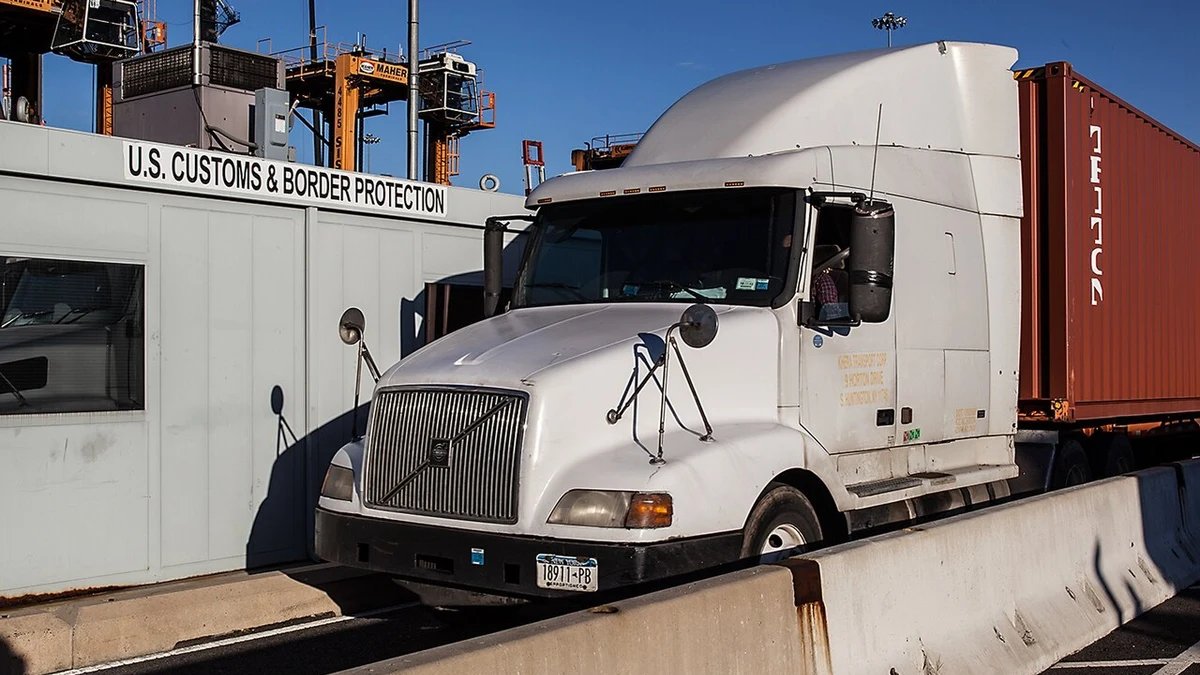
A container truck at a U.S. Customs radiation portal in the New York/Newark area, November 2012. International archive illustration, not a local inspection procedure. Photo: CBP Photography / Public domain. Cropped and resized. This is documentary stock imagery, not a claim that Synesys owns the pictured facility, vehicle or shipment.