

A commercial invoice for customs should let a declarant identify the transaction, the goods and the price without guessing. Check parties, product descriptions, currency, line totals and separately stated charges against the order and packing records before it reaches a border file.
Last verified: 17 November 2026. Scope: South African shippers and their freight partners.
In this guide
Read the commercial invoice for customs as a transaction record
A warehouse booking may call a load “six pallets”, but Customs needs to understand the goods and their transaction. The commercial invoice for customs should be read alongside the purchase order, sales terms and packing list. Six pallets of valves and six pallets of empty plastic crates are not interchangeable descriptions simply because the truck footprint is similar.
SARS’s current SARS SC-CF-55, Revision 14, effective 14 August 2026 addresses invoice information, supporting records and customs worksheets. Ask the declarant which information is required for your procedure. This guide proposes a review routine; it does not replace the prescribed declaration fields or the judgement needed to classify and value the actual goods.
Use a real transaction identifier and the relevant version of the commercial invoice for customs. Where there is no sale—for example a return or temporary movement—explain the purpose to the declarant. Do not invent a token selling price to make the spreadsheet balance. The customs valuation treatment needs to be resolved from the facts.
Commercial invoice for customs: a line-level review
| Check | Question to ask | Evidence to compare |
|---|---|---|
| Parties | Who sells, buys and acts as importer/exporter? | Order and appointed-party instructions |
| Goods | Can an unfamiliar reader identify each product? | Part number, specification and packing record |
| Quantity | What is the unit: pieces, kilograms or sets? | Order, loaded tally and packing list |
| Currency | Which currency applies to every price? | Contract and invoice currency field |
| Arithmetic | Do quantity × unit price and line totals reconcile? | Recalculated line schedule |
| Charges | Where are freight, packing or insurance included? | Sales term and separate cost lines |
| Origin claim | What supports any preferential statement? | Producer and applicable origin evidence |
Download this article’s main table (CSV)
A product code helps only when someone can trace it. Attach the specification or catalogue description the clearing agent needs. “Parts for machine” may still leave the material, function and product identity unresolved. Good invoice preparation gives the declarant evidence; it does not tell them to choose whichever tariff heading appears cheapest.
Worked example: separate an arithmetic error from a customs question
Illustrative invoice, not a quoted price. An exporter’s draft lists 80 components at R250 each and 40 components at R300 each. The correct line totals are R20,000 and R12,000, giving R32,000 before any separately described freight or other charges. The draft instead shows R11,700 for the second line. That is an arithmetic discrepancy of R300; no tariff interpretation is needed to find it.
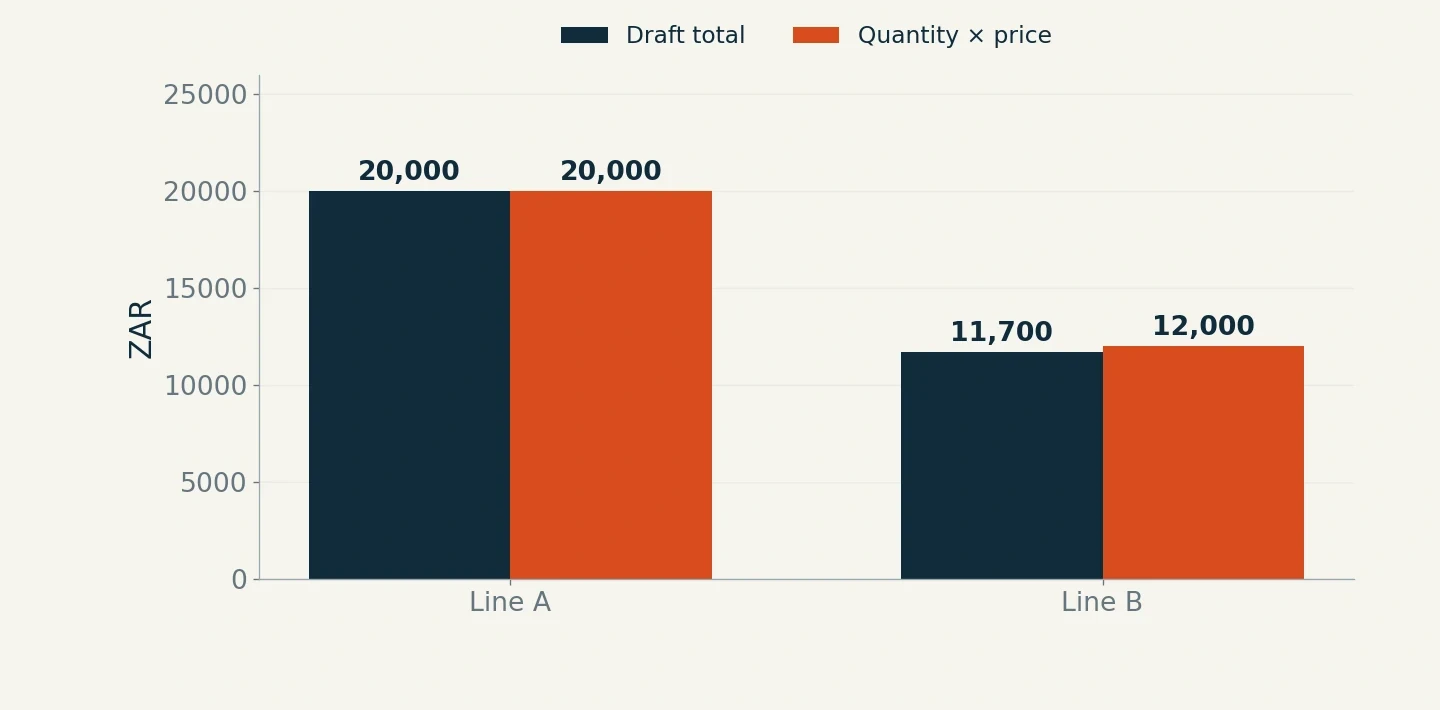
| Line | Draft total (ZAR) | Quantity × price (ZAR) |
|---|---|---|
| Line A | 20,000 | 20,000 |
| Line B | 11,700 | 12,000 |
Ask the issuer to correct the commercial invoice for customs and identify the superseded version. Do not quietly overwrite the exporter’s PDF in the shipment folder. Then let the declarant confirm whether a declaration already prepared or lodged must also change. The SARS: Goods Declaration guidance recognises that declarations may require amendment or cancellation depending on circumstances.
An arithmetic correction does not resolve origin, tariff classification or customs value. Keep those questions in separate fields so that a corrected subtotal is not mistaken for complete customs approval.
Check the packing basis without forcing false equality
An invoice quantity in pieces need not equal a packing-list quantity in boxes. It must be possible to reconcile them. With 120 components in 12 boxes, the link is 10 components per box. If one box contains a different product, a single average is not enough; use a package-to-line schedule.
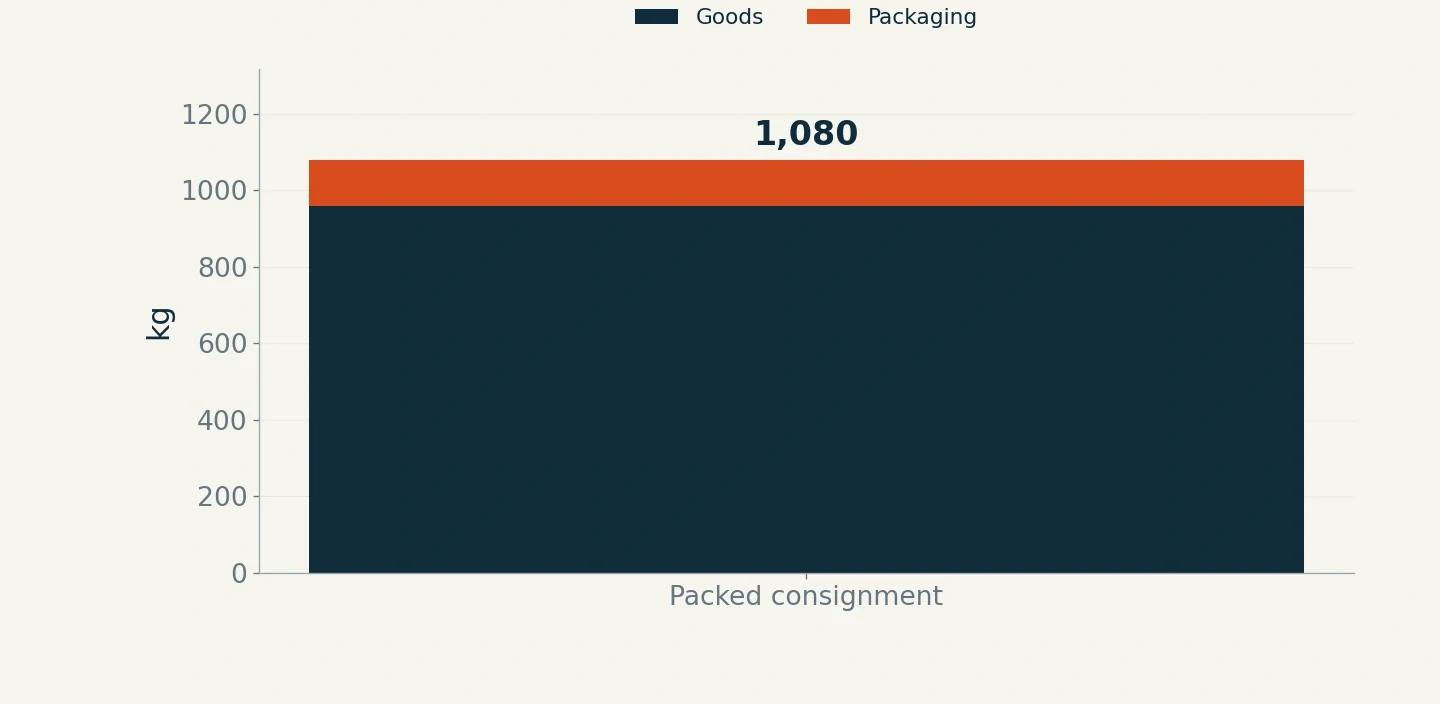
| Component | Mass (kg) |
|---|---|
| Goods | 960 |
| Packaging | 120 |
| Packed consignment | 1,080 |
Keep the package marks visible in the working schedule. A receiver in Gaborone should be able to identify a box against the paperwork without interpreting the seller’s internal abbreviations. Where a pallet is broken down or repacked, record the new package structure before sending the commercial invoice for customs onward.
Send a reviewable exception list to the declarant
A useful email says: “Invoice INV-EXAMPLE revision B replaces A; second line corrected by R300; packing count unchanged; please confirm declaration impact.” It identifies what changed and what did not. An email saying “new invoice attached” requires the clearing agent to discover the difference under time pressure.
For cross-border road work, distinguish the commercial review from carrier readiness. The C-BRTA: Cross-border transport permits information describes operator permit categories; an accurate invoice does not show that the appointed vehicle and operator meet the requirements of the route. Send the carrier the approved cargo and package description, and keep permit confirmation with the transport handoff.
| Field | Enter before approval |
|---|---|
| Approved invoice | Number, date and version |
| Reconciled totals | Quantity, unit price, currency and line sum |
| Open specialist questions | Classification, origin, valuation or restricted goods |
| Correction owner | Issuer and authorised approver |
| Dispatch decision | Approved / waiting, with reason and time |
If a mismatch remains, name the decision that is waiting on it. A wrong buyer entity is not the same problem as a formatting difference in an address. Ask the declarant to resolve materiality rather than letting the dispatch team make an unauthorised customs decision.
Questions shippers ask
Can I use a pro forma invoice instead?
Ask the declarant what is acceptable for the actual transaction and procedure. A pro forma document does not automatically establish the final transaction value or satisfy every clearance requirement.
Must the invoice show the same number as the packing list?
The units must reconcile. A line showing 120 pieces can legitimately correspond to 12 boxes; make the relationship explicit.
Should I put the transport cost inside the goods price?
Describe the agreed commercial structure and provide separate supporting details where required. The declarant determines customs treatment; do not hide a charge to simplify a form.
Use this with the rest of the library
Follow the practical next step: Cross-Border Freight Documents: A Practical South African Guide; Pre-Clearance Checklist: Prepare a Road Shipment Before the Border; Customs Document Mismatches: Fix Invoice, Weight and Packing Errors.
For the operating handoff, also use How to qualify a freight enquiry; Pallet dimensions for a road freight quote. If you need help scoping a shipment, send Synesys the collection, delivery and cargo details.
Sources and method
The external sources below support the rules or carrier terms cited in this article. The worksheets, decision methods and labelled examples are original Synesys educational analysis. They are not measured customer outcomes or market price benchmarks. Confirm the actual declaration, contract and shipment dates before relying on a numerical example.
- SARS SC-CF-55, Revision 14, effective 14 August 2026
- SARS: Goods Declaration
- C-BRTA: Cross-border transport permits
Continue with this topic
Cargo trucks awaiting customs clearance at Sost, Pakistan, photographed in 2007. International archive illustration, not South African clearance instructions. Photo: Anthony Maw, Vancouver, Canada / CC BY-SA 3.0. Cropped and resized. This is documentary stock imagery, not a claim that Synesys owns the pictured facility, vehicle or shipment.