

Customs document mismatches need a traceable correction: identify the inconsistent field, establish the true value from source evidence, and let the authorised issuer or declarant revise the affected record. Do not make documents agree by replacing a correct fact with a convenient one.
Last verified: 17 November 2026. Scope: South African shippers and their freight partners.
In this guide
First identify what the numbers describe
A packing list showing 1,080 kg gross and an invoice schedule showing 960 kg net may be consistent. A packing list showing 12 boxes and a truck tally showing 11 boxes is a different problem. Customs document mismatches should be sorted by meaning before anyone edits a PDF. Compare the unit, scope, source and version of each field.
The SARS: Goods Declaration guidance states that declarations may need amendment or cancellation depending on circumstances. The current SARS SC-CF-55, Revision 14, effective 14 August 2026 includes amendment procedures. Ask the appointed declarant which process applies to a lodged declaration; a shipper’s correction email is not itself a formal amendment.
Keep the physical cargo safe and identifiable while the issue is investigated. If the question is whether a box is missing, an authorised recount may resolve it. If the question is whether the seller used the wrong buying entity, the warehouse cannot settle it by relabelling the cartons.
Triage customs document mismatches by decision
| Mismatch | Evidence to obtain | Decision owner |
|---|---|---|
| Package count differs | Signed loaded tally and packing record | Warehouse/exporter, then declarant |
| Mass differs | Weighing record and net/gross basis | Warehouse or weighing source |
| Price or currency differs | Contract, issued invoice and payment terms | Commercial issuer, then declarant |
| Product identity differs | Specification, part number and photos where useful | Product owner + declarant |
| Party or route differs | Commercial instructions and actual movement | Importer/exporter + declarant |
| Origin statement unsupported | Producer evidence and applicable origin rule | Origin specialist/declarant |
Download this article’s main table (CSV)
The fastest useful message about customs document mismatches names the field. “Documents wrong” does not help a clearing owner distinguish a missing approval from a typographical error. Attach a marked comparison or a short table, while preserving the unedited originals.
Worked example: reconcile the package count
Illustrative case. Invoice attachments identify 120 components in 12 outer boxes. The loading tally shows 11 boxes, and a warehouse note says one damaged box was repacked into two smaller boxes. That explanation would produce 13 boxes, not 11. It cannot close the discrepancy. Stop the document approval and obtain a new physical tally tied to the package marks.
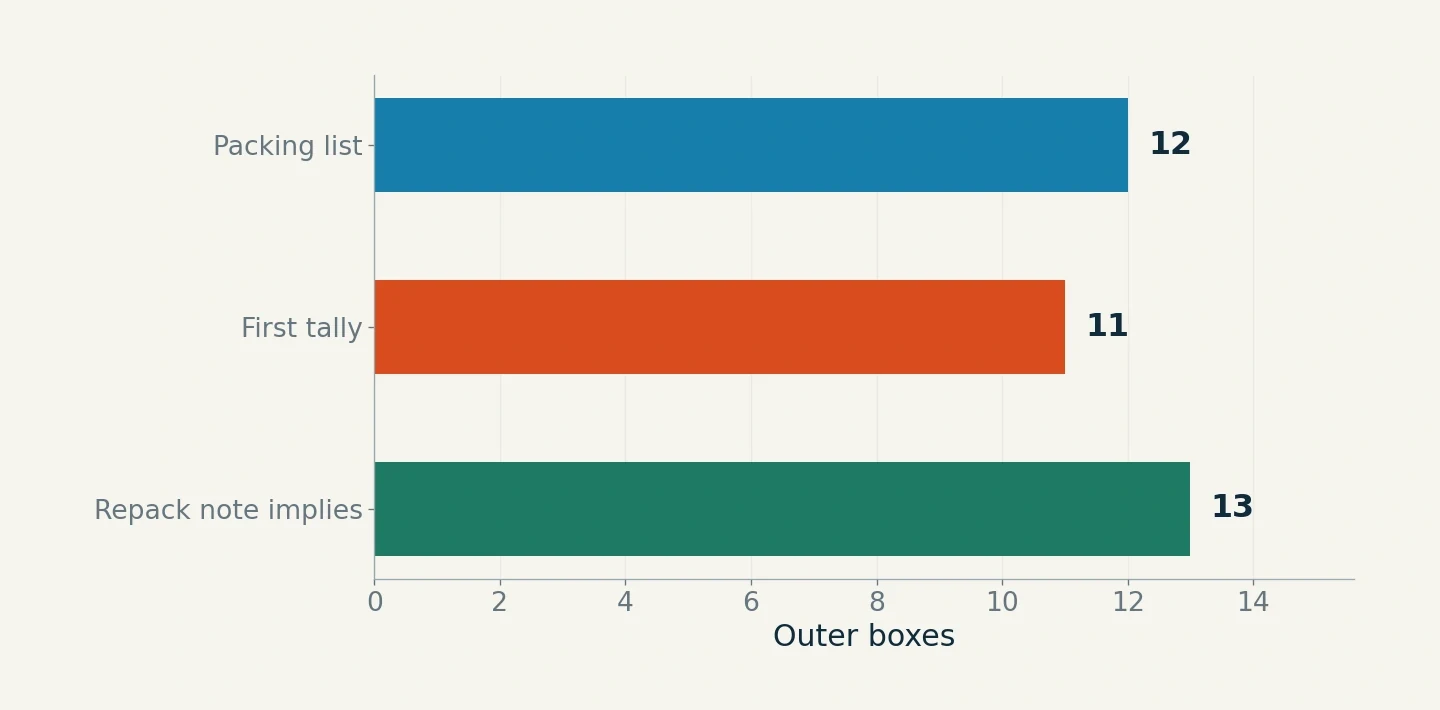
| Record | Outer boxes |
|---|---|
| Packing list | 12 |
| First tally | 11 |
| Repack note implies | 13 |
Assume the authorised recount confirms 13 boxes and the component quantity remains 120. The warehouse updates the packing schedule and labels; the exporter reviews the change; the declarant confirms the declaration impact. The corrected transport instructions use the same shipment identity. The chain is evidence first, correction second, dispatch decision last.
Do not reuse the earlier PDF under its old filename. Add a revision identifier and a note that the new pack supersedes it. A person at the destination should be able to see which version was used when the truck departed.
Track customs document mismatches in a correction ledger
| Field | Before | Evidence-backed correction | Issuer / approval |
|---|---|---|---|
| Outer packages | 12 boxes | 13 boxes after recount | Warehouse revision + exporter sign-off |
| Product quantity | 120 units | 120 units, unchanged | Product tally |
| Declaration impact | Not assessed | Declarant confirms required process | Named clearing owner |
| Carrier instruction | Earlier pack | Replacement pack reference | Dispatcher acknowledgement |
Correct the evidence trail, not just the PDF
- Conflicting records: two or more documents disagree.
- Source evidence: compare each record with the source evidence.
- Authorised revision: if the source evidence settles it, issue the authorised revision.
- Unresolved: obtain evidence, then return to the conflicting records.
For a financial change, record the currency as well as the amount. A ZAR figure and a USD figure are not different estimates of the same field unless the conversion basis is stated. Do not let an internal planning exchange rate silently replace the valuation basis the declarant needs to use.
If a loaded vehicle or border changes, tell the carrier and clearing owner together. The SARS: Transit, updated 19 August 2026 page demonstrates why transport and customs records are linked in controlled movements. Which documents change depends on the actual procedure; this article does not prescribe a shortcut.
Tell the customer what is known and what remains open
A good update distinguishes a confirmed fact from an estimate: “Recount complete; 13 outer boxes confirmed; revised packing list issued; clearing review pending.” That tells the receiver why the departure estimate remains conditional without exposing private commercial documents to everyone in the distribution list.
Keep the correction file for customs document mismatches with the job after delivery. It is useful when an invoice is challenged or the customer later reports a shortage. For the operational handling of a stopped load, use the separate held-load guide; this article’s purpose is the documentary correction, not a promise to accelerate an authority’s decision.
The final check is simple: can a new colleague reconstruct what changed, why it changed and who authorised the next movement? If not, the documents may look tidy while the control remains incomplete.
Questions shippers ask
Can I correct the clearing agent’s declaration myself?
Provide the evidence to the appointed declarant and ask them to apply the appropriate procedure. Do not substitute an edited copy for a formal amendment.
Does every different weight mean a false declaration?
No. First establish whether each record describes net goods mass, gross packed mass or vehicle-related mass. A genuine unexplained difference still needs investigation.
Should I discard the old invoice after correction?
Retain the issued versions with their revision trail according to the applicable recordkeeping arrangements. Make the current approved version unmistakable.
Use this with the rest of the library
Follow the practical next step: Cross-Border Freight Documents: A Practical South African Guide; Commercial Invoice for Customs: What a Shipper Must Check; Pre-Clearance Checklist: Prepare a Road Shipment Before the Border.
For the operating handoff, also use What to do when a cross-border freight load is held; How to record a partial freight delivery. If you need help scoping a shipment, send Synesys the collection, delivery and cargo details.
Sources and method
The external sources below support the rules or carrier terms cited in this article. The worksheets, decision methods and labelled examples are original Synesys educational analysis. They are not measured customer outcomes or market price benchmarks. Confirm the actual declaration, contract and shipment dates before relying on a numerical example.
- SARS: Goods Declaration
- SARS SC-CF-55, Revision 14, effective 14 August 2026
- SARS: Transit, updated 19 August 2026
Continue with this topic
A worker applying a seal at a container door, photographed in 2017. Illustrative archive photograph; it does not establish a specific customs procedure. Photo: Mstephen247 / CC BY-SA 4.0. Cropped and resized. This is documentary stock imagery, not a claim that Synesys owns the pictured facility, vehicle or shipment.