
Customs transit acquittal means proving that a customs-controlled movement has been completed under its applicable procedure. Build the evidence file against the declaration, not just the delivery booking, and assign someone to resolve missing or inconsistent proof before the deadline.
Last verified: . South African guidance; destination-country rules must be checked separately.
In this guide
Customs transit acquittal is a separate closeout task
A truck can be back in the yard while its customs transit acquittal evidence is incomplete. The delivery report may say “done”, but the declaration file needs its own completion test. Keep the two statuses separate rather than treating the transport system’s green tick as a customs decision.
The SARS acquittal and proof-of-export annexure sets out evidence by procedure and transport mode. Read it with the declaration’s actual customs procedure code. It does not support a universal claim that a customer signature, GPS point or invoice settles every customs liability.
The current SARS SC-CF-55 policy says that where Customs stops an in-bond or transit declaration and requests acquittal documents, the declarant must upload them to the DPS case within 30 days from the goods-declaration date. This is a single-sourced policy statement checked against paragraph 3.27 on 17 November 2026. Confirm the applicable deadline with the declarant; do not substitute the delivery date.
Match the evidence to the declaration
| Field | What to reconcile | Why it matters |
|---|---|---|
| Declaration | Exact entry and consignment identifiers | Avoids proof from another shipment. |
| Goods | Marks, quantity and descriptions across records | Exposes unexplained shortages or substitutions. |
| Customs events | Required exit, receiving or endorsement evidence | Connects completion to the applicable procedure. |
| Dates | Declaration date, movement events and request details | Supports correct ageing and follow-up. |
| Authority and quality | Required authentication, legibility and lawful corrections | Avoids apparently complete but unacceptable evidence. |
Download this article’s main table (CSV)
A receiving record can be useful but insufficient customs proof. A warehouse might use an internal booking number while the declarant needs the declaration relationship. Ask for a cross-reference rather than altering the original record to create one retrospectively. Preserve what the receiver actually issued.
Paragraph 3.27 addresses discrepancies between acquittal documents and the declaration, and prohibits correction fluid on acquittal documents. Keep originals and use the proper amendment route. A tidy file assembled through undocumented edits is weaker than an honest file showing how a discrepancy was resolved.
Worked example: an ageing list that prompts action
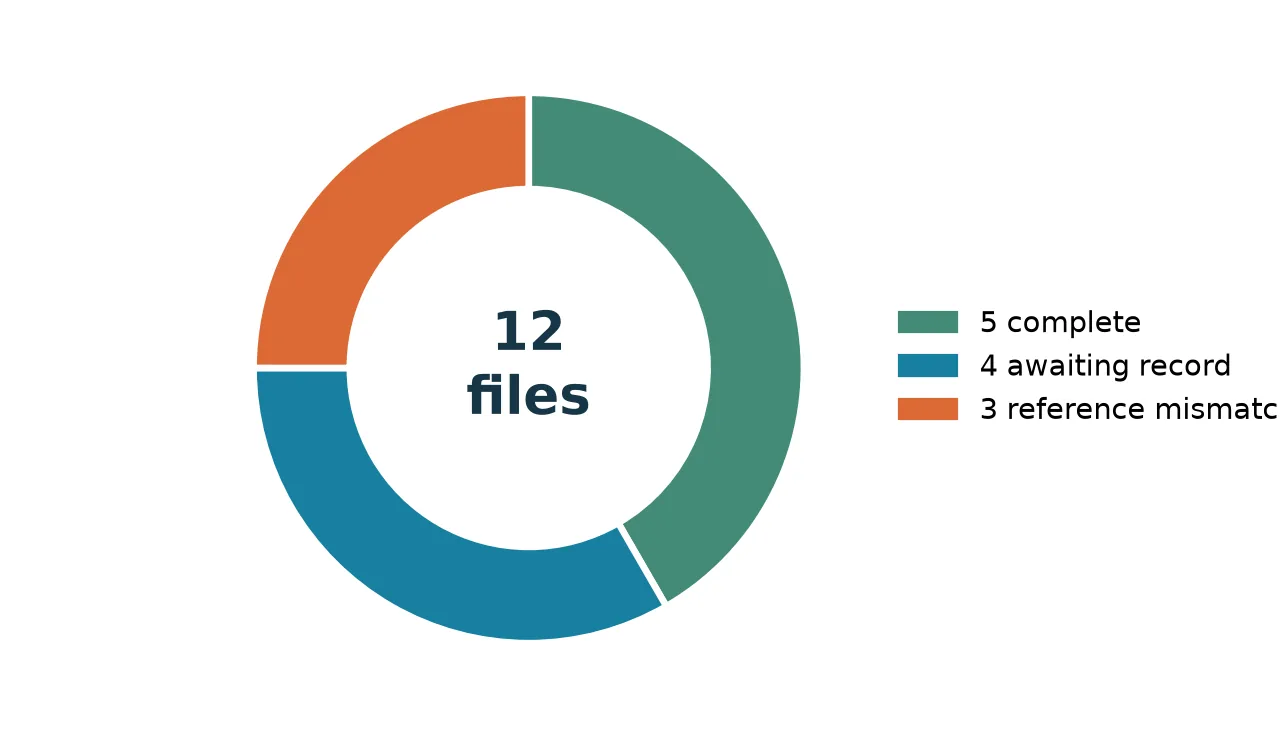
Illustrative file-management scenario. A coordinator reviews 12 open files. Five have complete evidence, four await a receiving or exit record, and three have mismatched references. These counts are invented to demonstrate a register; they are not a survey of South African customs performance.
| Status | Files |
|---|---|
| Complete | 5 |
| Awaiting record | 4 |
| Reference mismatch | 3 |
| Total | 12 |
Do not report “seven files need attention” and stop there. Give the four missing-evidence files an owner who can obtain the record. Give the three mismatch files an owner who can determine whether the wrong document was attached or an authorised amendment is required. The corrective actions differ; the work queue should show that.
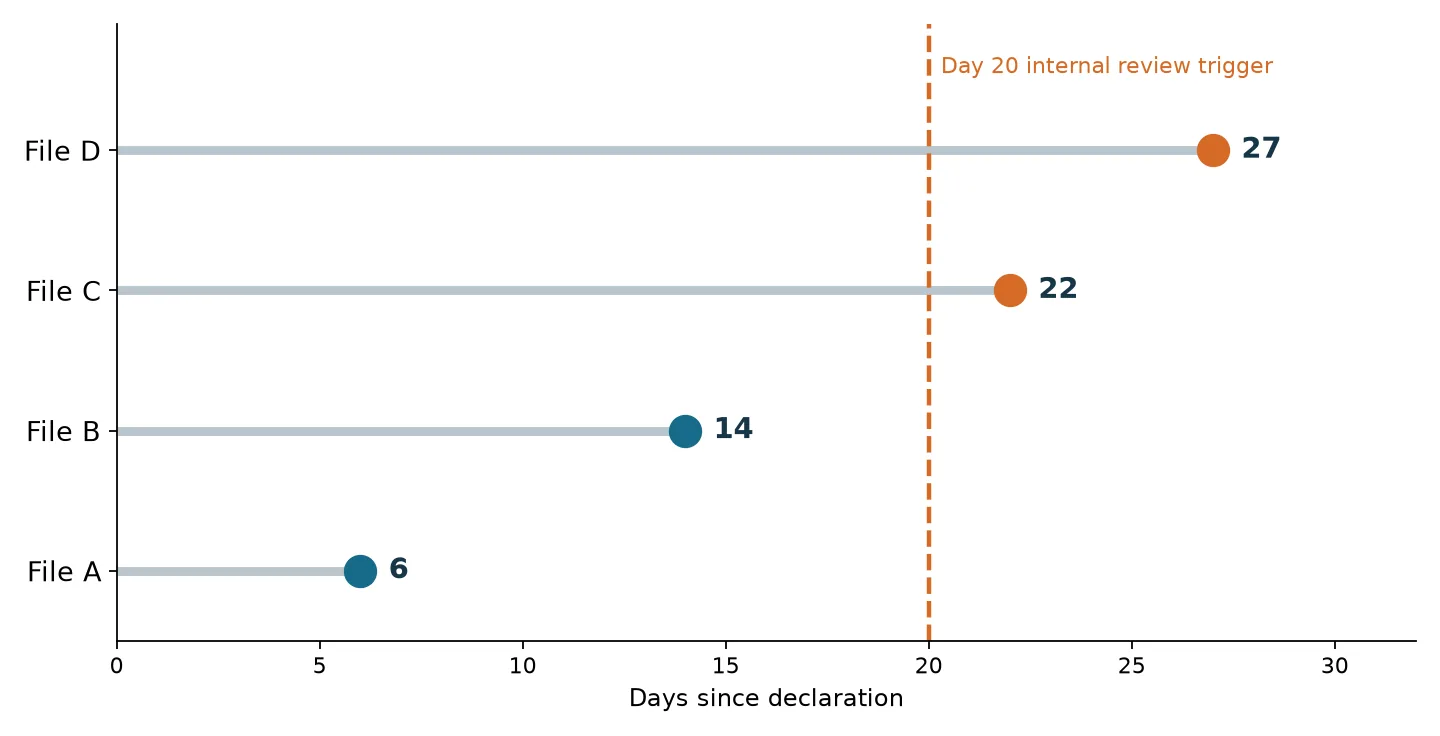
In the second illustrative view, declaration A is 6 days old, B 14 days, C 22 days and D 27 days. An internal review target at day 20 brings C and D forward. Day 20 is a fictional management trigger, not a legal deadline. Its purpose is to leave investigation time before the applicable deadline.
| File | Days since declaration |
|---|---|
| File A | 6 |
| File B | 14 |
| File C | 22 |
| File D | 27 |
If evidence will not be available in time, the declarant should assess the proper extension process early. Do not assume an extension is automatic, or that an informal reminder suspends a deadline. Record the application, what was requested and what was actually approved.
Make customs transit acquittal evidence recoverable
- Create a row for each declaration before the vehicle leaves.
- Record the required evidence and who will obtain it.
- Store readable source records under the consignment reference.
- Reconcile identifiers and dates; flag discrepancies without overwriting originals.
- Have the customs-file owner confirm acceptance or the next outstanding action.
- Retain that confirmation under the applicable record-retention requirements.
Use meaningful statuses: “awaiting receiving record”, “reference mismatch under review”, or “submitted to declarant, acceptance unconfirmed”. Avoid “almost closed”. The next person should understand the missing action without reading a message thread from beginning to end.
The handoff matters when a driver changes vehicles or goes off duty. Evidence must reach the company file rather than remain on a personal phone. Agree the upload or document-return process before dispatch, with enough quality to read stamps, references and signatures where required.
The commercial records in From Proof of Delivery to Invoice can support invoice closeout. Keep their purpose distinct from customs transit acquittal. Return to the bonded cargo planning guide if the responsible customs owner is unclear.
When the truck arrived but the file will not close
Start with the actual rejection or query. Missing exit evidence and an invoice-reference mismatch require different responses. Capture the request accurately inside the private job file, then ask the declarant to identify the corrective route. Do not submit a collection of unrelated documents simply to show that something was sent.
If there is a cargo discrepancy, use How to Record a Partial Freight Delivery to preserve the physical facts. Do not make a customer sign for an unconfirmed quantity to complete transport paperwork. The commercial and customs investigations should use the same honest observations.
A useful weekly metric is unresolved files by reason and age, with the oldest actionable exception visible. It is more useful than a broad claim that the business is compliant. A manager can see which document chase or decision is needed today and whether a file is approaching a time-sensitive stage.
When a handoff failed because the wrong instruction was used, correct the process as well as the file. The removal in bond vs transit comparison helps brief future movements. If identifiers conflict, retain the seal discrepancy record with the final authorised resolution rather than deleting it once the truck is released.
Questions shippers ask
Is a POD enough for customs transit acquittal?
Not as a blanket rule. Start from the declaration’s procedure and the SARS acquittal annexure, then have the declarant confirm required evidence. Commercial delivery and customs closure can require different records.
When does the acquittal clock start?
For customs transit acquittal, check the applicable rule and case. SC-CF-55 paragraph 3.27 describes a 30-day period from the goods-declaration date for the specified supporting-document request. Do not assume it starts when the driver returns or the customer pays.
Can we amend an incorrect acquittal document ourselves?
Do not make undocumented changes or use correction fluid. Preserve the original, describe the discrepancy and ask the declarant which authorised correction or declaration amendment is required.
Sources and verification notes
- SARS SC-CF-55-A10, Revision 4, effective 30 March 2026
- SARS SC-CF-55, Revision 14, effective 14 August 2026
- SARS: Customs Endorsement Documents Requirements
Sources checked on 17 November 2026. Charts and worked scenarios are original Synesys educational models; invented quantities, times and amounts are labelled illustrative. They are not customer results, published market prices or regulatory limits.
Continue with this topic
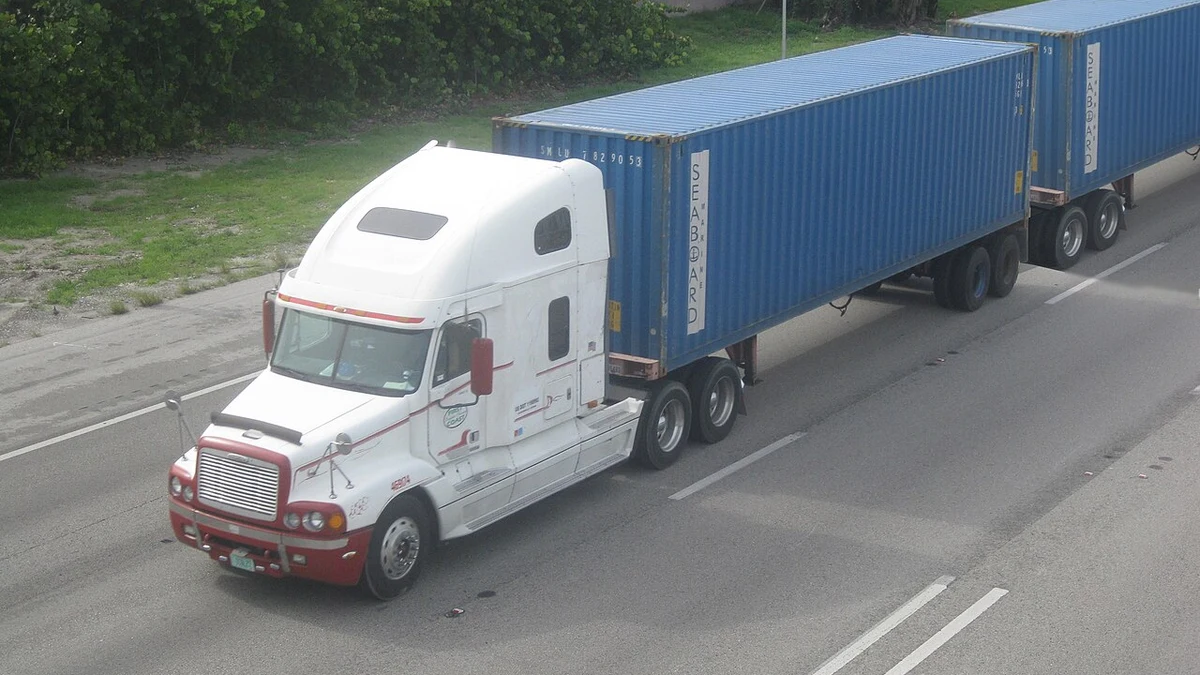
A road vehicle hauling two containers. International archive photograph; this vehicle configuration is not presented as approved for South African or SADC roads. Photo: 20px|link=User:Wikideas1|Wikideas1 Wikideas1 (talk) (Uploads) and Joseph Madden (Joedamadman)(Joedamadman on the English Wikipedia) / CC BY 3.0. Cropped and resized. This is documentary stock imagery, not a claim that Synesys owns the pictured facility, vehicle or shipment.