
SADC rules of origin determine whether goods qualify as originating under the relevant regional trade arrangement. Buying, storing or dispatching goods in South Africa does not by itself establish origin. Match the actual product and production process to the applicable rule before claiming preference.
Last verified: . South African guidance; destination-country rules must be checked separately.
In this guide
SADC rules of origin start with the product, not the truck
A South African invoice tells the buyer who sold the goods. It does not necessarily identify where the goods acquired originating status. A container of imported equipment resold from a Gauteng warehouse should not be called SADC-origin simply because the truck departs from Johannesburg.
SADC describes a qualifying route as goods being “wholly produced or obtained within a Member State”. Its customs overview also recognises sufficient processing of non-originating inputs. These are starting concepts. The product-specific rule, the relevant trading arrangement and the shipment’s supporting evidence decide the actual claim.
Keep SADC regional preference separate from the SADC-EU Economic Partnership Agreement and from SACU customs arrangements. Similar names do not make the rules interchangeable. A document headed “certificate of origin” also needs to be checked for the particular agreement and destination where the importer intends to use it.
This article focuses on the shipper’s evidence process. It does not determine a product’s tariff classification or entitlement to a preferential rate. Use the SARS treaty directory to locate the governing annex and working-or-processing list, then ask a competent customs adviser to apply the current rule to the goods.
The questions an origin file must answer
| Question | Evidence to assemble | Common false shortcut |
|---|---|---|
| What is the product? | Precise description, composition and confirmed tariff classification | A sales category such as machinery or food. |
| Where and how was it made? | Producer identity, production description and batch records | The exporter’s address. |
| What inputs were used? | Material list, supplier records and origin evidence where relevant | Treating every locally purchased input as originating. |
| Which rule applies? | Applicable agreement and product-specific condition | A guessed universal local-content percentage. |
| Can the shipment prove the claim? | Consistent invoice, goods, certification and consignment records | Assuming an issued document prevents verification. |
Download this article’s main table (CSV)
The introductory notes to the SADC processing list explain how product-specific processing conditions are interpreted. The public SARS-hosted reference is an older annex text, not a promise that every tariff line is unchanged. Confirm the current applicable legal text before a commercial claim is made.
Origin is not an accounting slogan. “We spend most of the money locally” can still be the wrong test. A rule may concern a specified manufacturing process, tariff classification change or a value condition. The file must show the test that applies, with the correct definitions and evidence.
Do not make a certificate application the first time the business thinks about origin. By then the goods may be sold, the truck booked and the buyer expecting a particular duty treatment. Resolve uncertain origin before the quotation commits the business to an unverified saving.
Worked example: local purchasing is not the same as origin
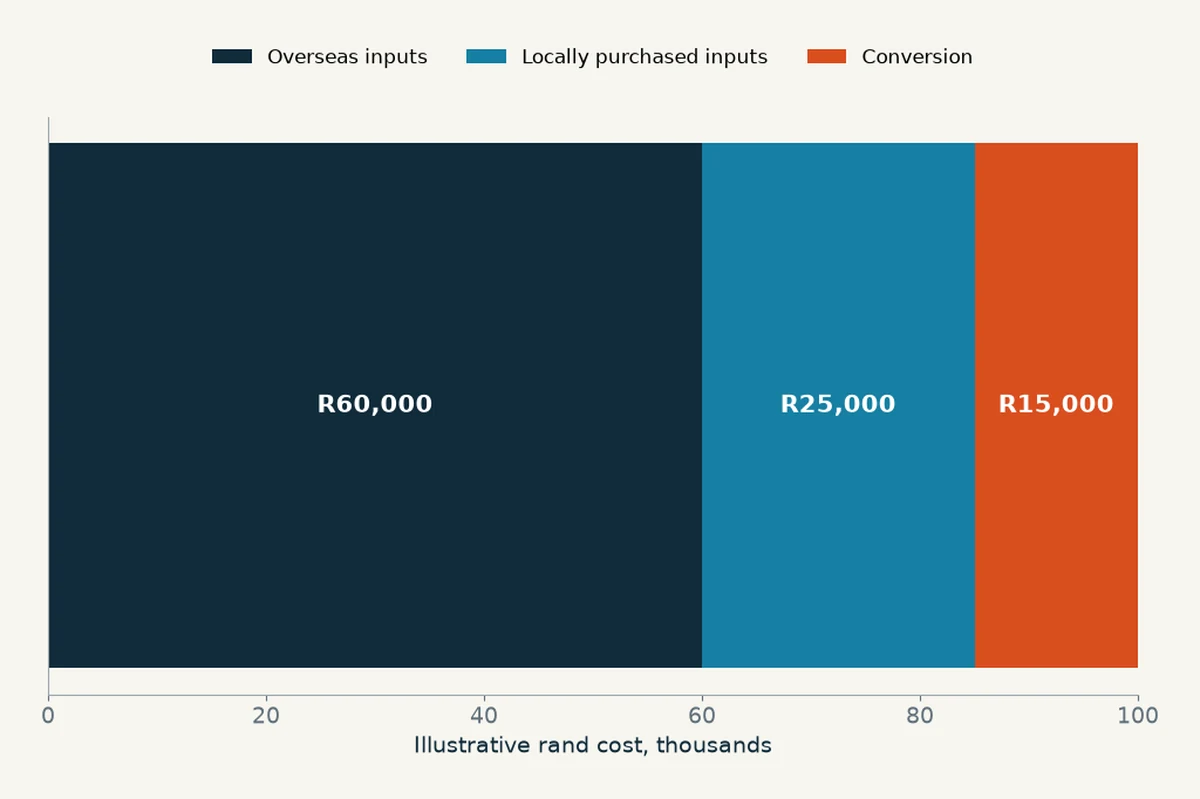
Illustrative manufacturing example, not a legal origin determination. A fictional South African producer builds a product using inputs recorded at R60,000 from overseas, R25,000 bought locally and R15,000 in local conversion costs. The model’s R100,000 total is simply an internal production-cost illustration. It is not necessarily the ex-works price or the valuation basis in an origin rule.
| Cost element | Amount (ZAR) |
|---|---|
| Overseas inputs | R60,000 |
| Locally purchased inputs | R25,000 |
| Conversion | R15,000 |
The R25,000 local purchase could include imported goods resold by a South African distributor. The procurement ledger therefore cannot prove that this amount is originating material. Ask the supplier for the appropriate producer or origin evidence, then have the responsible adviser determine how it is treated under the applicable rule.
Equally, the R15,000 conversion cost does not automatically confer origin. A product may require a particular manufacturing operation that the producer has not performed. A percentage calculated from a convenient ledger total can be mathematically correct and legally irrelevant.
- Supplier A and Supplier B records
- Production records
- Exported product
An honest internal status might be “origin assessment incomplete: locally purchased input evidence outstanding”. That is more useful than a green “local product” label. The buyer can see which commercial assumption remains open, while the manufacturer knows exactly which evidence request will move the file forward.
If the rule eventually supports the claim, retain the calculation and supporting records used. If it does not, change the commercial plan rather than stretching the explanation. A different supplier, production process or pricing basis may deserve assessment, but none should be presented as an approved origin strategy without a new review.
What a certificate does—and what it does not do
The SADC e-Certificate of Origin description explains electronic issuance and authentication. Electronic handling can improve the document process, but it does not turn unsupported goods into qualifying goods. Confirm which certificate process is accepted for the actual country pair and shipment.
Certification, preferential customs duty and import VAT are separate questions. Avoid promising “tax-free” delivery simply because an origin document is available. The importer needs the applicable tariff treatment and tax calculation confirmed in its own jurisdiction, including any conditions outside the origin rule.
The exporter and producer may be different businesses. A distributor cannot explain manufacturing merely by presenting its own sales invoice. The producer evidence chain must connect the product being certified with the actual production process. Our SADC Certificate of Origin guide turns that requirement into a practical application file.
If the factory uses imported components, continue to Imported Components and SADC Origin. The question is not whether importing a component is allowed in the abstract. It is whether this product, made through this process, satisfies this applicable rule.
Protect the buyer’s decision before dispatch
Ask the importer’s clearing representative to review the intended preference claim before the truck is committed. Agree the product description, expected certificate, commercial document references and any unresolved evidence. That review can expose a mismatch while the team still has options to correct the file.
Keep the buyer’s budget transparent. Separate the confirmed landed-cost components from the duty treatment that depends on an unresolved claim. The landed-cost guide provides a framework for recording those assumptions without presenting them as final assessed charges.
If Customs questions the claim, collect the actual query and respond to its substance. A new copy of the same certificate will not resolve a question about production. The Rejected SADC Preference guide separates document defects, product-rule issues and consignment-evidence gaps.
Do not put a driver in the position of explaining factory records at a border. Identify the exporter, producer and declarant contacts who can supply evidence. Use Who Owns Each Handoff on a Freight Job? to connect the right person to that customs question.
The origin worksheet to build once and maintain
- Product and batch: description, specification, invoice and quantity.
- Classification: confirmed tariff line, adviser and date.
- Rule: agreement, product-specific condition and version checked.
- Production: site, actual processes and relevant batch records.
- Inputs: supplier, value or quantity basis where relevant, and supporting origin evidence.
- Certification: exporter, producer evidence, issuing process and consignment match.
- Review trigger: supplier change, product redesign, process change or amended rule.
Give the worksheet an owner in the producing or exporting business. Freight operations can help connect the documents to the load, but cannot invent manufacturing evidence. A named owner stops a repeated border question from becoming a last-minute request sent to every person involved in the shipment.
Review the file when a supplier or production method changes. A certificate issued for a previous batch is not proof that a redesigned product still qualifies. The practical value of an origin library is a repeatable evidence process, not a collection of confident statements that nobody can trace back to the factory.
Questions shippers ask
Do goods bought in South Africa automatically qualify for SADC preference?
No. Place of purchase is not enough. Establish the product’s applicable rule, actual production process and supporting evidence. Imported goods resold by a local distributor do not become originating merely through the local sale.
Is there one local-content percentage for every SADC product?
No universal percentage should be assumed. Product-specific conditions and definitions matter. Ask the adviser to identify the exact rule and its calculation basis before using a percentage in a quotation or certificate file.
Does a SADC certificate eliminate import VAT?
Do not assume that. Preferential customs duty treatment and import VAT are distinct questions. The importer’s adviser must confirm the applicable tariff and tax treatment in the destination jurisdiction.
Can we rely on last year’s origin assessment?
Use it as a starting record, then check for changed inputs, suppliers, manufacturing steps, product classification or legal rules. The assessment must still describe the current product and shipment.
Sources and verification notes
- SADC: Customs and rules of origin
- SARS: SADC Treaty and Protocols
- SADC origin: Introductory notes to AppendixI, hosted by SARS
- SADC: What is the e-Certificate of Origin?
Sources checked on 17 November 2026. Charts and worked scenarios are original Synesys educational models; invented quantities, times and amounts are labelled illustrative. They are not customer results, published market prices or regulatory limits.
Continue with this topic
A crane-equipped truck handling bagged crushed-glass material, May 2007. Archive cargo-handling photograph, not evidence that a product qualifies for originating status. Photo: Calvin Koronale / CC BY-SA 4.0. Cropped and resized. This is documentary stock imagery, not a claim that Synesys owns the pictured facility, vehicle or shipment.