
Landed cost combines the purchase and delivery costs needed to get goods to the intended destination. For South African import planning, build a separate cash-funding view: import VAT can require funding even when the business may qualify to deduct it later.
Last verified: 17 November 2026. Scope: South African shippers and their freight partners.
In this guide
Define the destination before calculating landed cost
A Durban port quotation and a delivered Boksburg quotation have different endpoints. Add them to a comparison without checking scope and the cheaper option may simply stop earlier. Write the destination precisely: terminal gate, bonded warehouse, consignee’s yard or goods placed at a particular receiving bay. Identify which loading, unloading and return tasks belong to that endpoint.
The IFRS Foundation: IAS 2 Inventories summary explains that inventory cost includes purchase, conversion and other costs incurred to bring inventory to its present location and condition. That accounting principle is not permission to capitalise every delay charge. Your finance team must decide the appropriate accounting treatment. The shipper’s first job is to expose the cost and evidence, not hide it in an “other” line.
The Synesys working method uses two totals: an operating or landed-cost budget under an agreed cost definition, and the peak cash needed to execute the shipment. Label both. A delivery manager needs to know whether a payment can stop release even if the accountant expects a later tax deduction.
Build the cost bridge in named layers
| Layer | What to record | Common source of double counting |
|---|---|---|
| Goods | Purchase value and currency | Adding supplier-included freight again |
| Origin preparation | Packing, collection and export tasks | Treating every origin charge as excluded |
| Main movement | Sea/air/road linehaul and agreed surcharges | Comparing unlike scope or equipment |
| Border/port handling | Applicable clearing, handling and inspection charges | Confusing carrier and terminal invoices |
| Duty/tax treatment | Verified duty and import VAT assumptions | Treating all tax as a permanent cost |
| Inland delivery | Truck, access, unloading and delivery conditions | Omitting the last receiving handoff |
| Equipment closure | Container return and related terms if relevant | Stopping the budget at unloading |
Download this article’s main table (CSV)
Put the currency and tax basis on every quoted charge. If one supplier quotes excluding VAT and another supplies an inclusive total, normalise the comparison before ranking it. For a foreign-currency item, retain the quote currency, the planning exchange rate and its date. Ask the declarant separately about the exchange-rate basis for customs purposes.
SARS’s SARS: Duties and Taxes for Importers page shows why import taxes need their own calculation. Its standard import VAT rate is 15%, with an added-tax-value calculation that can include a 10% uplift and non-rebated duties. Scope and exceptions matter. These numerical tax rules are single-authority sourced to SARS; the examples below are not a tariff ruling.
Worked example: the truck rate is only one part
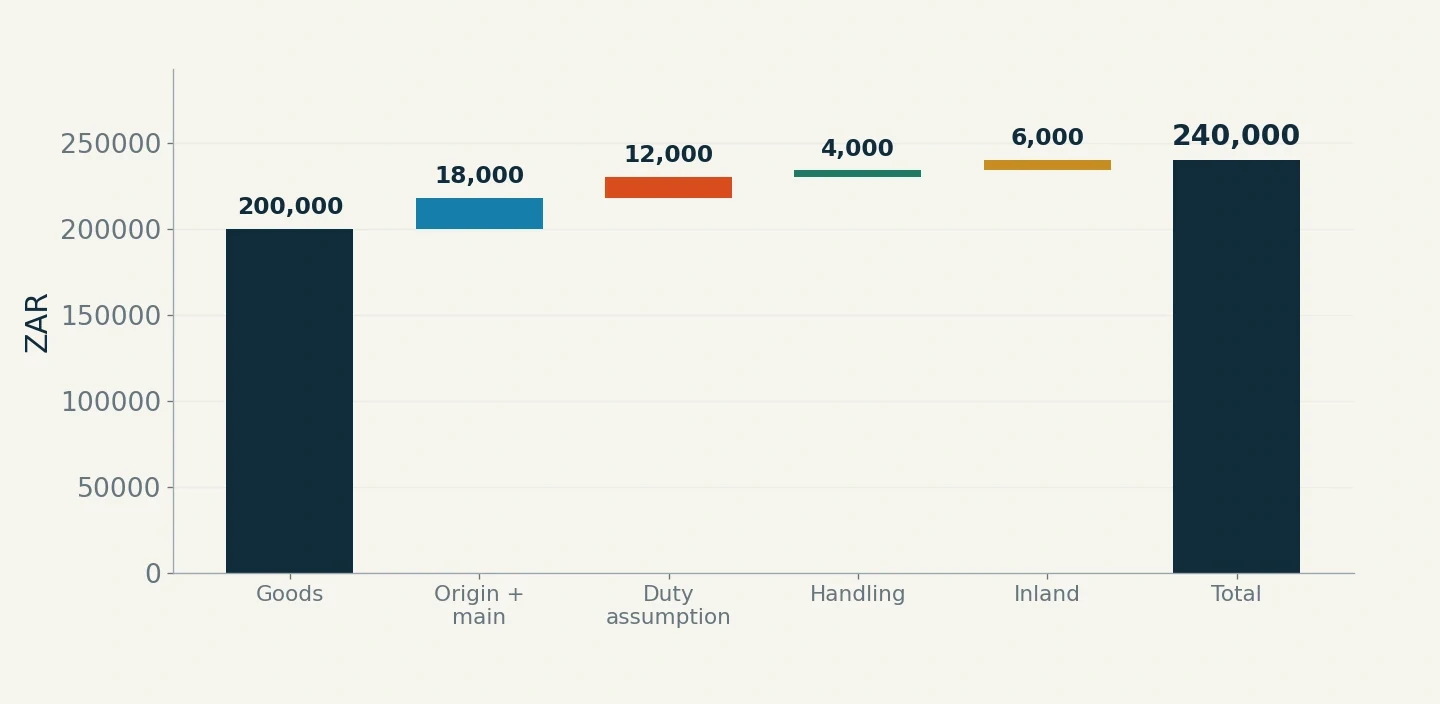
Illustrative budget, not market rates. Assume goods cost R200,000, origin and main transport R18,000, non-recoverable duty R12,000, clearing/handling R4,000 and inland delivery R6,000. Assume an accountant has approved those components for this planning comparison. The cost view before recoverable import VAT is R240,000. The figures are deliberately simple so a reader can audit the arithmetic.
| Illustrative component | Amount (ZAR) | Running total (ZAR) |
|---|---|---|
| Goods | 200000 | 200000 |
| Origin + main movement | 18000 | 218000 |
| Assumed non-recoverable duty | 12000 | 230000 |
| Clearing/handling | 4000 | 234000 |
| Inland delivery | 6000 | 240000 |
| Component | Amount (ZAR) |
|---|---|
| Goods | 200,000 |
| Origin + main | 18,000 |
| Duty assumption | 12,000 |
| Handling | 4,000 |
| Inland | 6,000 |
| Total | 240,000 |
The R6,000 inland truck line is 2.5% of the R240,000 illustrated total. A negotiation that saves R500 on that line would change the total by R500, not by the percentage shown against truck cost alone. That is why procurement should compare complete, equivalent outcomes before celebrating a low transport rate.
Do not copy this example into a customs declaration. The customs value is not automatically the sum of every delivery-budget line. Product classification, origin, valuation, rebates and procedure require the real documents and the appointed specialist’s review.
Separate the cash bridge from the cost bridge
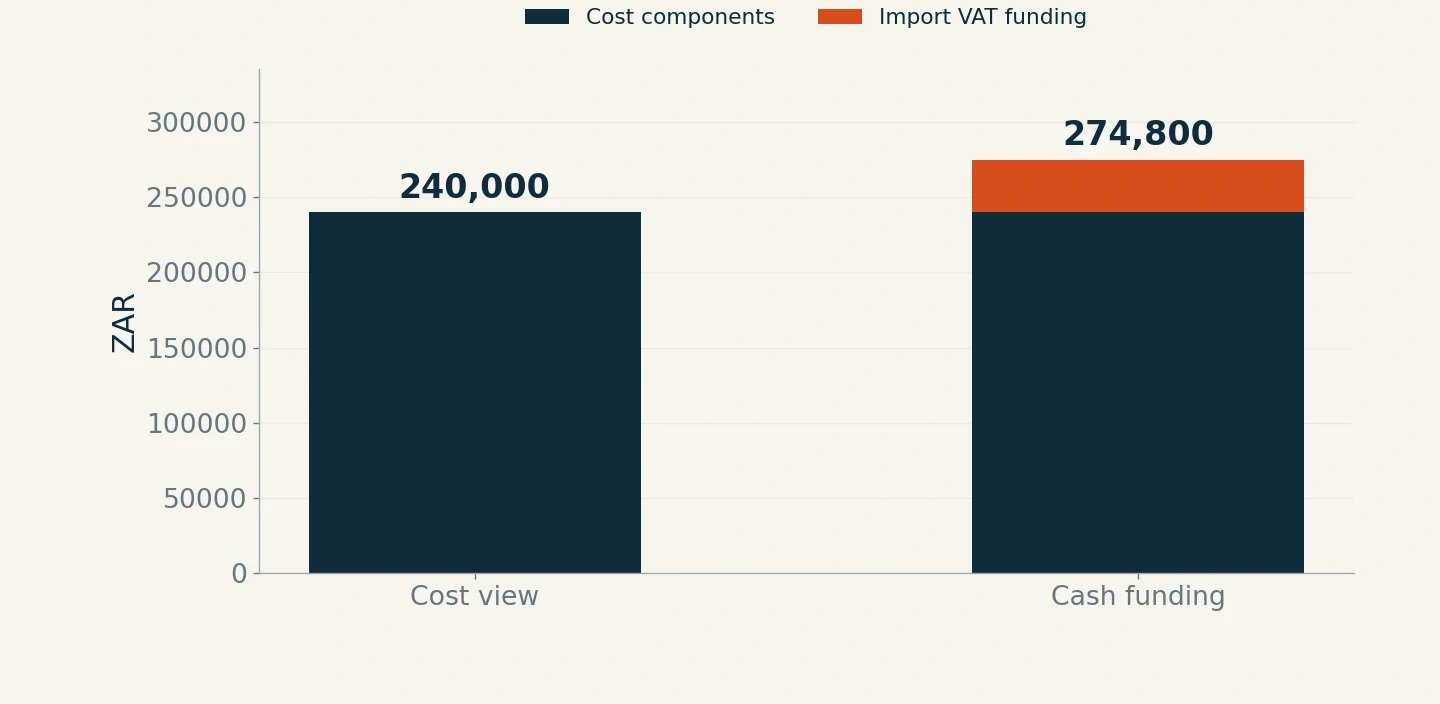
Suppose the same illustrative shipment requires R34,800 of import VAT funding before release. That number is used here solely to demonstrate cash flow; the dedicated import VAT article shows a separate assumed customs-value calculation. If R240,000 of costs and R34,800 of VAT must all be funded before customers pay, the illustrated cash requirement reaches R274,800.
| View | Cost components (ZAR) | Import VAT funding (ZAR) | Total (ZAR) |
|---|---|---|---|
| Cost view | 240,000 | none shown | 240,000 |
| Cash funding | 240,000 | 34,800 | 274,800 |
A VAT-registered importer does not receive an automatic cash refund the moment goods arrive. The SARS VAT 404, Guide for Vendors, Issue 15 explains conditions and supporting evidence for input-tax deductions. Ask finance to confirm the entity entitled to deduct, the documents held and the expected treatment. A shipping agent’s invoice and the importer’s Customs tax record have different roles.
The treasury question is practical: who pays which amount, on what date, and what stops if it is not paid? If the clearing owner uses a deferment arrangement, record the agreed reimbursement date. If the importer must prefund, obtain the verified amount early enough to avoid an avoidable payment hold.
Price the unknowns as scenarios
Do not label an uncertain charge zero. Use “not yet quoted” and name the person who must close it. A possible inspection cost, an unconfirmed unloading method and a container-return instruction are different uncertainties; they deserve different actions. A generic contingency percentage can mask all three without solving any of them.
Create a base case and a defined stress case. For example, a shipment can have a quoted normal delivery price and a separately quoted cost if the receiver cannot unload within the agreed time. Use the supplier’s actual trigger and rate. If no rate is available, leave the scenario unpriced rather than inventing a South African market benchmark.
For containerised cargo, read the carrier and terminal terms rather than assuming a truck quotation covers equipment time. Maersk: Terms for Detention and Demurrage distinguishes storage, demurrage and detention. The amount and clock for your shipment require the actual agreement and current local terms.
Use a budget you can reconcile after delivery
| Worksheet column | Purpose |
|---|---|
| Component + supplier | Who issued the charge and what it covers |
| Currency + amount + tax basis | Makes arithmetic comparable |
| Included in which contract? | Prevents double counting |
| Evidence/reference | Quote, invoice, declaration or receipt |
| Payment due / release dependency | Exposes cash constraints |
| Cost treatment owner | Finance confirms tax/accounting treatment |
| Budget / actual / variance reason | Turns a delivery into useful next-shipment evidence |
When actual cost differs, record the reason before changing the next budget. “Transport expensive” is not actionable. “Second delivery attempt because the forklift was unavailable” identifies a receiving-site control that can be changed. Keep the commercial decision connected to the physical event.
The strongest landed-cost comparison is one another person can reproduce from the same evidence. If a line depends on a phone promise, get it confirmed. If a tax assumption is unresolved, mark the limitation. A complete, qualified budget is more useful than a precise-looking total built on missing scope.
Questions shippers ask
Is landed cost the same as the freight rate?
No. Freight is one component. State the delivery endpoint and include the relevant purchase, handling, duty and delivery components without double counting.
Should import VAT be included in landed cost?
Show import VAT separately and ask finance to determine whether it is deductible and how it should be treated. Even potentially deductible VAT can create a cash-funding requirement.
Can I use one duty percentage for every product?
No. The duty position depends on the actual goods, classification, origin, procedure and any applicable relief. Obtain the shipment-specific assessment.
Why compare cash and cost separately?
A payment can be needed before release even when it is not expected to remain a permanent cost. Separate views stop a funding gap being hidden by an accounting assumption.
Use this with the rest of the library
Follow the practical next step: Freight Quote Exclusions: Find the Charges Outside the Headline Rate; Import VAT Cash Flow: Separate Tax Funding from Freight Cost; Freight Cost Allocation: Divide a Mixed Shipment Without Hiding Losses.
For the carrier’s side of the same commercial conversation, Kweli: Use your own trip records before growing the fleet explains why complete-trip records matter. Compare that operating perspective with the shipper budget here; neither is a substitute for the other’s evidence.
For the operating handoff, also use How to compare road freight quotes; How to reconcile a road freight invoice. If you need help scoping a shipment, send Synesys the collection, delivery and cargo details.
Sources and method
The external sources below support the rules or carrier terms cited in this article. The worksheets, decision methods and labelled examples are original Synesys educational analysis. They are not measured customer outcomes or market price benchmarks. Confirm the actual declaration, contract and shipment dates before relying on a numerical example.
- IFRS Foundation: IAS 2 Inventories
- SARS: Duties and Taxes for Importers
- SARS VAT 404, Guide for Vendors, Issue 15
- Maersk: Terms for Detention and Demurrage
- Kweli: Use your own trip records before growing the fleet
Continue with this topic
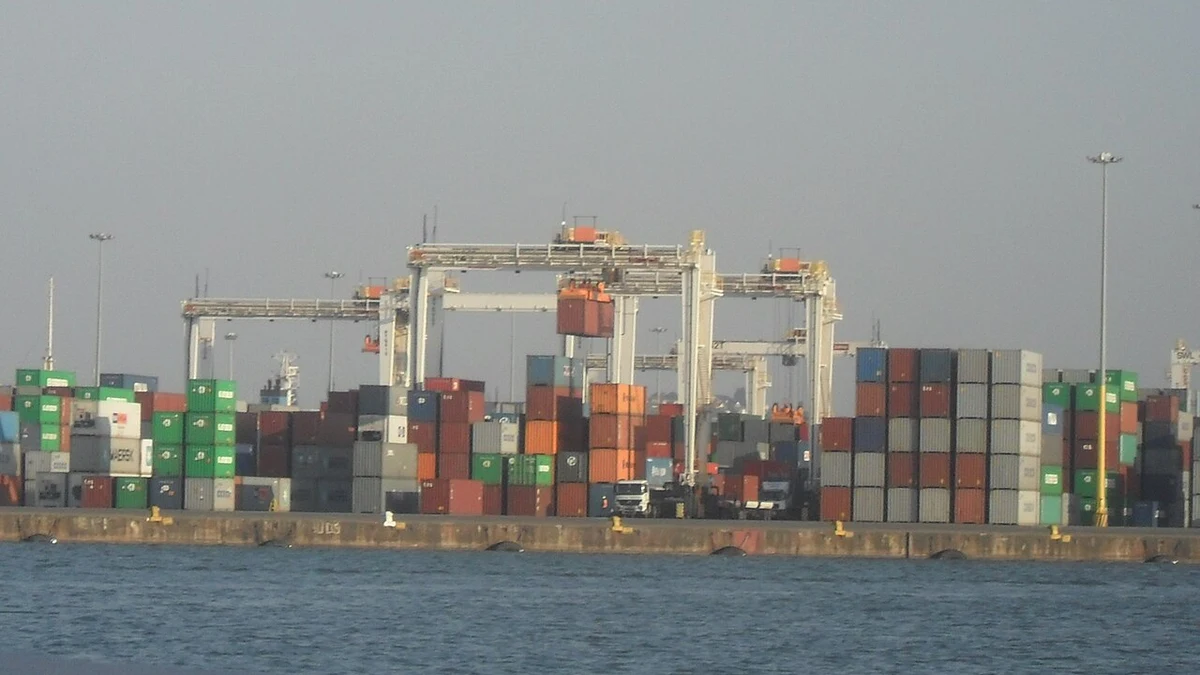
Container handling at the Port of Durban, July 2010. Archive photograph, not a live terminal-status report. Photo: Christophe Badoux / CC BY-SA 3.0. Cropped and resized. This is documentary stock imagery, not a claim that Synesys owns the pictured facility, vehicle or shipment.