

Freight ETA confidence describes how strongly the available evidence supports a delivery window. A truck position is one observation. Clearance, safe onward movement and the receiving slot still need confirmation before a dispatcher can turn that position into a credible arrival commitment.
Last verified: 17 November 2026. All journey records and time budgets below are illustrative training data, not Synesys operating results or a prediction for a named corridor.
In this guide
Freight ETA confidence: give a window and its conditions
Suppose a Durban collection has been released but the truck has not yet gated out. “Arrival tomorrow morning” hides the starting point. State the event instead: “The estimate begins at confirmed terminal gate-out. The receiver’s morning slot is requested, not yet confirmed.” That gives the cargo owner something concrete to verify.
Report freight ETA confidence with three fields together: arrival window, evidence time and next decision. A fresh position can coexist with an old customs assumption. Conversely, release may be confirmed while the device has stopped transmitting. Ask which missing event could materially change the estimate rather than treating every update as equally informative.
Use trip history with the same start and finish
For a repeat lane, define the measurement before collecting the sample. Gate-out to receiving gate-in measures a different interval from cargo-ready to unloading complete. Include incomplete and disrupted trips in the exception record; quietly deleting them makes the remaining sample look more reliable than the service actually was.
| Trip | Elapsed hours | Trip | Elapsed hours |
|---|---|---|---|
| 1 | 18 | 6 | 22 |
| 2 | 19 | 7 | 24 |
| 3 | 19 | 8 | 26 |
| 4 | 20 | 9 | 31 |
| 5 | 21 | 10 | 40 |
Download this article’s main table (CSV)
The sample median is 21.5 hours: the middle values, 21 and 22, averaged. Eight of the ten illustrative trips finish within 26 hours; nine within 31 hours. Those are descriptions of this small invented sample. Calling a new shipment “90% certain” from ten unrelated trips would go beyond the evidence.
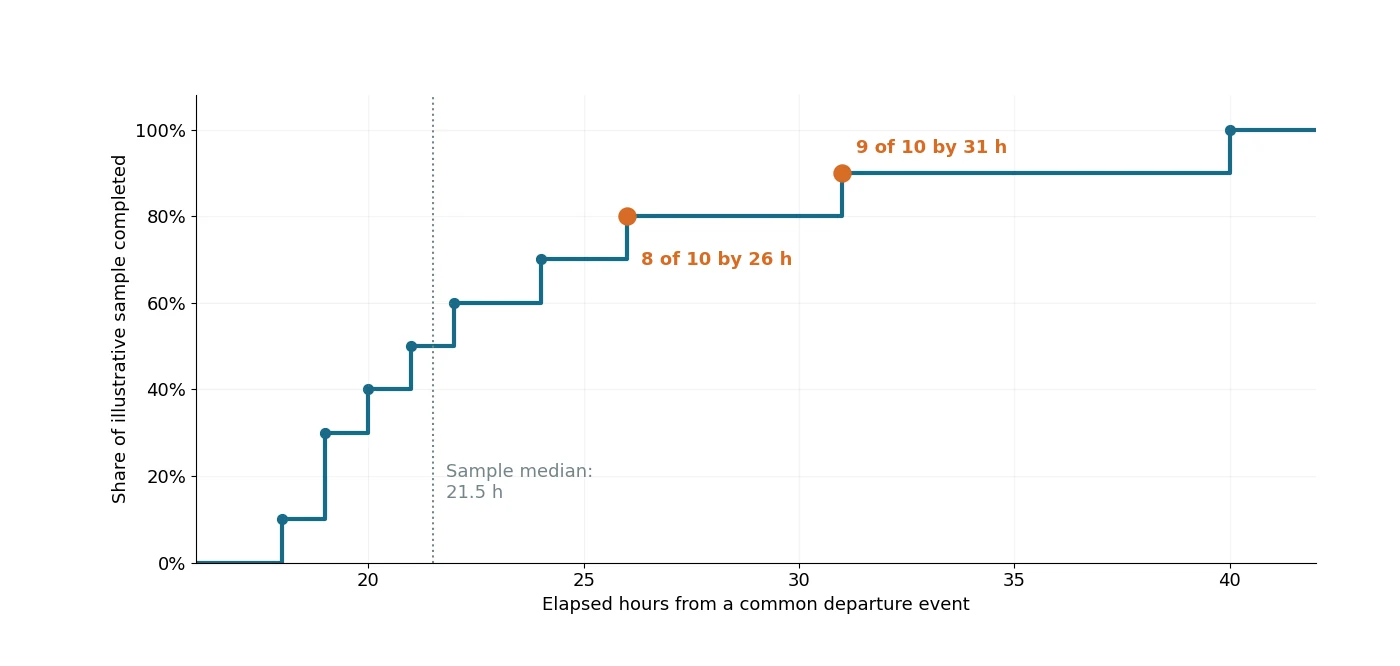
| Elapsed hours from a common departure event | Share of sample completed |
|---|---|
| 18 | 10% |
| 19 | 30% |
| 20 | 40% |
| 21 | 50% |
| 22 | 60% |
| 24 | 70% |
| 26 | 80% (8 of 10 by 26 h) |
| 31 | 90% (9 of 10 by 31 h) |
| 40 | 100% |
| Sample median | 21.5 h |
Separate the long journeys by cause. If the 40-hour observation reflects a missed appointment, examine whether the current receiving arrangement removes that constraint. Do not remove the observation simply because it is inconvenient. Record why the newer process is comparable or different, and retain the original sample for review.
Rebuild the remaining journey after a material event
Reassess freight ETA confidence when the estimate’s assumptions change. In a second illustrative case, start at 08:00 after a confirmed handoff. The remaining movement budget is three hours, check-in one hour, unloading two hours and paperwork one hour. Arrival at the gate is 11:00; unloading completes at 14:00; documentation closes at 15:00. Those are separate milestones, not three interchangeable delivery times.
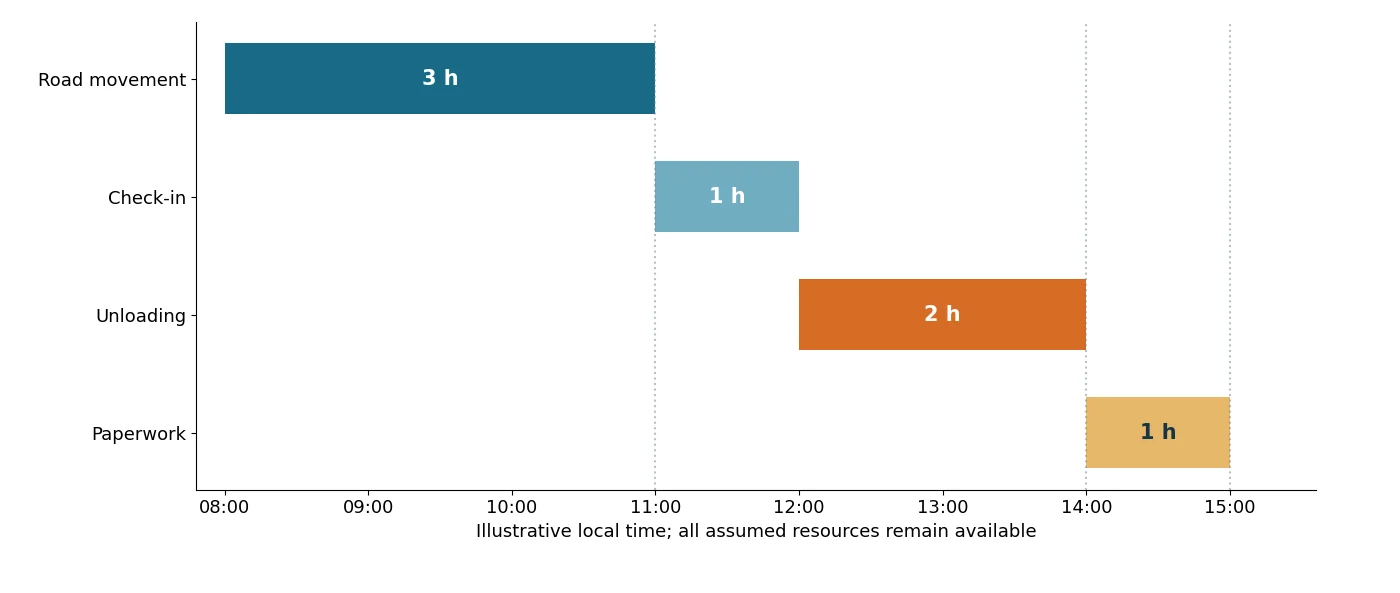
| Step | From | To | Duration |
|---|---|---|---|
| Road movement | 08:00 | 11:00 (gate arrival) | 3 h |
| Check-in | 11:00 | 12:00 | 1 h |
| Unloading | 12:00 | 14:00 (unloading complete) | 2 h |
| Paperwork | 14:00 | 15:00 (paperwork complete) | 1 h |
If gate-in slips to 12:30, ask whether the unloading crew and equipment are still available. Adding 90 minutes mechanically to every later milestone assumes the downstream resources remain available. A missed slot may create a much larger delay. The missed delivery slot guide explains the operational handoff to make next.
A real forecasting example, with its limits
The CSIR’s 12 August 2026 PortOps report describes pilot operability predictions achieving up to 85% accuracy between September 2025 and January 2026. This is a single-sourced result for that pilot, not truck ETA accuracy. CSIR engineer Johan Kieviet cautions: “forecasts remain subject to uncertainty.”
That distinction matters to a Cape Town cargo owner. A model predicting when wind may permit terminal operations is not a confirmation that a particular container is released, accessible and allocated a truck slot. Ask what event a forecast predicts and what the accuracy measure counts as correct before using its percentage in a customer promise.
The World Bank’s 2023 logistics release likewise discusses system reliability across borders. Neither that report nor the CSIR pilot supplies a universal transit-time allowance for a Durban–Johannesburg truck. Match each source to the decision it can actually support.
Write a useful arrival update
Use a freight ETA confidence record in your dispatch sheet: confirmed event and timestamp; current arrival window; assumptions still open; next evidence expected; receiver action needed; update owner. For a Johannesburg delivery, the receiver might need an answer before 13:00 to retain a crew. Put that decision deadline ahead of the next routine position message.
An example update might read: “Terminal gate-out confirmed at 08:00. Gate arrival planned 11:00–12:00, subject to the operator’s safe journey plan. Receiver has confirmed acceptance until 12:00. We will update after the next agreed handoff, or immediately if that window is no longer credible.” This is illustrative wording, not a status for a real load.
For a freight ETA confidence update, keep personal tracking data within the people authorised for the job. The cargo owner needs a useful status, not an unnecessary stream of driver location history. See writing a freight exception update for a concise incident record, and freight disruption contingency for decisions that need approval.
Build the delivery promise into the route plan
Return to the SADC freight route planning pillar when a different crossing or port changes the handoffs. Use alternative port routing when marine and inland decisions interact. Kweli’s driver-to-dispatch message guide supplies the operator’s side of the same information exchange.
Freight ETA confidence questions
Does live tracking make the delivery time certain?
No. A position shows where a device was observed. It does not establish customs release, safe road access, unloading capacity or an accepted receiver appointment. Identify the next unresolved event that could change the window.
Should I quote the average or the median?
First state what period you measured and show the distribution. The median describes the middle observation; an average is sensitive to long trips. Neither alone explains whether the next shipment can meet a fixed appointment. Retain exceptions and explain them.
When should the customer receive an update?
After a material confirmed event, when an assumption fails, or before the customer’s next decision deadline. Agree those triggers before departure. A scheduled message that arrives after the receiver has released its crew is too late to protect the slot.
Sources and verification
- CSIR: PortOps tool to aid Port of Cape Town’s wind woes, 12 August 2026 — checked 17 November 2026.
- World Bank: Logistics Performance Index 2023 release, 21 April 2023 — checked 17 November 2026.
- driver-to-dispatch message guide — checked 17 November 2026.
Continue with this topic
A container truck on Kenya’s Mai-Mahiu road, October 2026. International archive freight illustration, not a measured SADC transit journey. Photo: VickyOmondi / CC0. Cropped and resized. This is documentary stock imagery, not a claim that Synesys owns the pictured facility, vehicle or shipment.