

Axle weight distribution depends on where the load sits, not just how much it weighs. Moving cargo can increase one axle-group load while reducing another. Confirm the actual vehicle’s limits and distribution requirements; a legal total mass does not prove every axle is legal.
Last verified: 17 November 2026. South African shipper education; verify the actual shipment, contract, policy and destination requirements before dispatch.
In this guide
Why axle weight distribution changes with position
A dense crate near the rear of a loading area does not act like the same crate near the front. Its position changes the reactions carried by the vehicle’s supports. Real trucks add tare mass, suspension behaviour, coupling geometry and axle groups, so an internet sketch cannot establish the actual axle loads.
The IMO/ILO/UNECE CTU Code includes centre-of-gravity calculations and distribution guidance. South African road freight compliance guidance separately identifies permissible axle masses and securing. The sources support the need for both checks; this guide deliberately does not publish one generic axle-limit table for all combinations.
A simple model that exposes the mistake
Illustrative mechanics, not an actual truck. Consider a simply supported beam with supports 6.0 m apart and a 10 t point load. Put the load 2.0 m from the left support: its contribution is 10 × 4/6 = 6.67 t at the left and 10 × 2/6 = 3.33 t at the right, rounded to two decimals. The contributions still add to 10 t.
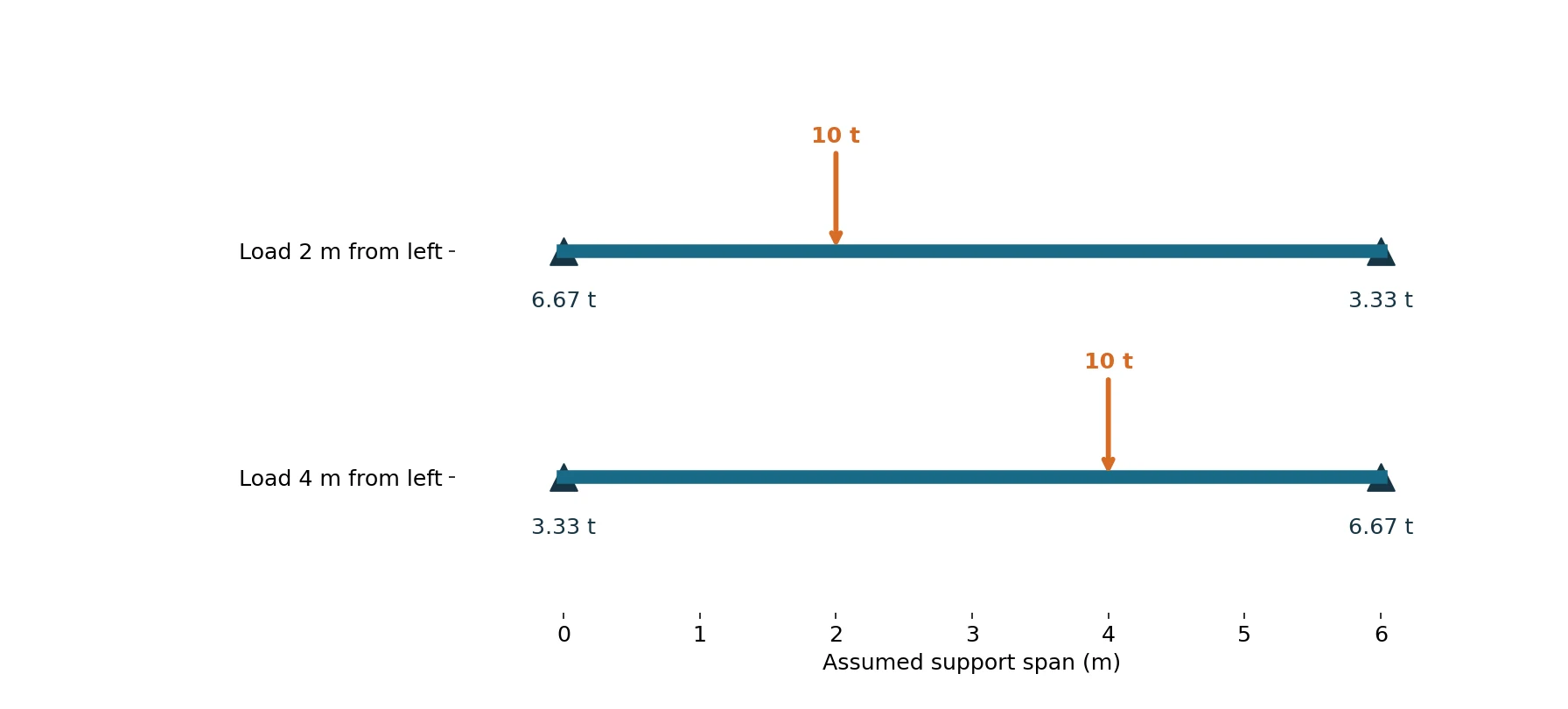
| Load position | Left support (t) | Right support (t) |
|---|---|---|
| 2 m from left | 6.67 | 3.33 |
| 4 m from left | 3.33 | 6.67 |
Move that same load to 4.0 m from the left support and the contributions reverse. Nothing has been added to the beam, yet the right support now carries more. This is why a weighbridge total alone cannot establish axle weight distribution. The beam omits the vehicle’s own mass and is not a substitute for a competent axle assessment.
Do not label those calculated reactions as steer, drive or trailer-axle loads. The diagram has only two abstract supports. Axle weight distribution on a real combination must be checked using its actual dimensions, masses and operator-approved information, then verified by the appropriate method before the vehicle is released.
Real published data: a CTU teaching example
The CTU Code’s 2014 Annex 7 Appendix 4 provides the following worked dataset. It is single-sourced published teaching data, not measured Synesys operations or a road vehicle’s permitted loading envelope. Each package group contributes its mass multiplied by its distance from the front of the stowage area.
| Group | Mass (t) | Distance (m) | Mass × distance (t·m) |
|---|---|---|---|
| 1 | 3.5 | 0.7 | 2.45 |
| 2 | 4.2 | 1.4 | 5.88 |
| 3 | 3.7 | 3.0 | 11.10 |
| 4 | 2.2 | 3.8 | 8.36 |
| 5 | 4.9 | 5.1 | 24.99 |
| Total | 18.5 | — | 52.78 |
Download this article’s main table (CSV)
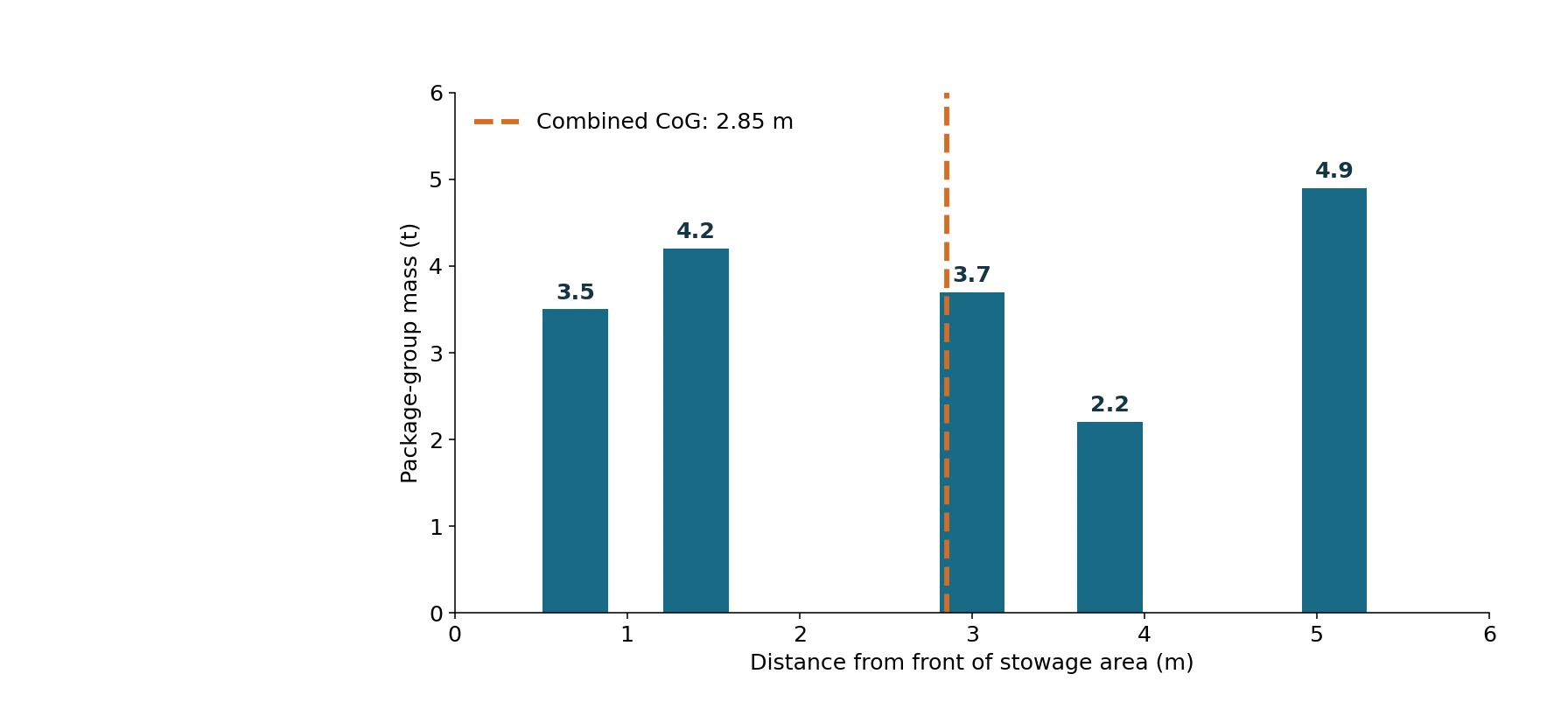
| Distance from front (m) | Package-group mass (t) |
|---|---|
| 0.7 | 3.5 |
| 1.4 | 4.2 |
| 3.0 | 3.7 |
| 3.8 | 2.2 |
| 5.1 | 4.9 |
| Combined centre of gravity | 2.85 m |
Divide 52.78 t·m by 18.5 t to obtain approximately 2.85 m. That locates the combined longitudinal centre of gravity in the teaching example. It does not say the cargo is permitted on your trailer. The answer must be compared with the applicable axle weight distribution requirements for the actual equipment.
Recheck after the first delivery
A multi-stop load changes when packages leave the vehicle. Removing rear packages can move the centre of gravity forward; removing front packages can move it rearward. An axle weight distribution check that only considers departure may miss a later configuration. Identify the remaining units and their positions after each stop.
Ask the operator to confirm the sequence before dispatch. If a receiver refuses a unit, the load on board is different from the planned state. Treat the refusal as a planning change, not merely a document exception. Use the broader truck load planning guide to keep footprint, handling and route constraints in the same discussion.
For a cross-border movement, verify the requirements in the destination and transit jurisdictions as well as South Africa. The Road Freight Association’s abnormal-load resources point to TRH11 and provincial material for abnormal operators. An exemption permit process is not a way to retrospectively legitimise an ordinary overloaded load.
What to give the competent operator
| Input | Why it matters |
|---|---|
| Actual combination | Identifies vehicle/trailer and configuration |
| Tare and equipment information | Separates the vehicle’s own mass from cargo contribution |
| Individual package masses | Prevents a misleading average from hiding dense units |
| Package positions and CoG information | Connects mass to distribution |
| Stop sequence and partial-load states | Shows the configurations after each delivery |
| Verification record | Captures the final approved plan and the method used to check it |
Do not move dense units around on intuition at the gate. Obtain instructions from the responsible competent operator and record the revised arrangement. The pallet loading plan and capacity-measure comparison explain the space side of the same decision. The body selection guide helps check handling access.
A useful dispatch record states what was actually loaded and what was checked. “Under payload” is an incomplete statement if nobody checked axle weight distribution. Keep uncertainty visible and identify who can resolve it before release.
Questions shippers ask
Can I fix an axle overload by moving cargo?
Position can change the distribution, but a competent assessment of the actual vehicle is required. Moving cargo may create another overload or a securing problem. Do not use the abstract beam example as an instruction for a real truck.
Is the CTU centre-of-gravity example a legal limit?
No. It is a published calculation showing how to find a combined centre of gravity. The actual equipment and applicable legal requirements determine whether a proposed load is acceptable.
Must distribution be checked after part delivery?
Recheck axle weight distribution for each remaining-load state with the operator. The cargo position and mass can change after unloading, a refused delivery or a substituted unit, so the departure configuration alone may not describe the whole trip.
Continue in this learning cluster
Use the related guides when the next decision becomes specific:
- Truck Load Planning: Match Weight, Space and Site Access
- Pallet Loading Plan: Test the Footprint Before Confirming Capacity
- Loading Metres vs Cubic Metres: Which Capacity Measure Fits Your Freight?
Bring the completed worksheet and your actual shipment details to a freight conversation with Synesys. This guide helps prepare the decision; it does not promise an insurance outcome, legal approval or transport availability.
Sources and verification
- IMO/ILO/UNECE CTU Code, 2014, Annex 7 Appendix 4 — checked 17 November 2026.
- Road freight compliance in South Africa — checked 17 November 2026.
- RFA resources for abnormal-load operators — checked 17 November 2026.
The examples and visuals are original Synesys teaching models. Illustrative figures are deliberately separated from sourced facts and must not be used as tariffs, actual claim settlements or legal vehicle capacities.
Continue with this topic
A fuel truck at Serule, Botswana, March 2020. Archive photograph, not a legal axle-load example. Photo: Thabang S. Peter / CC BY-SA 4.0. Cropped and resized. This is documentary stock imagery, not a claim that Synesys owns the pictured facility, vehicle or shipment.