

Truck load planning must pass separate tests for mass, axle distribution, footprint, height, securing and site access. A load that fits the quoted pallet count can still be unsuitable. Give the operator measured package details before a truck is confirmed.
Last verified: 17 November 2026. South African shipper education; verify the actual shipment, contract, policy and destination requirements before dispatch.
In this guide
Truck load planning begins with the packages
“Ten pallets to Durban” is not a complete load brief. The transporter needs the external dimensions of the loaded units, their individual masses, whether they can be stacked, how they may be handled and the actual collection and receiving constraints. A pallet label does not reveal overhanging cartons or a top-heavy machine.
Measure the loaded unit, including packaging, projections and protective frames. Keep the package identifier attached to the measurement. If a mixed consignment has different unit sizes, do not replace them with one average pallet. The odd package is often the one that changes the truck, handling method or loading order.
The IMO/ILO/UNECE CTU Code’s supply-chain responsibilities emphasise communicating package information and unusual characteristics to the packer and carrier. The local planning implication is practical: the shipper should describe the cargo accurately, and the operator should confirm a suitable vehicle and loading arrangement. One party should not guess what the other party knows.
Treat capacity as several constraints
| Constraint | What to provide | What the operator must resolve |
|---|---|---|
| Total mass | Package masses and packing/securing material | Vehicle, trailer, registration and route limits |
| Axle distribution | Individual masses and planned positions | Acceptable distribution on the actual combination |
| Deck footprint | Loaded length and width, including overhang | Fit, loading order, clearances and securing space |
| Height | Loaded-unit height and handling clearances | Door, body, overhead and route clearance |
| Handling | Fork pockets, lift points and access needs | Equipment suitability and safe handling method |
| Receiving site | Gate, turning, surface, dock and appointment details | Vehicle access and unloading arrangement |
Download this article’s main table (CSV)
A trailer’s advertised payload is not a release instruction. Ask for the actual combination and the limiting requirement on the proposed route. A vehicle can be under its total mass ceiling while a particular axle group is overloaded. The South African road freight compliance guidance identifies permissible axle masses and load securing as separate matters to check.
Do not rely on a generic “SADC payload” number. A South African domestic movement and a cross-border journey can face different requirements. Obtain competent operator confirmation for each country and any route restriction that applies; for an abnormal move, use the relevant authority’s permit process rather than treating an ordinary quote as permission.
Use a footprint drawing to expose assumptions
Illustrative geometry, not a truck specification. Assume a perfectly rectangular deck 6.0 m long and 2.4 m wide. Assume each loaded pallet footprint is exactly 1.0 m by 1.2 m with no overhang. Two units fit across the width and six rows fit along the length, giving 12 floor positions before any operational allowance.
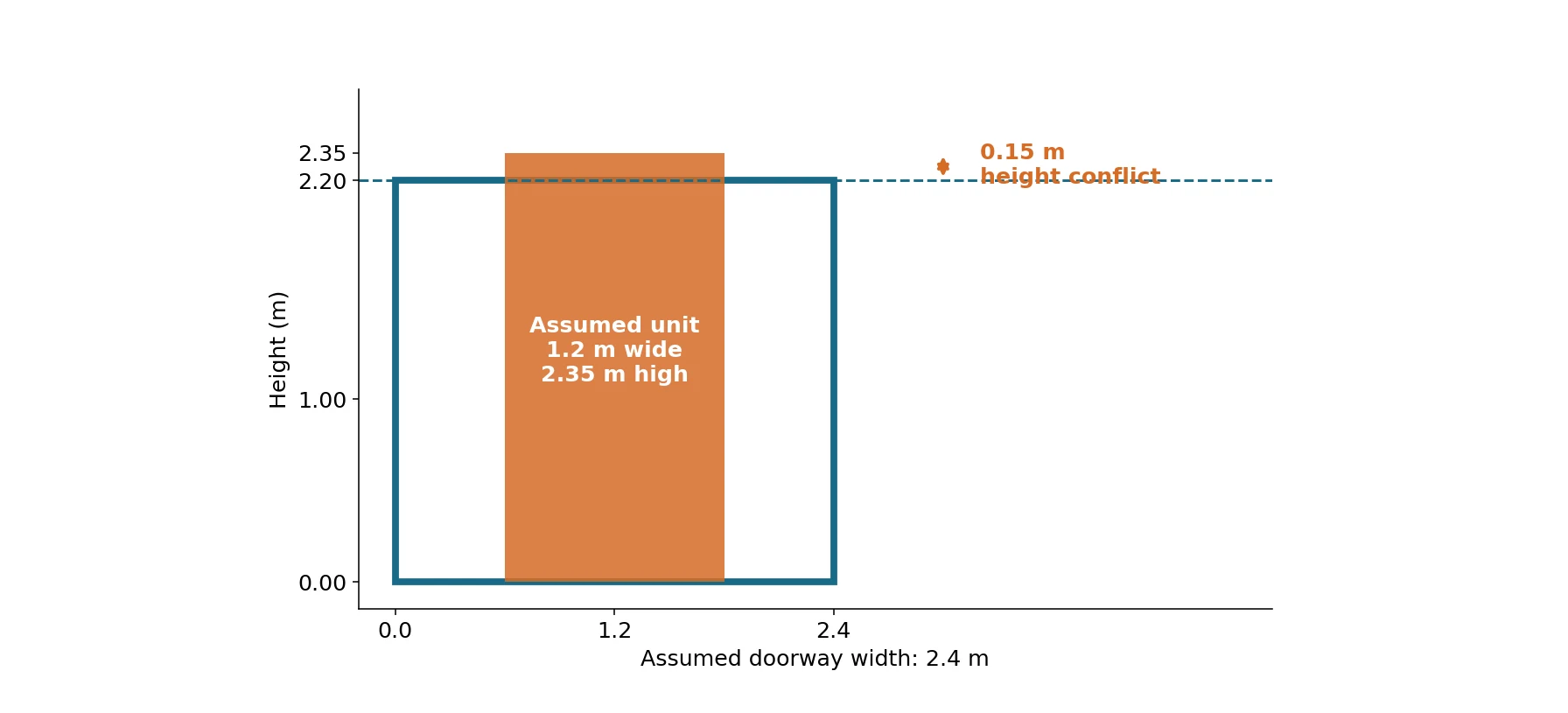
| Item | Width (m) | Height (m) |
|---|---|---|
| Assumed doorway | 2.4 | 2.20 |
| Assumed unit | 1.2 | 2.35 |
| Height conflict | 0.15 |
That calculation is a ceiling within the assumptions, not a booking guarantee. Real units may need gaps for securing, their packaging may project, the doorway may be narrower than the internal body or the receiver may need access to particular units. Record the deductions. A competent loading plan should show why a theoretical space is unavailable rather than quietly ignoring it.
If the first delivery needs a pallet at the front, consider how the crew will reach it. A geometric fit that requires unsafe handling or unnecessary unloading at an intermediate stop is not a useful plan. Mark delivery sequence and unit identifiers on the drawing, then confirm the handling method with the operator and receiver.
The separate doorway illustration assumes a 2.4 m wide, 2.2 m high opening and a unit 1.2 m wide by 2.35 m high. The width fits but the unit exceeds the opening by 0.15 m. These invented dimensions expose a different constraint; they are not dimensions of a quoted vehicle.
Add mass and distribution to the drawing
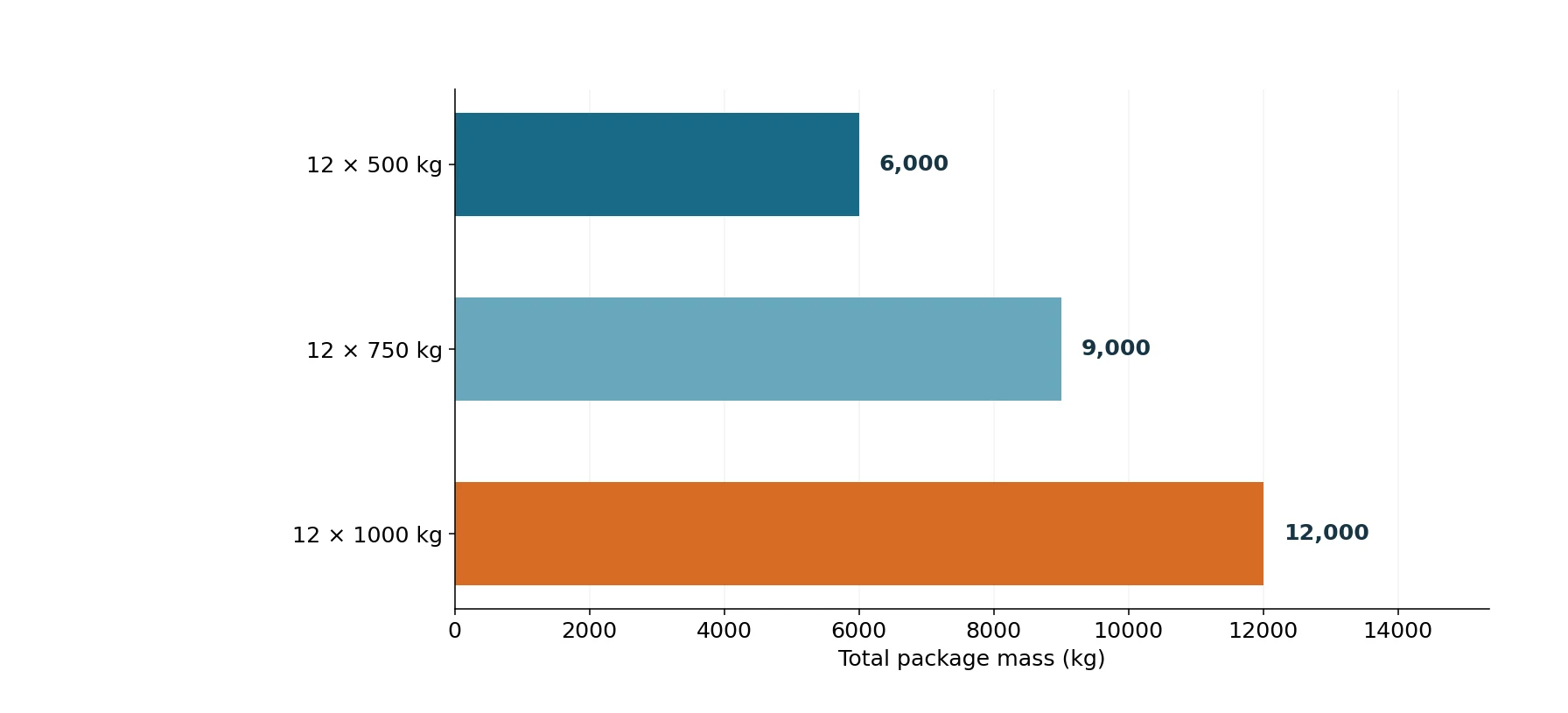
The same 12 footprints can contain very different goods. In the illustrative model, packages averaging 500 kg total 6000 kg; at 750 kg they total 9000 kg; at 1000 kg they total 12000 kg. None of those totals says that the assumed vehicle is legally permitted to carry the load. They simply show why “12 pallets” is not enough information.
| Packages | Total package mass (kg) |
|---|---|
| 12 × 500 kg | 6,000 |
| 12 × 750 kg | 9,000 |
| 12 × 1000 kg | 12,000 |
Use individual masses when units differ. Identify dense or offset loads and tell the operator where the centre of gravity is located if known. The CTU Code discusses load distribution and the importance of centre-of-gravity position. Its guidance does not replace the actual vehicle manufacturer’s distribution information, securing design or national law.
Ask how the operator will verify the final load. A plan may need to change when a package is added, moved or removed. A partial delivery also changes distribution. Keep the revised plan with the dispatch and receiving records; the final arrangement matters more than the version attached to the first quotation.
A suitable truck must also reach the cargo
Before selecting a body, confirm whether loading is from the side, rear or above and what equipment is available at both ends. A receiver with a rear dock may not be able to unload a unit requiring side access. A crane lift needs more detail than a note saying “forklift available”. Use the truck-body guide for that decision.
Ask the receiving site to verify the usable entrance, turning space, surface and unloading point. Do not accept a passenger-car map route as evidence that a loaded combination can enter. A Boksburg warehouse that accommodated the previous rigid truck may not accommodate the longer combination proposed for today’s shipment.
For a cross-border load, combine the vehicle plan with the document brief and the actual route decision. An equipment change made to solve floor space can affect clearance records, appointments or unloading equipment. Assign one person to communicate the final change to all relevant parties.
A release-ready load planning worksheet
| Package ID | Loaded L × W × H (m) | Gross package mass (kg) | Stackable? | Handling/access | Stop sequence |
|---|---|---|---|---|---|
| Enter each unit | Include packaging and overhang | Use measured or supported mass | State conditions, not a guess | Fork pockets/lift points/fragility | Identify the receiving stop |
| Packing and securing | Show additional footprint | Add relevant mass | Not applicable | Identify who provides it | Confirm removal at delivery |
Below the unit list, record the actual vehicle combination, usable body dimensions, operator-approved distribution, securing approach, access checks and outstanding questions. If an answer is missing, keep the question visible. “To be confirmed” is a task, not a passed check.
The supporting guides separate pallet footprint layout, axle weight distribution and loading metres versus cubic metres. Use them to prepare better information for a competent operator; do not turn a simplified teaching calculation into a self-issued loading approval.
Before release, compare the physical load against the final list. Count units, check visible packaging and record agreed exceptions. The pallet measurement guide helps remove ambiguity at quotation stage. A plan only adds value when it still describes what is on the vehicle.
Questions shippers ask
How many pallets fit on a truck?
There is no useful answer without the actual body dimensions, loaded pallet footprints, masses, stacking constraints and securing allowance. Use the theoretical layout only as a starting point and obtain operator confirmation for the real vehicle.
Can a load be under total weight but overload an axle?
Yes. Position changes how mass is carried by the vehicle’s support groups. Check the actual combination’s axle and distribution requirements; a total-only calculation cannot establish compliance.
Should I use standard pallet dimensions?
Use measured loaded dimensions. The pallet base can be smaller than the cartons, wrapping or protective frame above it. Identify different unit sizes rather than reporting an average.
Does a drawing replace a securing plan?
No. A footprint drawing shows space and sequence. The securing method must suit the cargo, vehicle and transport conditions and be confirmed by the responsible competent parties.
Continue in this learning cluster
Use the related guides when the next decision becomes specific:
- Axle Weight Distribution: Why Legal Total Mass Is Not Enough
- Pallet Loading Plan: Test the Footprint Before Confirming Capacity
- Loading Metres vs Cubic Metres: Which Capacity Measure Fits Your Freight?
Bring the completed worksheet and your actual shipment details to a freight conversation with Synesys. This guide helps prepare the decision; it does not promise an insurance outcome, legal approval or transport availability.
Sources and verification
- IMO/ILO/UNECE CTU Code: supply-chain responsibilities — checked 17 November 2026.
- IMO/ILO/UNECE CTU Code, 2014 — checked 17 November 2026.
- Road freight compliance in South Africa — checked 17 November 2026.
The examples and visuals are original Synesys teaching models. Illustrative figures are deliberately separated from sourced facts and must not be used as tariffs, actual claim settlements or legal vehicle capacities.
Continue with this topic
A heavy vehicle on Botswana’s A1 road, March 2020. Archive photograph; it is not a loading or permit specification. Photo: Thabang S. Peter / CC BY-SA 4.0. Cropped and resized. This is documentary stock imagery, not a claim that Synesys owns the pictured facility, vehicle or shipment.