
Cargo claim evidence should connect the loss to identifiable goods, an insured journey and a supported value. Build one consignment file with counts, condition records, transport instructions and notices; keep observations separate from allegations about cause.
Last verified: 17 November 2026. South African shipper education; verify the actual shipment, contract, policy and destination requirements before dispatch.
In this guide
Start the cargo claim evidence file with identity
A photograph of crushed wrapping may prove that wrapping was crushed. It does not, by itself, prove which invoice line was inside, when damage occurred or what the goods were worth. For cargo claim evidence, give every record a shipment reference and connect package identifiers to the packing list. A Boksburg dispatch file and a Durban receiving file should refer to the same goods.
Keep original photographs in the cargo claim evidence file, retaining the original files where possible. Record who took them, at which handover and what they show. A compressed screenshot sent through several phones can still be relevant, but identify it as a copy rather than quietly treating it as the original. Avoid publishing identity documents, driver contact details or customer invoices in a public incident post.
What belongs in an assessable file?
Club Marine’s cargo claim page requests, where applicable, damage photographs, invoices, carriage documents, packing lists and third-party correspondence. That is a real example of a provider’s evidence requirements. It is not a universal checklist of everything every insurer requires, nor a substitute for your insurer’s instructions.
| Evidence group | What it should establish | A common gap |
|---|---|---|
| Goods and value | Invoice lines, quantity, currency and supported value | Total invoice without identifying affected lines |
| Dispatch | Count, packaging condition, handling instructions and custody | A loading photo with no consignment link |
| Receiving | Package count, observed damage, time, place and sign-off | “Damaged” with no affected quantity |
| Journey | Waybill, vehicle changes, custody handovers and exceptions | Transfer between operators with no handover record |
| Notifications | Who was notified, when, how and what was requested | An unsent draft email mistaken for a notice |
| Assessment | Repair, replacement, survey or disposal instructions | Goods disposed of before instructions are obtained |
Download this article’s main table (CSV)
Keep the cargo claim evidence index short enough to use. A folder containing hundreds of unnamed files can slow an assessment. An index with a filename, creation date, author and one sentence of relevance is more useful than a polished narrative that makes claims the underlying records cannot support.
Reconcile quantities before arguing the amount
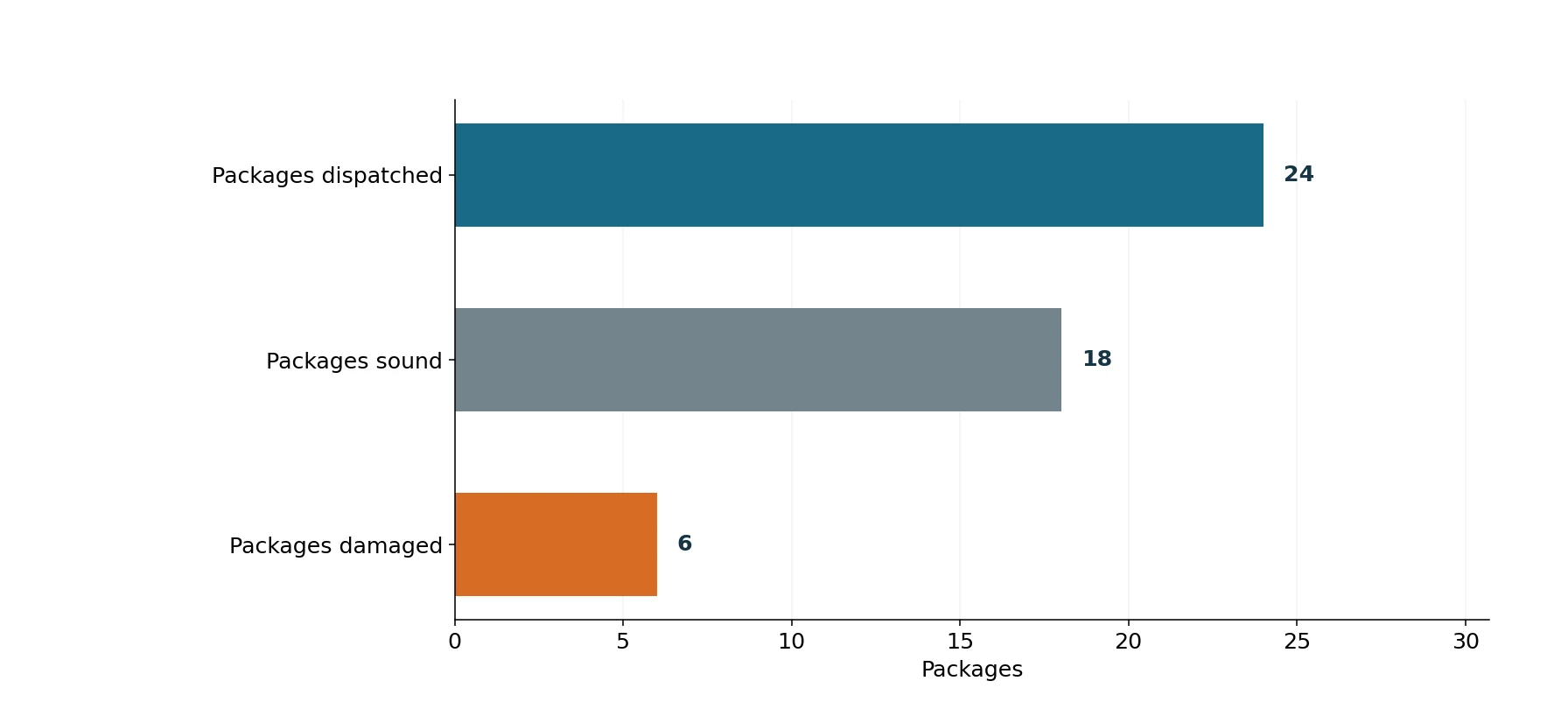
Illustrative example. A receiving team checks 24 numbered packages. It records 18 as apparently sound and 6 with visible damage. The arithmetic reconciles: 18 + 6 = 24. The team still cannot state that 25% of invoice value is lost unless package contents and loss values justify that calculation.
| Count | Packages |
|---|---|
| Packages dispatched | 24 |
| Packages sound | 18 |
| Packages damaged | 6 |
One damaged package may contain a high-value control panel while another contains replaceable fittings. Record the affected invoice lines, then distinguish damaged packaging from confirmed product damage. Ask for the competent assessment required by the insurer. Do not open hazardous or unstable cargo merely to improve a photograph.
If the receiving count is 23 rather than 24, record the discrepancy separately from damage. A shortage and a damaged unit may need different evidence. A driver’s note, a warehouse tally and a receiver’s signature can disagree; preserve all three and explain the difference instead of replacing them with one convenient version.
Build the chronology without guessing the cause
Use a chronology with the actual collection handover, transfers, arrival, inspection, discovery and notification. Label a missing timestamp as unknown. “Reported at 10:20” and “damage occurred at 10:20” are different statements. A cargo claim evidence file loses credibility when the reporting time is presented as proof of the event time.
A shared identifier makes records connect
The consignment reference connects:
- Invoice
- Packing list
- Loading record
- Waybill
- Damage photos
- Delivery exception
The immediate handover is covered in the cargo damage at delivery guide. Here, cargo claim evidence connects that handover record to the assessment. For each alleged cause, identify the supporting record and any uncertainty. An observed wet carton is a fact; blaming rain ingress during a particular transfer is a theory until evidence connects it.
Send initial notice through the channel required by the actual policy or contract and ask for a reference. Keep the sent record and acknowledgement. Do not wait to finish a perfect dossier if the notification obligation requires action now. No universal number of notice days is offered here because the applicable terms must be read.
Copy this claim evidence index
| Reference | File or record | Who created it? | What does it support? | Gap or follow-up |
|---|---|---|---|---|
| Goods | Invoice and package list | Shipper | Identity and value | Identify affected lines |
| Dispatch | Loading count and photographs | Dispatch supervisor | Condition and handover | Obtain original files |
| Receiving | Exception note and tally | Receiver | Observed condition and quantity | Explain count discrepancy |
| Journey | Waybill and handover records | Carrier | Custody and movement | Record vehicle transfer |
| Notice | Sent notification and acknowledgement | Policyholder or authorised contact | Notification record | Obtain insurer reference |
Treat the cargo claim evidence index as a working record, not a requirement to collect documents that do not exist. If a survey was not carried out, say so. If an earlier image is unavailable, identify the missing record. Do not recreate a dated loading photograph or ask someone to sign a statement about events they did not witness.
Before discussing settlement, revisit declared value and underinsurance and the difference between cargo insurance and carrier liability. Use the proof of delivery photo guidance to improve the next handover. The practical improvement is a stronger evidence trail, not a promise that a particular file will secure payment.
Questions shippers ask
Can photographs alone prove a cargo claim?
They can support observed condition, but the file also needs to identify the goods, journey, value and relevant circumstances. Ask the insurer what further records or assessment it requires.
Should I admit the carrier caused the damage?
Record observations accurately and follow the policy and contract instructions. Do not turn an untested theory into an admission. The evidence and applicable obligations need to be assessed.
Can damaged goods be thrown away?
Obtain appropriate insurer, surveyor and safety instructions before disposal or salvage action. Preserve evidence where safe and lawful, and record any urgent protective action and why it was necessary.
Continue in this learning cluster
Use the related guides when the next decision becomes specific:
- Cargo Insurance in South Africa: Cover, Liability and Claims Explained
- Goods in Transit Insurance vs Carrier Liability: What Is Actually Covered?
- Cargo Declared Value and Underinsurance: Questions to Settle Before Dispatch
Bring the completed worksheet and your actual shipment details to a freight conversation with Synesys. This guide helps prepare the decision; it does not promise an insurance outcome, legal approval or transport availability.
Sources and verification
- Club Marine Cargo Insurance Claim — checked 17 November 2026.
- Hollard Marine Insurance — checked 17 November 2026.
The examples and visuals are original Synesys teaching models. Illustrative figures are deliberately separated from sourced facts and must not be used as tariffs, actual claim settlements or legal vehicle capacities.
Continue with this topic
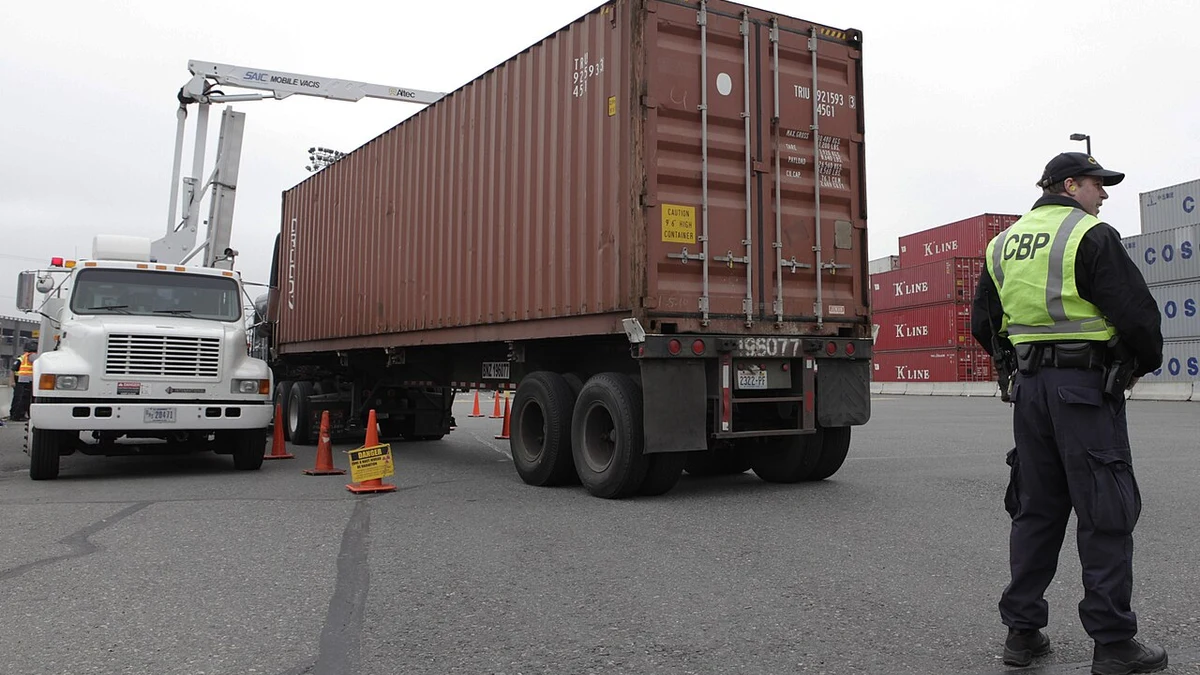
A U.S. Customs inspection setting in Seattle, September 2010. International archive illustration; this does not show an insurance claim or local customs procedure. Photo: CBP Photography / Public domain. Cropped and resized. This is documentary stock imagery, not a claim that Synesys owns the pictured facility, vehicle or shipment.