
Goods in transit insurance and carrier liability answer different questions. One concerns insured loss of goods; the other concerns a carrier’s legal responsibility. Before accepting a freight quote, establish which protection is offered and whose interest it protects.
Last verified: 17 November 2026. South African shipper education; verify the actual shipment, contract, policy and destination requirements before dispatch.
In this guide
Goods in transit insurance is not a liability promise
A Johannesburg buyer asks a transporter, “Are you insured?” The reply is yes. That exchange leaves the central issue unresolved: insured against what, for whose benefit and under which conditions? A vehicle policy, cargo policy and liability arrangement do not become the same product because one operator holds all of them.
When reviewing goods in transit insurance, write two questions on the booking file. First: what policy could respond to physical loss or damage to these goods? Second: under what contract and legal basis could the carrier be liable? The answers may connect, but they should not be collapsed into one tick box. Hollard’s marine product range provides a practical example of distinct interests being insured.
Compare the evidence behind each claim
| Issue | Cargo physical-loss question | Carrier liability question |
|---|---|---|
| Who seeks payment? | The insured party with the relevant insured interest | The party entitled to pursue the carrier |
| What must be shown? | A loss falling within the actual policy terms | Responsibility under the applicable contract and law |
| What can limit recovery? | Exclusions, excess, value basis, limits and conditions | Liability terms, defences, limits and the facts |
| What is useful evidence? | Value, condition, shipment identity, transit and event records | Those records plus instructions, custody and contractual obligations |
Download this article’s main table (CSV)
These are review prompts, not a statement that every cargo claim avoids questions of liability or that every carrier contract has an enforceable cap. If a document contains a limit, ask a competent adviser how it applies. Do not import a sea-carriage or overseas road convention limit into a South African domestic movement without checking the legal basis.
An illustrative limit comparison
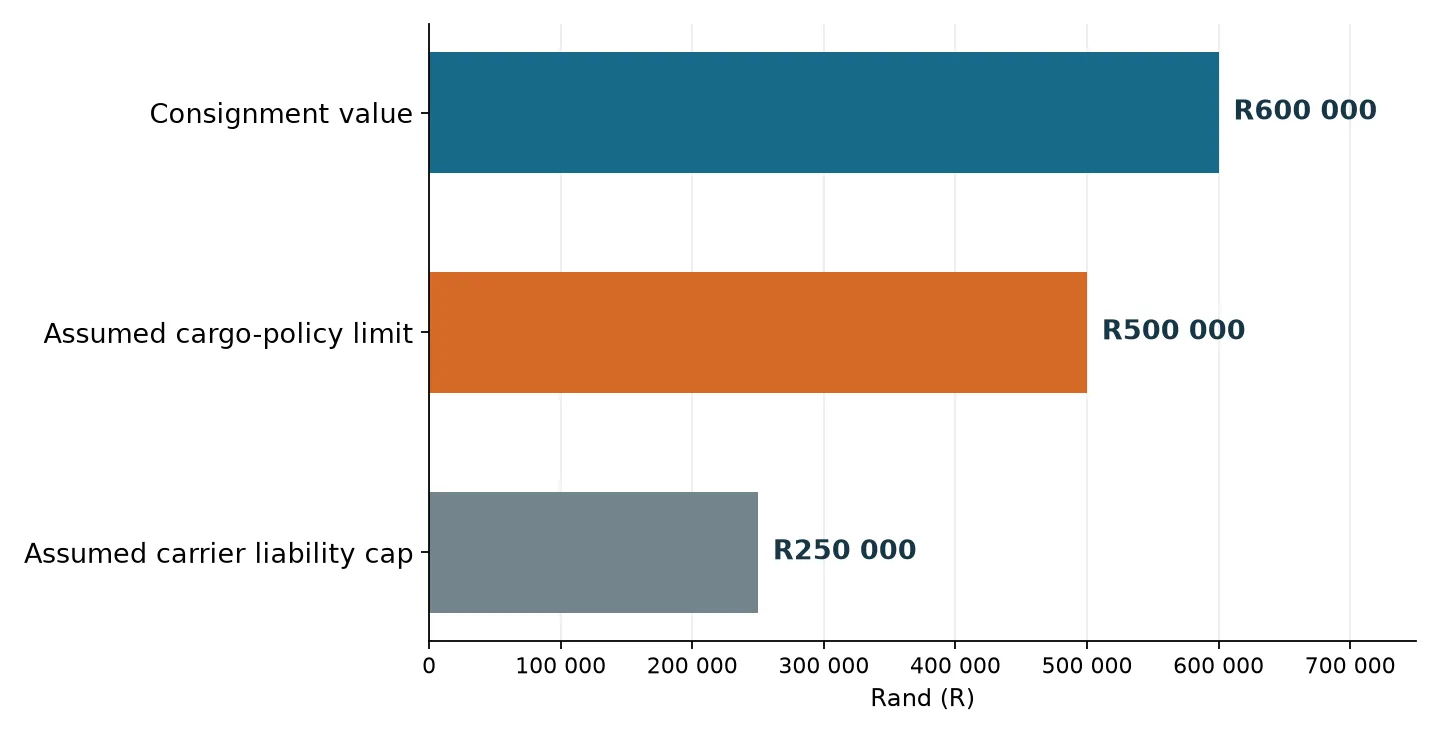
Illustrative teaching example. Suppose the consignment value is R600000, a cargo policy document shows a R500000 limit and the proposed transport contract states a R250000 liability cap. Those are three different numbers. No settlement can be calculated from them alone. The carrier cap in this example is an invented contract assumption, not a published industry rule.
| Item | Amount (rand) |
|---|---|
| Consignment value | R600000 |
| Assumed cargo-policy limit | R500000 |
| Assumed carrier liability cap | R250000 |
The point of the chart is to expose the questions. Does the goods in transit insurance policy insure the shipper’s interest? Does its valuation basis match the R600000 declaration? Is the contractual cap applicable and enforceable? Which event occurred, and was a relevant condition followed? A procurement team should request answers rather than treating the highest printed number as available compensation.
Even when a loss amount is agreed, the excess and the allocation of uninsured costs still need to be understood. If several owners’ consignments share one truck, ask whether a per-vehicle, per-event or other limit could apply. Keep the discussion specific to the wording; do not invent a simple division rule for mixed loads.
Ask for an insurance answer the shipper can use
Send the actual commodity, package count, declared value, collection and delivery points, borders, intended transfers and handling arrangements to the goods in transit insurance contact. Ask for the insured party, section, territory and relevant conditions to be identified. If the transporter uses a subcontractor, include that fact in the question.
| From a cargo loss | Question to establish |
|---|---|
| Physical-loss policy | Covered event? |
| Carrier responsibility | Liable under contract / law? |
Hollard’s trucking page lists goods-in-transit cover and optional contingency liability separately. The practical lesson is narrow: even a provider’s product list distinguishes categories. It does not establish that your transporter bought an optional extension. Obtain the goods in transit insurance schedule and confirmation rather than relying on the product webpage.
Do not describe goods in transit insurance as “fully insured” in your purchase order while material questions remain unresolved. State precisely what was provided and what remains to be confirmed. That makes the release decision honest. The broader cargo insurance guide supplies a shipment release worksheet; this article focuses on the distinction that should come before it.
A two-column booking record
| Record | Complete this before release |
|---|---|
| Physical loss protection | Insured party; insurer; section; goods; journey; value; excess; relevant conditions |
| Carrier responsibility | Contract version; named carrier; subcontracting terms; obligations; claims channel |
| Unresolved gap | Exact question; recipient; written reply; decision maker |
| Evidence owner | Who captures loading count, condition, seals and receiving exceptions |
Attach the accepted transport instructions to this record. An email saying “use our usual terms” is hard to investigate later if the usual version changes. Keep the version actually agreed for the consignment. This is an evidence discipline, not an assertion that saving an attachment makes every clause valid.
When receiving damage, follow the receiving damage workflow and prepare the cargo claim evidence file. When deciding a declared amount, use the declared value questions. Do not delay initial notice while attempting to decide all questions of fault; use the policy and contract notification instructions.
Questions shippers ask
Does the carrier’s insurance automatically insure me?
No. Identify the insured interest and whether the policy protects your interest or the carrier’s responsibility. Ask who is entitled to notify and pursue the insurance claim.
Does a liability cap always decide the amount paid?
No. Applicability and enforceability depend on the contract, legal context and facts. A cargo insurer’s response is also governed by its own policy. Get a shipment-specific explanation rather than applying a generic cap.
Is “all risks” the same as unlimited cover?
No. Ask for the actual exclusions, limits, excess and conditions. A broad product label is not a promise that every loss, cause or amount will be paid.
Continue in this learning cluster
Use the related guides when the next decision becomes specific:
- Cargo Insurance in South Africa: Cover, Liability and Claims Explained
- Cargo Claim Evidence: Build a File an Insurer Can Assess
- Cargo Declared Value and Underinsurance: Questions to Settle Before Dispatch
Bring the completed worksheet and your actual shipment details to a freight conversation with Synesys. This guide helps prepare the decision; it does not promise an insurance outcome, legal approval or transport availability.
Sources and verification
- Hollard Marine Insurance — checked 17 November 2026.
- Hollard Trucking Insurance — checked 17 November 2026.
The examples and visuals are original Synesys teaching models. Illustrative figures are deliberately separated from sourced facts and must not be used as tariffs, actual claim settlements or legal vehicle capacities.
Continue with this topic
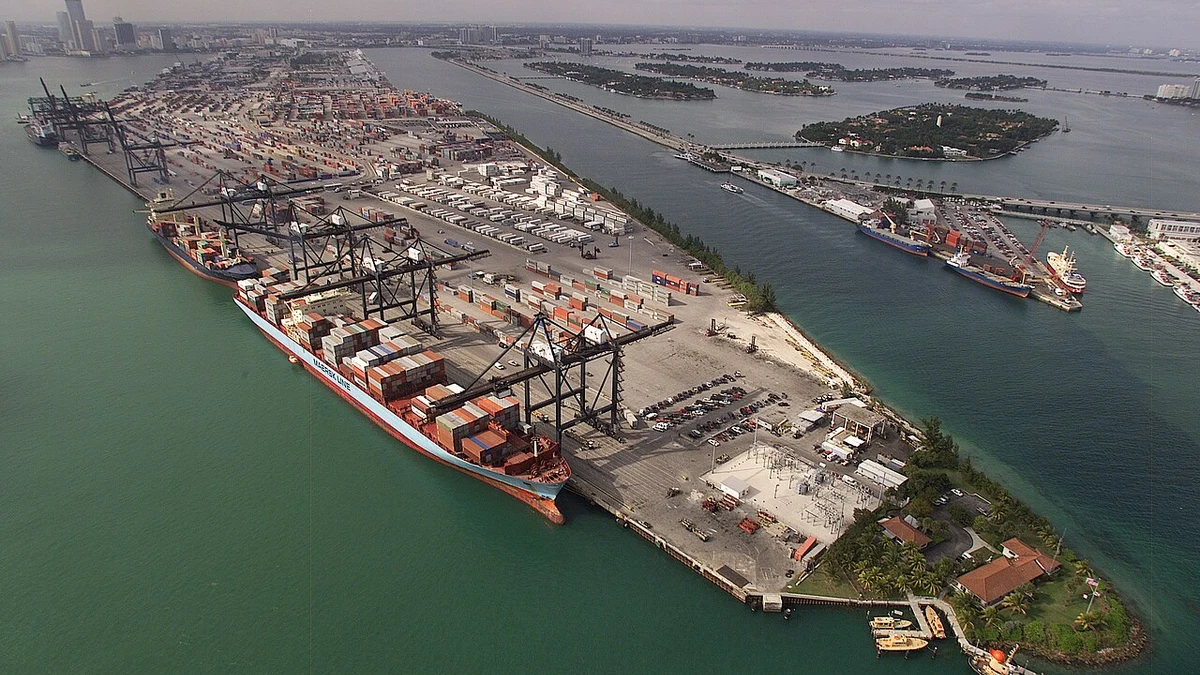
An aerial archive photograph of the Port of Miami, published by U.S. Customs. The original capture date is not specified; this is not a current port-status image. Photo: James R. Tourtellotte / Public domain. Cropped and resized. This is documentary stock imagery, not a claim that Synesys owns the pictured facility, vehicle or shipment.