
Cargo insurance protects a defined financial interest under a policy; a transporter’s insurance certificate does not prove your consignment is fully covered. Before a South African road shipment leaves, match the goods, value, route and handling to the actual wording.
Last verified: 17 November 2026. South African shipper education; verify the actual shipment, contract, policy and destination requirements before dispatch.
In this guide
Cargo insurance starts with the insured interest
A Boksburg shipper can pay a transport invoice without being the insured party under the carrier’s policy. Start by asking whose financial loss the policy is intended to protect. Then identify the goods and the journey. A company name and an expiry date on a certificate answer only a small part of that question.
The useful distinction is between damage to the goods and the carrier’s responsibility for that damage. A physical loss policy may respond to a covered event without the shipper first proving the haulier was legally liable. A liability arrangement needs the applicable liability conditions to be met. Neither description promises payment: the schedule, endorsements, exclusions and facts still decide the result.
Hollard’s marine product descriptions separately identify cargo-related products and carriers’ interests. That is a reason to ask which product applies, rather than treating every document headed “transit insurance” as interchangeable. This article is a preparation guide, not a recommendation to buy a particular insurer’s product.
Test the journey rather than the insurance label
Write the actual movement in a sentence: sealed machinery crates collected in Boksburg, transferred at a depot, moved through Beitbridge and delivered at a named site in Zimbabwe. The policy discussion can then follow the goods. A quote that says “South Africa” does not answer whether the cross-border leg or the depot handling is included.
| Question | Evidence to request | Problem it exposes |
|---|---|---|
| Who is insured? | Schedule naming the insured and insured interest | Your goods may not be insured for your benefit |
| Which property? | Goods description, commodity restrictions and declaration | The actual cargo may fall outside the description |
| Which journey? | Territorial limits and transit start/end provisions | A border, warehouse or return leg may be outside scope |
| Which amount? | Basis of valuation, load limit and excess | The declared amount may not match the exposure |
| Which conditions? | Security, parking, subcontracting and handling requirements | A certificate may omit a condition relevant to the loss |
Download this article’s main table (CSV)
Put disputed or unclear answers in writing before loading. If the insurance contact cannot connect the certificate to the policy section and your consignment, the answer is incomplete. A deadline at the loading bay is a poor place to discover that the insured commodity description says general packaged goods while the shipment is temperature-controlled stock.
Read extensions and exclusions as operational instructions
Hollard’s commercial insurance overview distinguishes full and restricted goods-in-transit cover. Its trucking page separately lists optional extensions. Those are product-specific examples, not a list of protections every policy includes. Ask the insurer or your insurance adviser to identify the actual wording for theft, handling, temperature damage and subcontracted carriage.
Turn each relevant condition into an assigned task. If approved parking is required, who confirms the overnight stop? If tracking is required, who checks it before dispatch and receives the alert? If the shipment changes vehicles, who checks whether the replacement and new carrier remain acceptable? A condition nobody owns is difficult to follow consistently.
“All risks” should never be read as “every possible loss”. Ask where the cover stops and what evidence the insurer would need. For a refrigerated consignment, for example, recording the agreed set point is different from proving the product temperature before loading. The distinction matters when someone later tries to explain whether damage occurred in transit or before the goods were handed over.
“Full or restricted cover is available” — Hollard Commercial Insurance.
That short distinction is useful at procurement: ask which version is actually on the schedule before treating the word “insured” as an answer.
A worked value check before dispatch
Illustrative example, not a quotation or claim calculation. A shipper values a machinery load at R800000. The carrier supplies a document showing a R600000 load limit and a R20000 excess. The immediate questions are whether the interest, goods and journey are covered and how settlement is valued. The R200000 difference between value and limit is a warning to investigate, not a prediction of a particular shortfall.
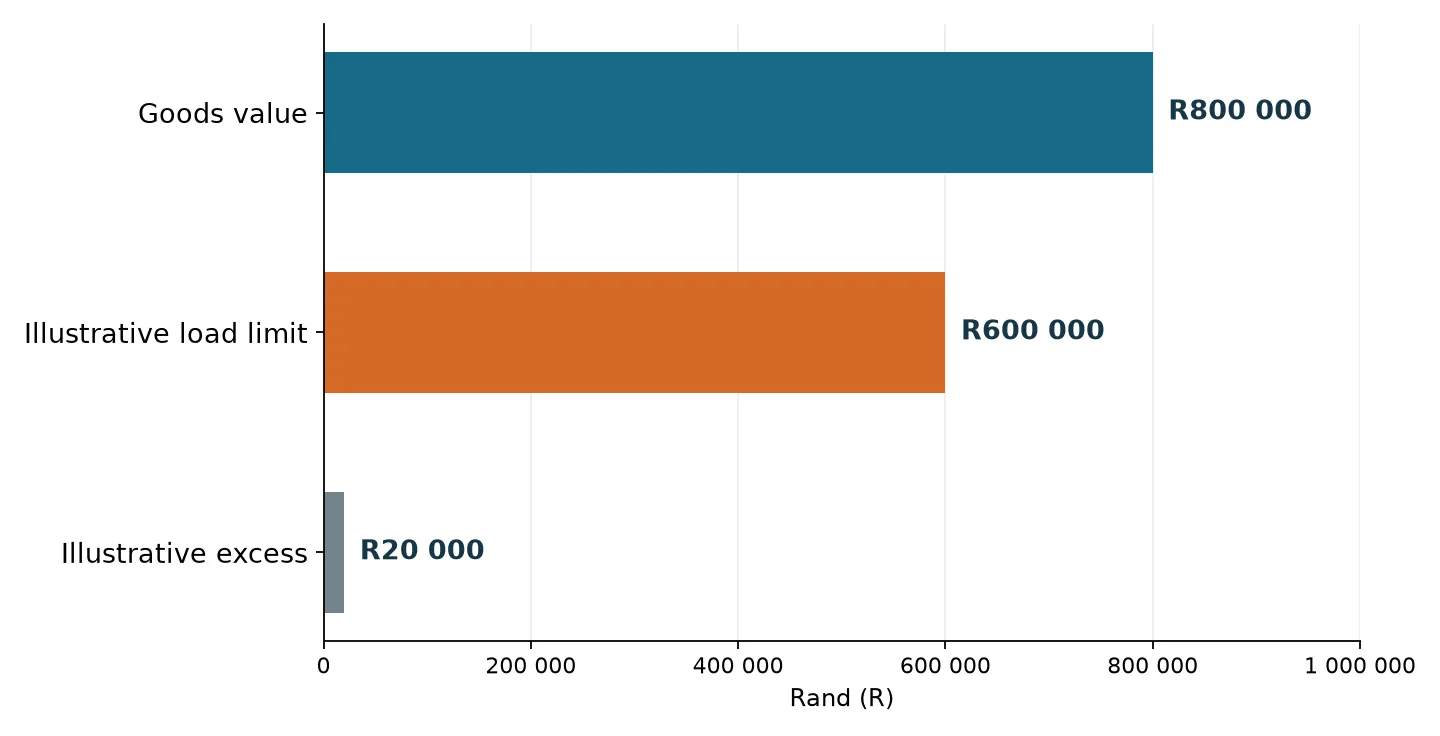
| Item | Amount (rand) |
|---|---|
| Goods value | R800000 |
| Illustrative load limit | R600000 |
| Illustrative excess | R20000 |
Do not simply subtract the excess from the limit and announce the amount payable. A policy can contain different bases of settlement, sublimits or an average clause. The event might be excluded. Ask the adviser for a worked explanation using the real schedule and the proposed goods value; keep that answer with the shipment records.
The declared amount should follow the agreed valuation basis, not whichever invoice happens to be easiest to retrieve. Distinguish purchase value, replacement cost, freight and any additional insured components. If the load changes, update the declaration before it moves. The supporting cargo declared value guide includes a sensitivity example showing why a stale declaration can matter.
Build the claim file before there is a claim
The dispatch file should connect the goods description to package identifiers, counts, invoice values and the vehicle handover. Photographs without an identifiable consignment are harder to interpret. A clean delivery note without a physical count is not the same thing as a verified clean delivery. Use the proof of delivery photo guide to make the visual evidence legible.
Club Marine’s cargo claim submission page requests documents such as invoices, contracts of carriage, packing lists and damage photographs where applicable. It is one provider’s claims list, not a universal deadline or guarantee. Your own insurer can ask for different or additional evidence; obtain its requirements and notification instructions before departure.
| Stage | Point on the journey |
|---|---|
| 1 | Collection |
| 2 | Transfer / storage |
| 3 | Receiver |
When damage is found, protect people first, prevent further loss where it is safe and competent to do so, and contact the relevant insurer or adviser promptly under the actual policy. Record what is observed separately from theories about cause. Do not destroy goods, authorise salvage or admit liability without understanding the policy and getting the appropriate instructions. Read the cargo damage at delivery guide for the immediate receiving handover.
The cargo insurance release worksheet
| Field | Enter before the truck is released |
|---|---|
| Shipment identity | Reference; seller; buyer; package identifiers; commodity |
| Physical journey | Collection; transfers; storage; borders; final unloading; returns |
| Insured interest | Who holds cover; who can claim; named insured; adviser confirmation |
| Value and limits | Currency; valuation basis; load value; limit; excess; sublimits |
| Operational conditions | Security; approved stops; tracking; loading and unloading; subcontractors |
| Exceptions | Unanswered question; owner; written instruction; release decision |
| Evidence route | Contacts; notification channel; dispatch records; receiving records |
Use a separate row for each unresolved question. “Adviser to confirm cover” is too vague for a release decision. “Adviser to confirm in writing whether depot transfer at the named address is inside the insured transit” gives the owner a concrete task. Synesys can coordinate the freight plan, but insurance acceptance must come from the party authorised to give it.
For recurring deliveries, review the worksheet whenever cargo, route, value or subcontractor changes. Reusing the previous file without checking those fields creates an appearance of control while leaving the decision stale. A reusable process should make changes visible; it should not make them easier to overlook.
Questions shippers ask
Is a transporter’s insurance certificate enough?
No. Use it to identify the insurer, policyholder and stated cover, then obtain the relevant schedule and written confirmation for the goods, value and journey. The certificate alone may omit exclusions or conditions that matter to your consignment.
Does cargo insurance cover a late delivery?
Do not assume it does. Separate physical cargo loss from delay, lost sales and contractual penalties. Ask the adviser which losses are insured under the actual wording and which remain a commercial risk.
Can I claim from both the carrier and my insurer?
Notify the appropriate parties, disclose other insurance and follow the relevant instructions. Do not plan on receiving double compensation for the same loss. Recovery rights and the sequence of claims depend on the contracts and facts.
Should loading and unloading be included?
Ask explicitly. Identify who handles the goods, the equipment used and the point at which cover begins or ends. Do not infer handling cover from the words “goods in transit”.
Continue in this learning cluster
Use the related guides when the next decision becomes specific:
- Goods in Transit Insurance vs Carrier Liability: What Is Actually Covered?
- Cargo Claim Evidence: Build a File an Insurer Can Assess
- Cargo Declared Value and Underinsurance: Questions to Settle Before Dispatch
Bring the completed worksheet and your actual shipment details to a freight conversation with Synesys. This guide helps prepare the decision; it does not promise an insurance outcome, legal approval or transport availability.
Sources and verification
- Hollard Marine Insurance — checked 17 November 2026.
- Hollard Commercial Insurance — checked 17 November 2026.
- Hollard Trucking Insurance — checked 17 November 2026.
- Club Marine Cargo Insurance Claim — checked 17 November 2026.
The examples and visuals are original Synesys teaching models. Illustrative figures are deliberately separated from sourced facts and must not be used as tariffs, actual claim settlements or legal vehicle capacities.
Continue with this topic
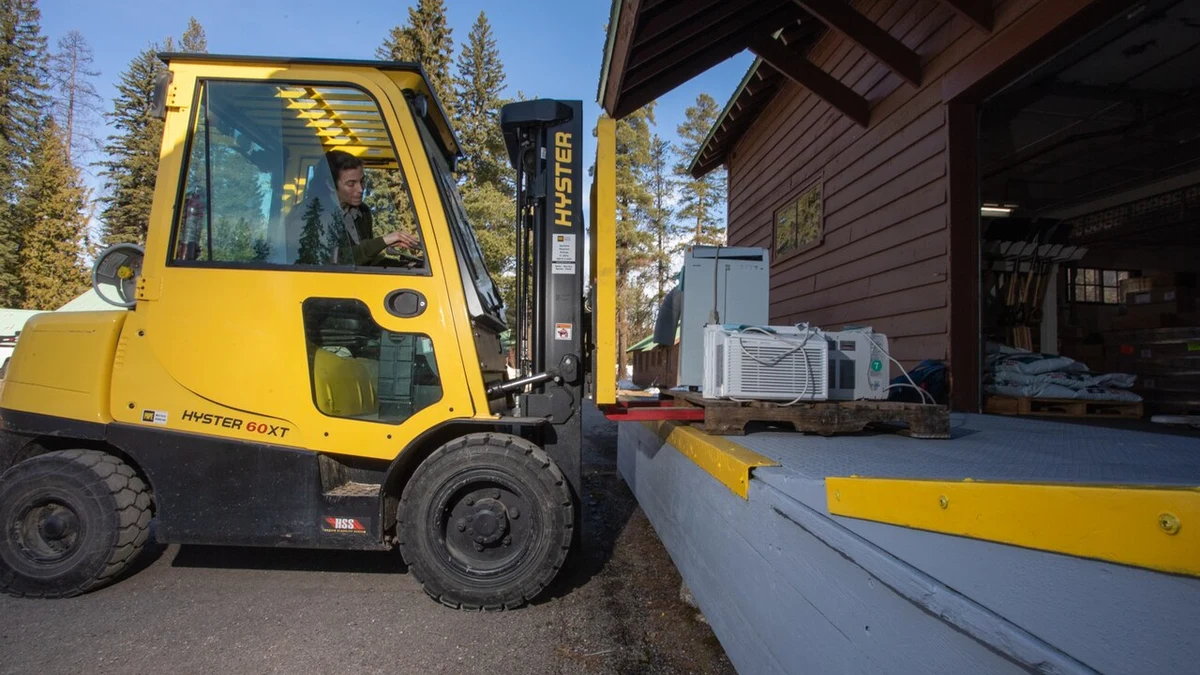
A U.S. National Park Service supply technician moving a pallet by forklift, March 2022. Illustrative archive photograph. Photo: GlacierNPS / Public domain. Cropped and resized. This is documentary stock imagery, not a claim that Synesys owns the pictured facility, vehicle or shipment.