

Cargo declared value must match the valuation basis agreed with the insurer, not a convenient estimate from last month. Before dispatch, reconcile the actual load, insured amount and any average clause, then ask for a written explanation of settlement.
Last verified: 17 November 2026. South African shipper education; verify the actual shipment, contract, policy and destination requirements before dispatch.
In this guide
Agree what cargo declared value means
An invoice can show a selling price while an insurance declaration calls for another basis. Ask the adviser which cargo declared value is required: purchase value, replacement value or another agreed measure, and whether freight or additional components are included. Record the currency. A Boksburg collection file should not leave the insurer to guess whether a number is rand or US dollars.
Separate cargo declared value for the whole consignment from the value of damaged goods and from the policy’s limit. Those figures may be related, but they answer different questions. The wider cargo insurance guide starts with the insured interest; this article addresses the amount that needs to be declared once that interest is understood.
A limit is not a valuation method
Hollard’s trucking product page describes a first-loss settlement basis for a listed goods-in-transit offering. That is a product-specific example, not a rule for every South African cargo policy. It illustrates why a shipper must ask how its own policy treats the load value, rather than assuming every policy applies proportional average.
| Term to identify | Question for the actual wording |
|---|---|
| Basis of valuation | How is the value of the insured property calculated? |
| Sum insured or load limit | What limit applies to this consignment, vehicle or event? |
| Average or underinsurance clause | Does one apply, and how is the proportion calculated? |
| Excess | How does the first amount payable apply? |
| Sublimit | Does a commodity, event or expense have a lower ceiling? |
| Other insurance | What disclosure and contribution provisions apply? |
Download this article’s main table (CSV)
Ask the adviser to demonstrate how cargo declared value affects settlement under the real schedule, rather than accepting verbal reassurance that the cover is “enough”. Hollard’s commercial overview also distinguishes full and restricted cargo cover; the amount cannot cure an event that falls outside the chosen cover. Value and scope both need a clear answer.
Understand average without treating it as universal
Illustrative model, not an actual policy calculation. Assume a policy explicitly applies proportional average, the correct property value is R1000000, the insured amount is R600000 and a covered partial loss is R100000. Under the simplified assumed formula, R100000 × (R600000 ÷ R1000000) = R60000 before any excess, limit or other provision.
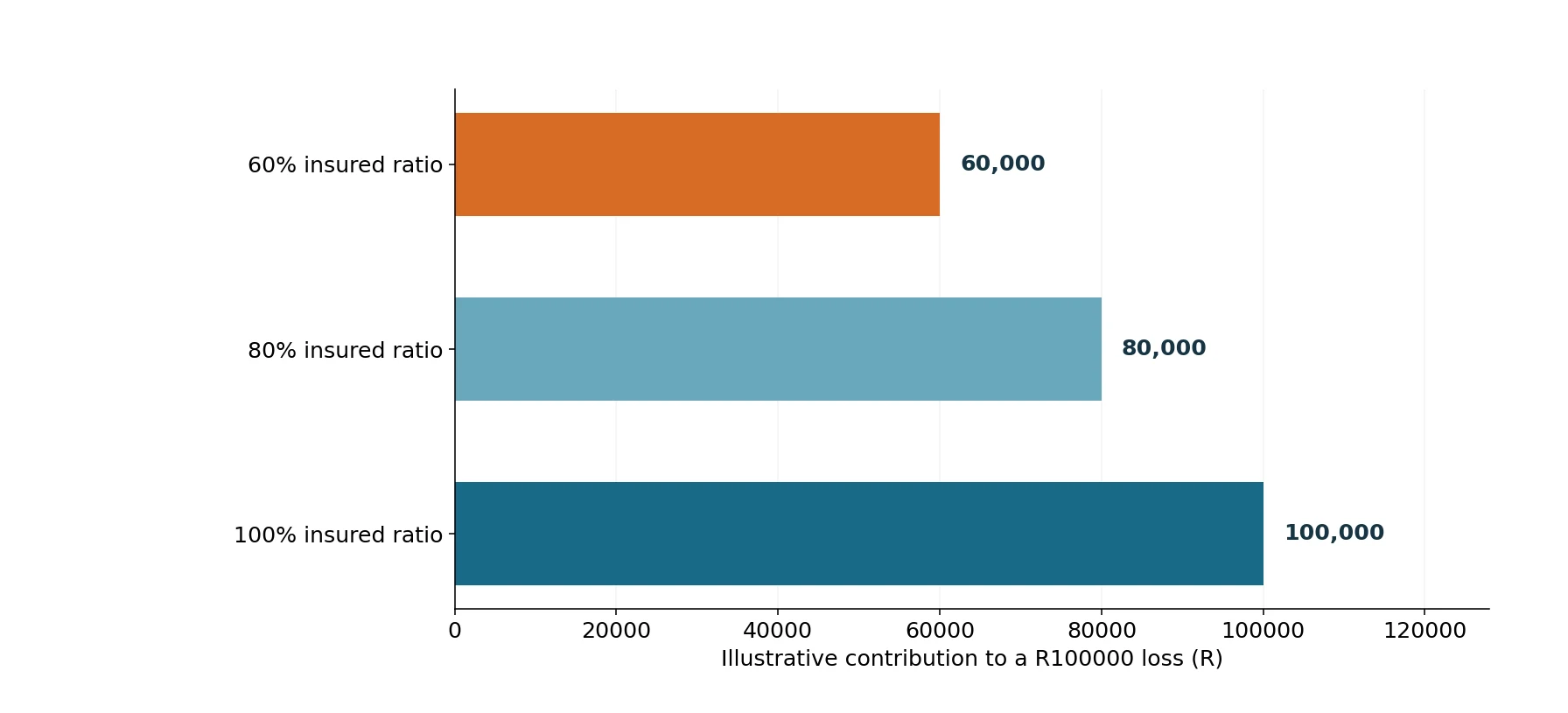
| Insured ratio | Illustrative contribution to a R100000 loss (R) |
|---|---|
| 60% | 60,000 |
| 80% | 80,000 |
| 100% | 100,000 |
If the insured amount in that same assumed model were R800000, the contribution before further terms would be R80000. With R1000000 insured, it would be R100000. These numbers show the arithmetic of an assumption. They do not establish that your policy contains average, what values it uses or whether a loss is covered.
An adviser who says the policy is on a first-loss basis should identify the relevant clause and explain how it changes the example. Keep the explanation. Do not combine wording from two products to create a more favourable imaginary policy. A settlement method is only useful when it belongs to the policy that actually insures the shipment.
Declare the peak that actually travels
A recurring Johannesburg route can carry ordinary spares one week and expensive electronics the next. The truck and distance are unchanged; the insured value is not. A declaration copied from the first delivery can be stale even if the operator and driver remain the same.
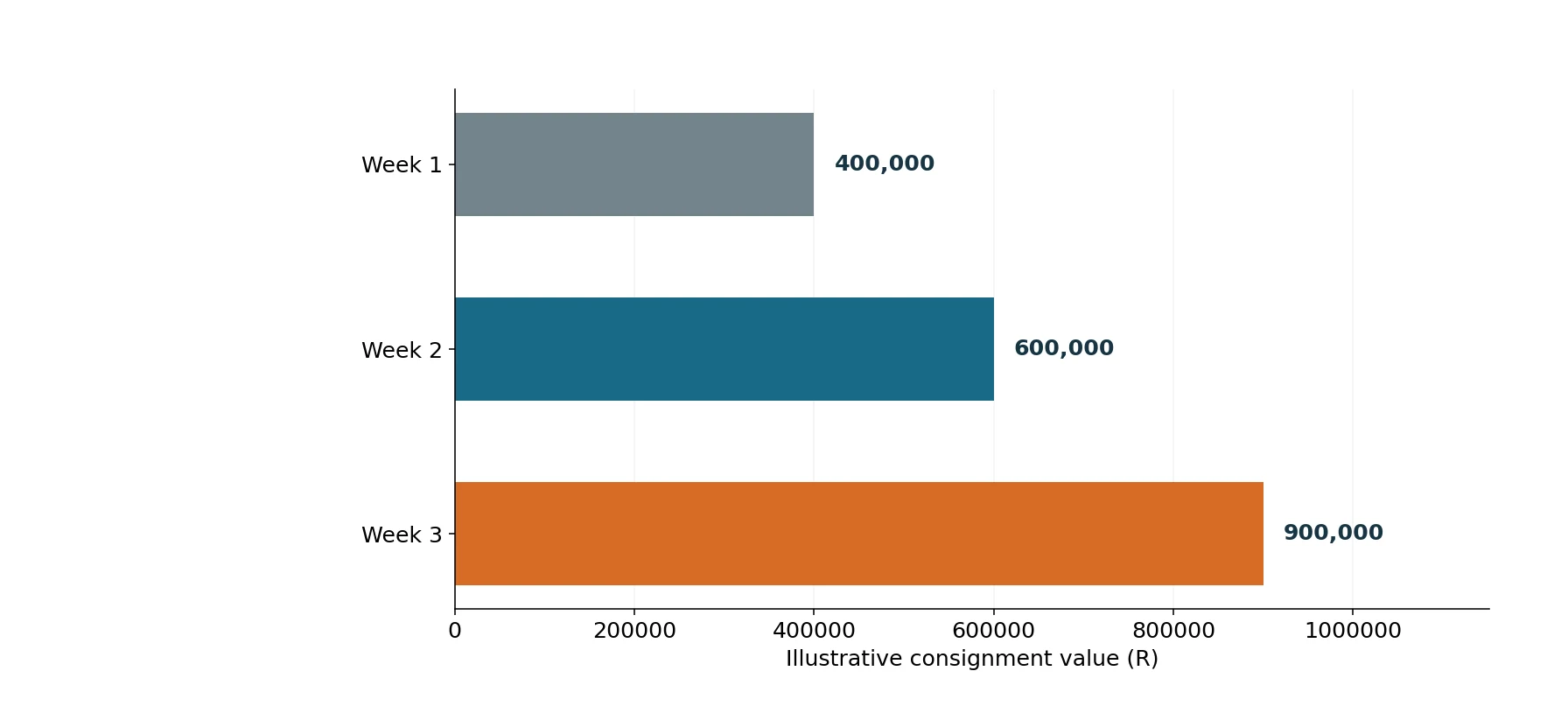
| Week | Illustrative consignment value (R) |
|---|---|
| Week 1 | 400,000 |
| Week 2 | 600,000 |
| Week 3 | 900,000 |
Illustrative loads: R400000 in week one, R600000 in week two and R900000 in week three. A R600000 reference figure describes the middle week, not the final shipment. Reconcile cargo declared value against the actual load before release, including additions made after the initial quote. Tell the insurance contact if cargo, route, transfer arrangements or value changes.
For mixed-owner loads, do not assume each owner has a separate full vehicle limit. Ask how the policy aggregates interests and events. For part deliveries, record what remains on board after each stop. A delivery receipt should identify the packages removed so the remaining value can be reconciled rather than estimated.
A value declaration worksheet to keep with the load
| Field | Shipper entry | Evidence |
|---|---|---|
| Goods | Commodity and package identifiers | Packing list |
| Value basis | The basis required by the policy | Written adviser confirmation |
| Currency and amount | Value of the actual consignment | Invoice or supported valuation |
| Limit and aggregation | Applicable limit and relevant sublimits | Schedule and endorsements |
| Settlement method | Average, first loss or other wording as applicable | Clause reference and worked explanation |
| Change control | Late additions, split deliveries or route changes | Revised declaration and acknowledgement |
Have the person responsible for cargo declared value sign off the final goods list. That person should be able to explain the value basis and evidence, not merely copy a total from a purchase order. If a value is unresolved, record what must be obtained to resolve it. Do not silently use zero, last month’s figure or an average to force the form through.
If damage has already occurred, preserve the cargo claim evidence and use the receiving damage process. The declaration history belongs in that file, including any changes and acknowledgements. The carrier liability comparison explains why the cargo value and a transport-contract cap must still be considered separately.
Questions shippers ask
Does underinsurance always reduce a partial claim proportionally?
No. It depends on the actual wording and valuation basis. The proportional example here applies only to the expressly assumed average clause. Ask the adviser to demonstrate the method under your own policy.
Should freight be added to the goods value?
Include it only as required or permitted by the agreed valuation basis. Obtain that basis in writing; do not assume the invoice total or selling price is automatically the correct insured amount.
Can the declared value be updated after booking?
Notify the appropriate insurance contact before the change takes effect and obtain the necessary acknowledgement or endorsement. A transport booking amendment is not, by itself, confirmation of amended insurance cover.
Continue in this learning cluster
Use the related guides when the next decision becomes specific:
- Cargo Insurance in South Africa: Cover, Liability and Claims Explained
- Goods in Transit Insurance vs Carrier Liability: What Is Actually Covered?
- Cargo Claim Evidence: Build a File an Insurer Can Assess
Bring the completed worksheet and your actual shipment details to a freight conversation with Synesys. This guide helps prepare the decision; it does not promise an insurance outcome, legal approval or transport availability.
Sources and verification
- Hollard Trucking Insurance — checked 17 November 2026.
- Hollard Commercial Insurance — checked 17 November 2026.
The examples and visuals are original Synesys teaching models. Illustrative figures are deliberately separated from sourced facts and must not be used as tariffs, actual claim settlements or legal vehicle capacities.
Continue with this topic
A raw-material warehouse serving plastics manufacture, April 2009. Illustrative archive photograph. Photo: Cjp24 / CC BY-SA 3.0. Cropped and resized. This is documentary stock imagery, not a claim that Synesys owns the pictured facility, vehicle or shipment.