
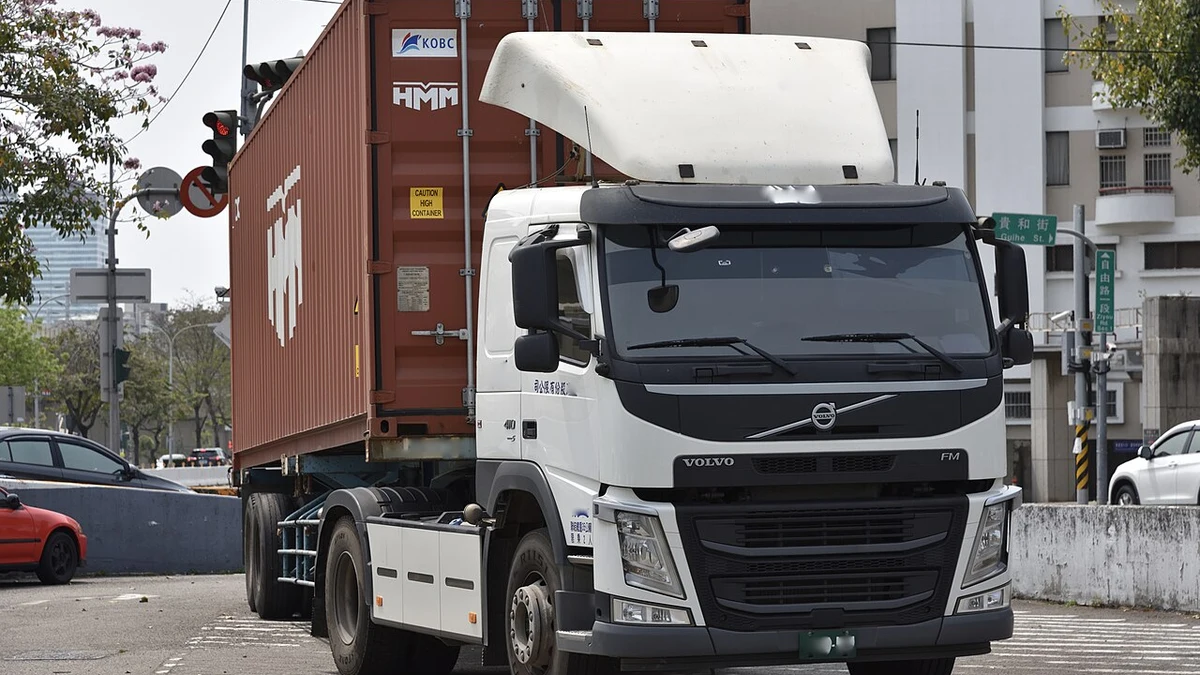
Bonded cargo stays under customs control while duties and taxes are suspended. For a South African road movement, confirm the procedure, authorised carrier, declared destination and closure evidence before dispatch. Delivery alone does not close the customs file.
Last verified: . South African guidance; destination-country rules must be checked separately.
In this guide
What bonded cargo means for a South African shipper
A pallet can be physically ready and still be unavailable for an ordinary delivery. If it is moving under a bonded customs procedure, the shipper must plan both the cargo movement and the evidence that will close that procedure. Treating the work as a normal truck booking leaves the most consequential handoff unassigned.
The SARS transit guide distinguishes national transit within South Africa and SACU from international transit through South Africa. It says in-transit goods must travel with a licensed remover of goods in bond. Check the particular movement and any lawful exemption with the declarant; owning a truck is not proof of the required status.
Start with the goods, not the abbreviation. Where were they landed? Have duties and taxes been brought to account? Are they going to a South African customs warehouse, another SACU destination, or a destination beyond the common customs area? The answers determine which customs question needs resolving. They do not follow from the customer’s trading address.
This guide is a shipper’s planning framework, not an instruction to select a customs procedure code without advice. The declaration must describe the actual transaction. A route to Zambia does not make every item on the vehicle a transit consignment. Different consignments can have different statuses; a mixed load needs a consignment-level plan.
The control plan: release, custody and closure
| Control | Question before dispatch | Evidence to retain |
|---|---|---|
| Procedure | Which customs procedure and destination apply? | Declarant’s instruction and accepted declaration reference |
| Carrier | Who is the actual remover and who bears the customs liability? | Verified remover details and any approved subcontracting arrangement |
| Movement | Which vehicle, packages, seals and border points are declared? | Manifest, package list and identifying details |
| Exception | Who contacts Customs if the plan changes? | Named contact and permission record where required |
| Closure | What proves this procedure is complete? | Procedure-specific acquittal evidence and responsible person’s confirmation |
Download this article’s main table (CSV)
Do not leave closure to “the clearing agent” as an unnamed role. Record the company, the person, the consignment reference and the expected evidence. The warehouse receiving clerk may confirm a package count while the declarant needs a different record to close the customs movement. Both can be doing their job correctly and still leave the file open.
The SARS acquittal annexure lists evidence by customs procedure and mode. Its current published revision is effective 30 March 2026. Use the row that applies to the declaration; a proof of delivery is not a universal replacement for the customs evidence listed there.
An Incoterm allocates specified sale responsibilities between buyer and seller. It does not remove customs responsibilities of a declarant or remover. Keep the freight instruction and customs instruction connected, but do not assume one document answers both questions. Our Incoterms road-freight guide explains the distinction.
Worked example: one movement, two finishing times
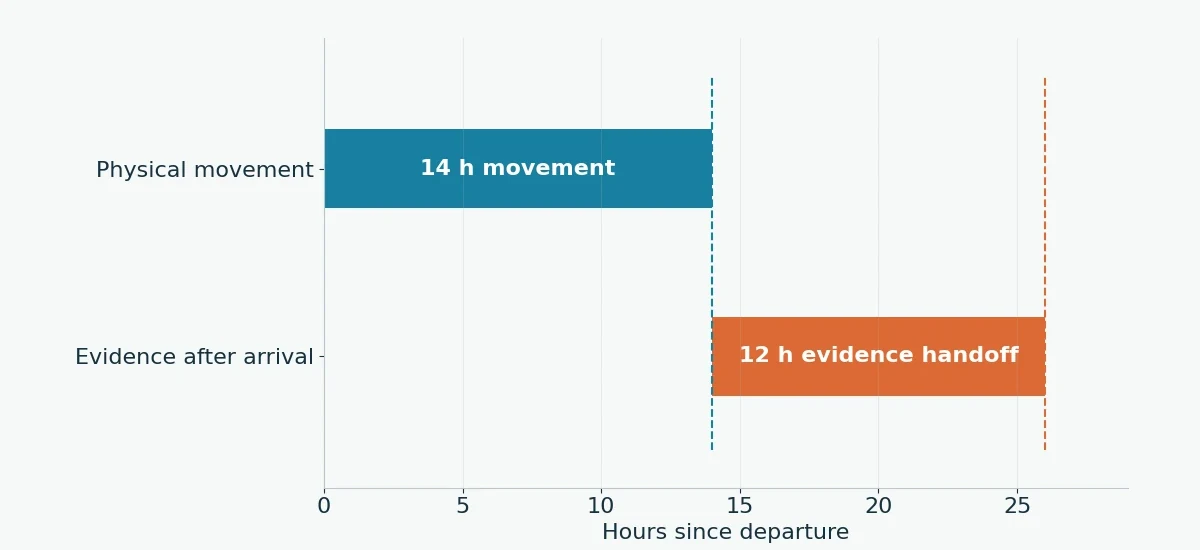
Illustrative scenario, not measured corridor performance. A consignment leaves a Durban facility at hour 0, reaches its authorised receiving point at hour 14 and has its evidence pack accepted by the file owner at hour 26. Physical movement takes 14 hours in this invented example; the administrative handoff adds 12 hours. These are model inputs, not delivery promises.
| Stage | From hour | To hour | Duration |
|---|---|---|---|
| Physical movement | 0 | 14 | 14 h movement |
| Evidence after arrival | 14 | 26 | 12 h evidence handoff |
The useful question is not whether 12 hours sounds fast or slow. Ask which event was missing. Was the declaration reference absent from the receiving record? Did the driver return an unreadable photograph? Was an authorised endorsement still needed? A timeline exposes the missing handoff without claiming every bonded movement follows the same sequence.
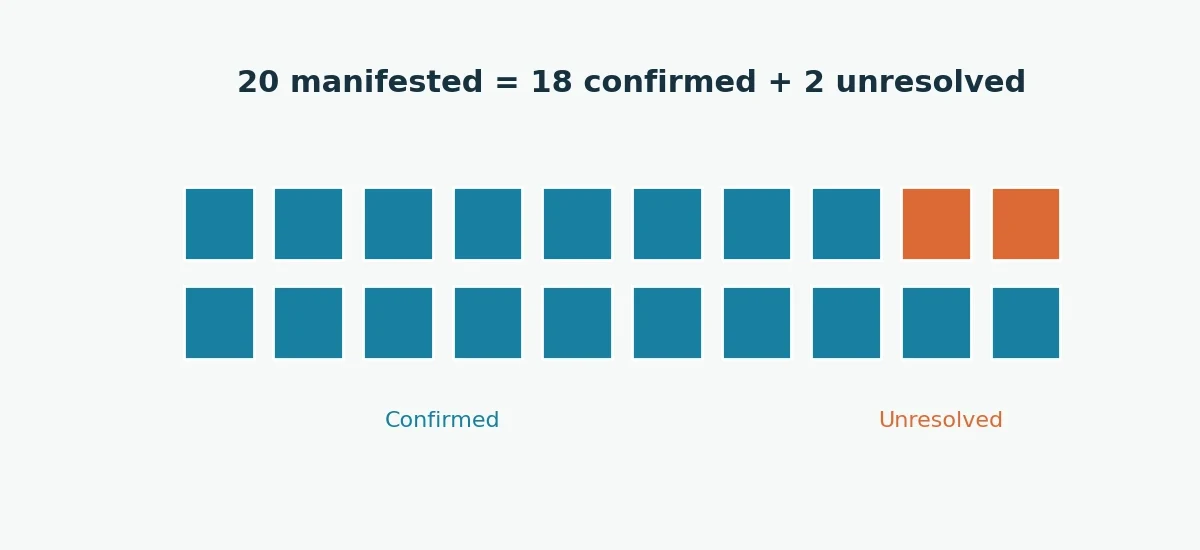
Suppose the receiving facility confirms 18 packages while the manifest lists 20. That discrepancy must not be fixed by editing the photograph or asking someone to sign for the original quantity. Preserve the source records, establish what arrived and ask the declarant which customs action is required. Commercial delivery completion and customs acceptance remain separate decisions.
| Manifested | Confirmed | Unresolved |
|---|---|---|
| 20 | 18 | 2 |
The initial exception report should state facts: consignment reference, time, location, manifested quantity, observed quantity, document copies and the person taking control. “Possibly on another truck” is an unverified hypothesis. Record it as a question, not the explanation. Use Who Owns Each Handoff on a Freight Job? to assign the follow-up.
Changes that require a controlled decision
A breakdown, changed warehouse appointment or unavailable border route is an operational problem with a customs dimension. The truck planner cannot assume changing the delivery address in a message also changes the authorised customs destination. For South Africa, SARS SC-CF-55, paragraphs 3.26–3.27 describes reporting unforeseen events and prior permission for specified activities. Apply the authorised customs process.
Do not instruct a driver to break a seal, transfer goods or take a different bonded destination merely to protect a delivery slot. Establish what Customs and the licensed remover require for that situation. A written stop-and-escalate rule is more useful here than a generic promise to keep the truck moving.
If a seal identifier differs from the records, preserve the observation before anyone tries to normalise it. A number entered incorrectly and a seal changed during an authorised examination are different possibilities. Neither should be assumed. The customs seal discrepancy guide provides a factual incident record, not instructions to interfere with a seal.
When commercial pressure builds, separate the choices. A shipper can authorise a revised customer delivery appointment. That does not give the shipper authority to approve a customs-controlled transfer. Make the commercial approval and the customs permission visible as different entries, each with its owner.
If another truck is proposed, identify the actual remover and obtain the relevant instruction before treating the substitute as interchangeable. The vehicle handoff may affect the manifest, customs records and evidence chain. A commercial acceptance from the buyer is useful, but it does not answer those separate questions.
Explain the unresolved issue to the receiver without promising a release time. A specific update—“awaiting the declarant’s instruction on the destination change”—is more useful than saying “customs delay”. It tells the receiver why the delivery window is uncertain and which decision will allow a revised plan.
A bonded-movement file you can use
- Goods identity: invoice lines, package marks and current package count.
- Customs identity: declaration reference, procedure, office and declared destination.
- Carrier identity: actual remover, vehicle and trailer details, plus any approved substitute.
- Control evidence: release status, manifest, applicable transit documents and seal observations.
- Exception owner: named declarant and remover contacts, with the instruction channel.
- Closure owner: specific evidence required, who obtains it and who confirms completion.
Keep the file at consignment level. If one truck carries several declarations, a folder called “Durban load” is not enough. Use a reference for each consignment and link it to the vehicle movement. The team can then identify which declaration remains unresolved after the other deliveries are complete.
Set an internal follow-up date before the applicable legal or customs deadline. Label it as your operational target. Give the declarant time to investigate missing documents or request an extension through the proper channel; never present an internal target as a statutory period.
Review the original instruction against the receiving arrangement before a weekend or shift change. The person taking over should be able to find the declaration, current status and next contact without searching a driver’s private message history. That is a practical test of whether the file belongs to the business rather than to one employee.
If a load is held, use What to Do When a Cross-Border Freight Load Is Held to organise the exception. For procedure choice, continue to Removal in Bond vs Removal in Transit. For completion, use Customs Transit Acquittal. The objective is a movement explained from release to closure, with no unexplained custody gap.
Questions shippers ask
Is bonded cargo the same as duty-free goods?
No. Bonded cargo here means goods moving under customs control with payment suspended under the applicable procedure. Suspension is not a blanket exemption. The declarant must establish the final treatment and evidence for the particular goods.
Can any South African transporter carry a bonded load?
Do not assume so. Ask the actual carrier and declarant to confirm applicable remover licensing and any exemption or subcontracting conditions. SARS publishes separate remover guidance; a freight quotation is not proof of authorisation.
Does a signed POD acquit the customs movement?
A delivery record may help establish custody, but use the procedure-specific acquittal requirements. The customs-file owner must confirm that the required evidence has been obtained and the movement properly closed.
Who should receive the first call when the plan changes?
The driver follows the operator’s safe escalation process. The movement file should identify the licensed remover and declarant responsible for customs instructions. Commercial instructions alone must not be treated as customs permission.
Sources and verification notes
- SARS: Transit
- SARS: Remover of Goods
- SARS SC-CF-55-A10, Revision 4, effective 30 March 2026
- SARS SC-CF-55, Revision 14, effective 14 August 2026
Sources checked on 17 November 2026. Charts and worked scenarios are original Synesys educational models; invented quantities, times and amounts are labelled illustrative. They are not customer results, published market prices or regulatory limits.
Continue with this topic
A Volvo container truck in Taichung, Taiwan, March 2021. International archive illustration; no local vehicle or customs approval is implied. Photo: Lokseng01 / CC BY-SA 4.0. Cropped and resized. This is documentary stock imagery, not a claim that Synesys owns the pictured facility, vehicle or shipment.