
SDS section 14 contains transport information, but it is not a carrier’s permission to collect. Match the safety data sheet to the actual product and revision, review the relevant transport details with a competent person, and resolve blanks or contradictions before booking.
Last verified: . South African guidance; destination-country rules must be checked separately.
In this guide
SDS section 14: useful information, not transport acceptance
The supplier sends a PDF containing SDS section 14 and the booking team ticks “SDS received”. That check proves a document arrived. It does not establish that the PDF describes the product, that the transport information is complete or that the carrier has accepted the shipment.
The South African Hazardous Chemical Agents regulations, Regulation 14A provide a structured SDS framework including transport information under section 14. This is workplace chemical-information regulation. Road-freight classification and acceptance must also follow the applicable transport requirements; one document does not collapse those separate decisions.
Read the product identifier before reading SDS section 14. A document for a concentrate may not describe a different dilution. A supplier may distribute several formulations under similar names. If the match is unclear, ask the manufacturer or responsible supplier for the correct document rather than guessing from the label colour.
What to look for and what to ask
| Check | Question to resolve | Booking response |
|---|---|---|
| Product and version | Does the sheet identify the goods actually offered? | Obtain an exact match or written clarification. |
| Transport classification | What transport details apply to the actual product and mode? | Have the competent reviewer confirm the classification. |
| Mode and jurisdiction | Does the sheet distinguish relevant transport regimes? | Do not apply an air or overseas-road entry indiscriminately. |
| Packaging or special conditions | What further information must the specialist assess? | Provide actual package and quantity details. |
| Missing or inconsistent information | Is a blank, statement or contradiction explained? | Refer to the supplier and specialist; do not infer an exemption. |
Download this article’s main table (CSV)
Look beyond one line saying “not regulated”. Identify which mode and conditions the statement concerns and whether it applies to the shipment proposed. If the product has changed or the carrier sees contradictory information, obtain clarification. Do not resolve the disagreement by selecting whichever document permits the booking.
Read related information where the reviewer needs it, including the product identity, composition and stability or reactivity information. A freight planner should not turn those sections into a self-made chemical compatibility ruling. Their practical purpose is to recognise the need for a competent decision and supply the correct records.
Worked example: document receipt is not document match
Illustrative document-control scenario. A shipper offers products A, B and C. Product A has a matching current supplier record; B has a record for a different formulation; C has no transport information supplied. These invented labels and statuses are not classifications of real chemicals.
Receiving an SDS does not establish a product match
| Product | Product identity | Revision record | Transport information |
|---|---|---|---|
| Product A | Checked | Checked | Checked |
| Product B | Not confirmed (?) | Checked | Not confirmed (?) |
| Product C | Checked | Checked | Not confirmed (?) |
Illustrative products. Cells show information-review status only. Illustrative document-review matrix. Records marked Checked mean checked information, not carrier acceptance.
The next action differs by line. For B, ask the supplier for the formulation match. For C, request the missing information and competent assessment. Do not mark the entire enquiry complete because product A has a usable record. The actual load remains subject to the carrier’s decision.
The second visual places the transport-information heading within a structured SDS. Its purpose is navigation. The surrounding sections have their own functions, and reading section 14 in isolation is not a substitute for a competent review of the product and movement.
Section 14 sits inside the complete safety-data-sheet structure
| Section | Heading |
|---|---|
| 1 | Identification |
| 2 | Hazard(s) identification |
| 3 | Composition / information on ingredients |
| 4 | First-aid measures |
| 5 | Fire-fighting measures |
| 6 | Accidental release measures |
| 7 | Handling and storage |
| 8 | Exposure controls / personal protection |
| 9 | Physical and chemical properties |
| 10 | Stability and reactivity |
| 11 | Toxicological information |
| 12 | Ecological information |
| 13 | Disposal considerations |
| 14 | Transport information |
| 15 | Regulatory information |
| 16 | Other information |
Navigation list based on the published SDS headings; not an SDS form. Original navigation graphic based on the published SDS structure. The full source document remains authoritative.
Keep the original supplier file with its revision identifier. If clarification arrives by email, retain it alongside the SDS and record who assessed it. Do not edit the supplier’s PDF to make the document appear consistent. The evidence trail should show where each statement came from.
The boundary between product information and transport documents
The Department of Transport dangerous-goods portal explains the domestic transport framework and the need for classification, appropriate packaging and trained responsibilities. An SDS contributes information to that process. It does not certify the actual package, vehicle, driver or receiving facility.
A dangerous-goods declaration and transport-emergency information have different roles from the SDS. Department of Transport awareness material on documentation distinguishes road and other modal requirements. Ask the specialist and carrier which documents apply to the load rather than attaching an SDS and assuming the paperwork is finished.
For multimodal freight, name the handoffs. A maritime classification entry may inform a sea leg but should not be copied mechanically into a South African road booking. The competent person needs the mode, route and actual transport configuration to assess the applicable requirements.
If a load contains batteries, Lithium Batteries by Road covers model-specific evidence. If several products share a vehicle, Dangerous Goods Mixed Loads explains why the combination requires its own review.
SDS section 14: a practical intake workflow
- Record exact product, manufacturer or supplier and shipment line.
- Keep the original SDS with its issue or revision date.
- Confirm the product and formulation match.
- Identify the relevant transport information and unresolved questions.
- Refer uncertainty to the supplier and competent transport reviewer.
- Link the carrier’s final acceptance and conditions to the reviewed enquiry.
Make the document status explicit. “Received”, “identity matched”, “technical review outstanding” and “carrier acceptance received” are different events. A single checkbox called “SDS compliant” conceals the difference and can encourage a dispatcher to treat an incomplete enquiry as authorised for collection.
Tell the warehouse which product and package arrangement were accepted. If it substitutes another formulation or quantity, notify the carrier before collection. The reviewed document set must describe what is loaded, not what the sales team originally intended to send.
Use the dangerous-goods road-freight guide for the complete preparation record. Use Cargo Ready for Collection for the warehouse handoff and the freight enquiry qualification guide to capture missing information early.
A useful closeout note states what the SDS section 14 review changed. Perhaps a formulation mismatch was corrected or the carrier required further evidence. Record the actual improvement. Do not claim that receiving a PDF has made the whole transport operation safe or legally compliant.
Questions shippers ask
Is section 14 the same as the whole SDS?
No. SDS section 14 is the transport-information section within a broader product safety-data sheet. Product identity and other relevant information must also be considered by the competent reviewer.
Can a blank section mean the goods are not dangerous?
Do not infer that. Ask the responsible supplier to explain missing or inapplicable information and have a competent person assess transport status for the actual product and mode.
Can we edit an old SDS to match a new product?
No. Obtain the appropriate current supplier document or clarification. Preserve originals and keep a traceable review record rather than rewriting a manufacturer’s statement.
Sources and verification notes
- Department of Employment and Labour: Regulations for Hazardous Chemical Agents,2021, Regulation 14A
- South African Department of Transport: Dangerous Goods Regulations
- Department of Transport: Dangerous Goods awareness, packaging and labelling, October 2025
Sources checked on 17 November 2026. Charts and worked scenarios are original Synesys educational models; invented quantities, times and amounts are labelled illustrative. They are not customer results, published market prices or regulatory limits.
Continue with this topic
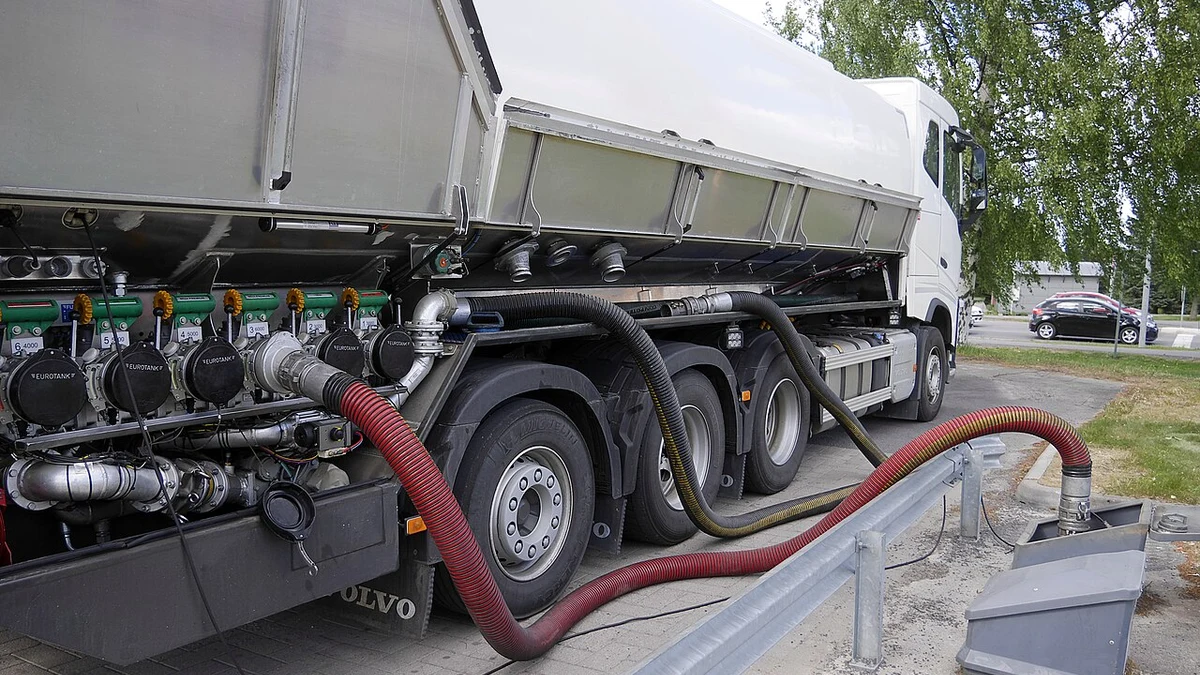
A fuel tanker delivering to a filling station, June 2018. Archive illustration, not instructions for dangerous-goods handling. Photo: Santeri Viinamäki / CC BY-SA 4.0. Cropped and resized. This is documentary stock imagery, not a claim that Synesys owns the pictured facility, vehicle or shipment.