
Dangerous goods mixed loads need a competent review of the actual products and quantities before carriage is accepted. Physical space, matching package shapes or individual product acceptance do not establish compatibility. Keep the proposed combination, relevant evidence and carrier decision together in one controlled load plan.
Last verified: . South African guidance; destination-country rules must be checked separately.
In this guide
Dangerous goods mixed loads: the combination is the question
For dangerous goods mixed loads, a carrier’s previous carriage of products A and B separately does not establish acceptance of the proposed combination, packaging arrangement and route. The load combination is a separate decision, and the shipper must make the full proposed cargo list visible.
The Department of Transport dangerous-goods framework connects classification and transport controls to domestic legislation and standards. A public article cannot replace the applicable compatibility, loading and exemption assessment. Use a competent specialist and an accepting carrier for the actual consignment.
This guide deliberately does not publish a chemical pairing table or a recipe for separating incompatible materials. Such a shortcut would hide product details, subsidiary hazards, packaging, conditions and jurisdiction. The useful shipper task is to supply complete information and preserve the resulting decision.
Dangerous goods mixed loads: the review record
| Record | Detail to include | Why it matters |
|---|---|---|
| Every product line | Exact identity and relevant transport classification | An omitted line is absent from the assessment. |
| Actual quantities | Package counts and required quantity units | Totals without units can misdescribe the proposed load. |
| Packaging and condition | Package type, condition and any return or waste status | The accepted arrangement must match presentation. |
| Proposed combination | All other cargo, including apparently ordinary goods | Individual acceptance is not mixed-load acceptance. |
| Route and receiver | Countries, modes and site arrangements | The load must fit the full journey and handoffs. |
| Decision and change control | Competent assessment, carrier acceptance and conditions | Later additions need review before loading. |
Download this article’s main table (CSV)
For dangerous goods mixed loads, ask the reviewer which quantity units are needed. Package count, mass and volume answer different questions. Do not convert between them using an assumed density or count a drum as a standard quantity when its contents and fill are different. Use reliable product and packing information.
A quotation for dangerous goods mixed loads must remain separate from the technical acceptance decision. A consolidation may save vehicle space while requiring a different transport arrangement. The carrier should quote the accepted proposal, with unresolved requirements identified, rather than promising an ordinary-load rate for a combination not yet reviewed.
Worked example: space saved does not mean acceptance gained
Illustrative load-planning scenario, not a dangerous-goods calculation. A fictional vehicle has 10 floor positions. Product A occupies four, product B three and ordinary cargo two, leaving one empty. These are invented space units. They say nothing about whether the products may travel together, the legal capacity or required segregation.
Available floor space is not a compatibility assessment
| Row | Unit 1 | Unit 2 | Unit 3 | Unit 4 | Unit 5 |
|---|---|---|---|---|---|
| Upper row | B | B | Other | Other | Empty |
| Lower row | A | A | A | A | B |
Illustrative space units only. This is NOT an approved loading or segregation layout. Illustrative floor-space plan only. It is not a safe-loading layout or compatibility instruction.
The physical planner can show that nine positions fit. The dangerous-goods reviewer must still assess the actual combination. Do not label the drawing an approved loading plan until the competent parties have determined and documented the applicable requirements.
Now suppose the warehouse proposes adding product C to the final empty position. The original acceptance covered A, B and the stated ordinary cargo. Product C changes the proposal even though it uses no extra vehicle. The addition must be reviewed before it is loaded.
A new product changes the proposal, even when it fits
Before loading:
- Accepted list
- Add product C
- Competent review
- Updated acceptance (this becomes the accepted list)
The important control is a freeze point: the moment the accepted cargo list is issued to the warehouse. A later change becomes a new decision request, not an unnoticed edit to a picking list. This is an internal planning control, not a new statutory approval category.
Why a home-made compliance percentage is misleading
Do not award a load “90% compliant” because most document fields are complete. The unresolved field could be the classification that determines the entire assessment. Track named missing decisions and evidence instead of using a reassuring average.
Similarly, do not copy an exemption calculation from another country, mode or edition of a standard. The specialist must establish the applicable requirements and any lawful exception for the actual products and quantities. The shipper’s role is to provide correct inputs and retain the assessed outcome.
The published HCA SDS framework helps establish the product-information record, while Department of Transport documentation material distinguishes transport documents. Neither supports treating an SDS folder as an approved mixed-load plan. Match each record to its purpose.
If a supplier document is unclear, SDS Section 14 explains the intake checks. If batteries are present, use Lithium Batteries by Road to identify model and condition evidence. The whole combination remains subject to review.
Control the warehouse and receiving handoffs
- Issue the accepted product list and package details to the warehouse.
- Record proposed substitutions or additions before loading.
- Refer changes to the competent reviewer and carrier.
- Keep acceptance conditions attached to the job instruction.
- Confirm the receiver’s arrangements for the actual load.
- Retain the final cargo list and the authority for approved changes.
A picking team may regard two products as interchangeable because they fill the same sales order. That is not a transport assessment. Give warehouse supervisors a clear route for resolving substitutions, so a commercial stock decision does not silently change the accepted consignment.
A receiving appointment should identify the cargo the site agreed to accept. A late added product can affect more than the vehicle; it may also affect the receiver’s handling and storage arrangements. Notify the responsible receiver and carrier before treating a change as approved.
Use Who Owns Each Handoff on a Freight Job? to assign decision owners, and Truck Load Planning for ordinary weight and space planning. Keep those physical checks alongside—not in place of—the dangerous-goods assessment.
Return to Dangerous Goods Road Freight for the full shipper preparation file. The practical result should be a load whose contents and accepted conditions are known to the people collecting and receiving it, with a visible process when something changes.
Questions shippers ask
If two products can be carried separately, can they share a truck?
Do not assume so. Dangerous goods mixed loads need competent review of the actual combination, quantities, packaging and applicable rules, followed by carrier acceptance.
Does empty truck space allow one more product to be added?
No. Unused space is a capacity fact, not compatibility approval. A new product or changed quantity must be referred through the agreed review and acceptance process before loading.
Can an online table determine exempt quantities for my mixed load?
A generic table should not be used as the shipment decision. The competent specialist must apply the correct requirements and any relevant exception to the actual product classifications, quantities, mode and jurisdictions.
Sources and verification notes
- South African Department of Transport: Dangerous Goods Regulations
- Department of Employment and Labour: Regulations for Hazardous Chemical Agents,2021, Regulation 14A
- Department of Transport: Dangerous Goods awareness, packaging and labelling, October 2025
Sources checked on 17 November 2026. Charts and worked scenarios are original Synesys educational models; invented quantities, times and amounts are labelled illustrative. They are not customer results, published market prices or regulatory limits.
Continue with this topic
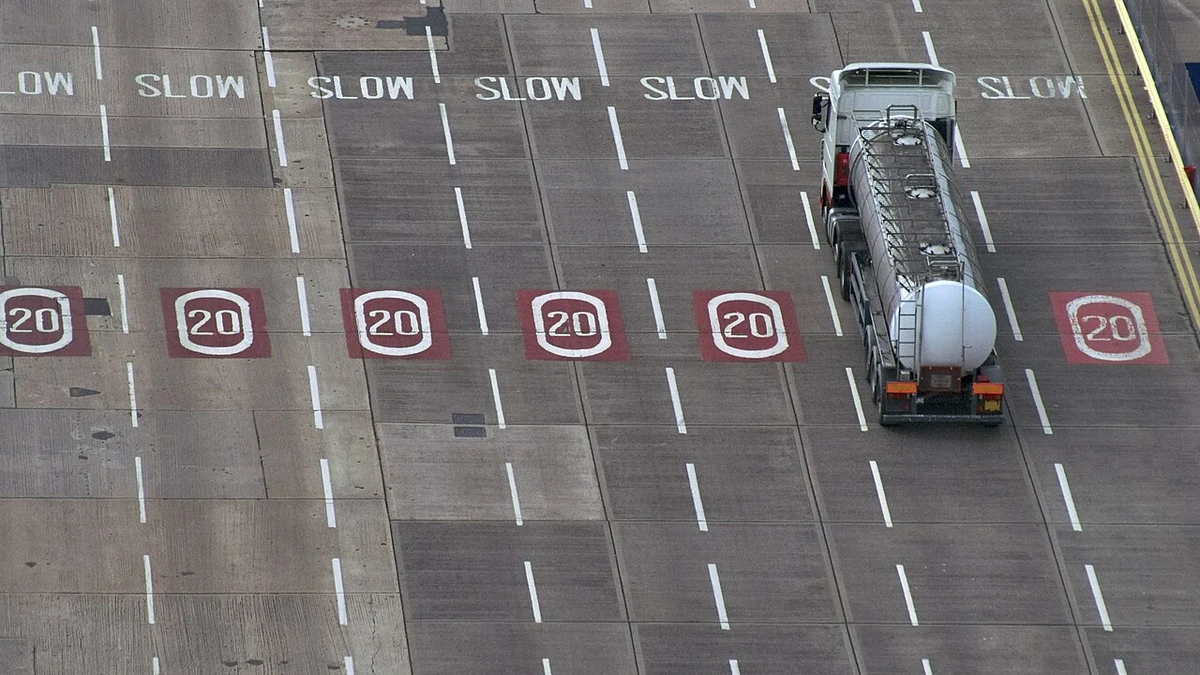
A road tanker waiting for ferry boarding in Dover, United Kingdom, August 2009. International archive photograph; no cargo compatibility is implied. Photo: Mozzihh / CC BY-SA 4.0. Cropped and resized. This is documentary stock imagery, not a claim that Synesys owns the pictured facility, vehicle or shipment.