
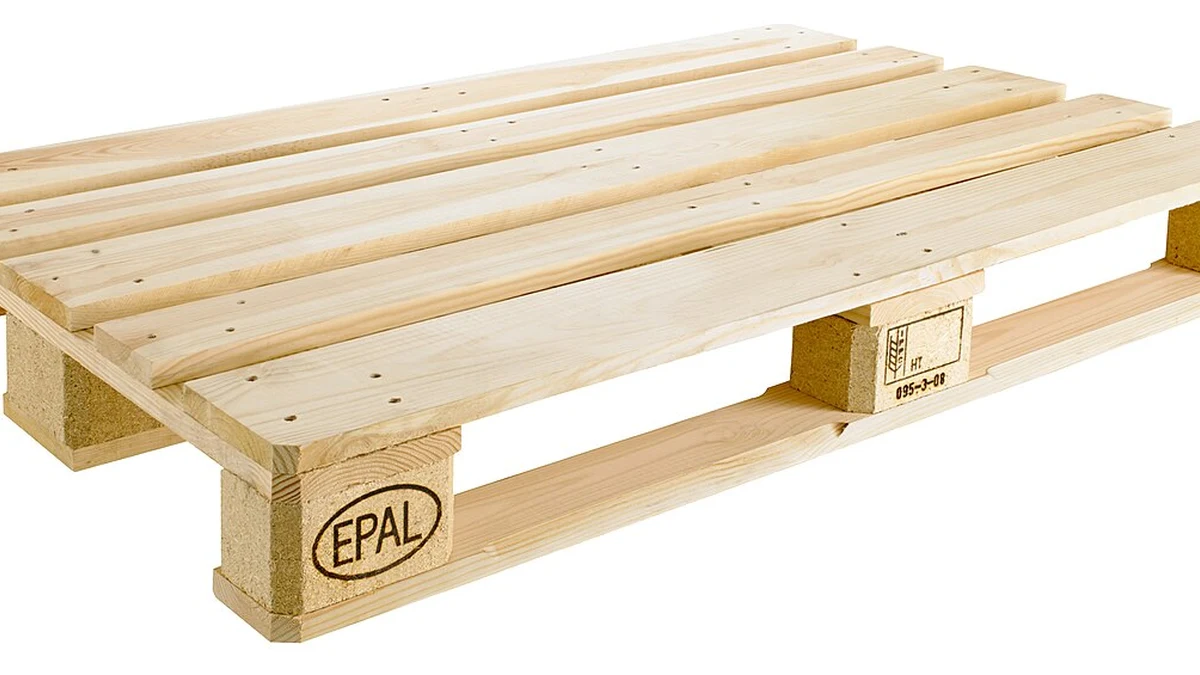
A pallet loading plan should use the measured loaded footprint, delivery sequence and securing allowance. Draw the units to scale before confirming a pallet count. Equal floor area does not guarantee equal fit, and a neat rectangle does not establish safe or legal capacity.
Last verified: 17 November 2026. South African shipper education; verify the actual shipment, contract, policy and destination requirements before dispatch.
In this guide
Measure the loaded unit for your pallet loading plan
A warehouse can describe its base as a standard pallet while the cartons above it overhang on both sides. The truck carries the loaded unit, not the catalogue base. Record length, width and height at the widest points, including wrapping, corner protection and frames. Use metres or millimetres consistently.
Mark stackability as a condition to confirm, not a default. The upper package’s mass, lower package strength, stability and handling method all matter. If the shipper cannot support a stacking claim, quote the units as non-stackable until the responsible parties approve another arrangement. The pallet dimensions guide covers the measurement brief.
A rotation test can change the count
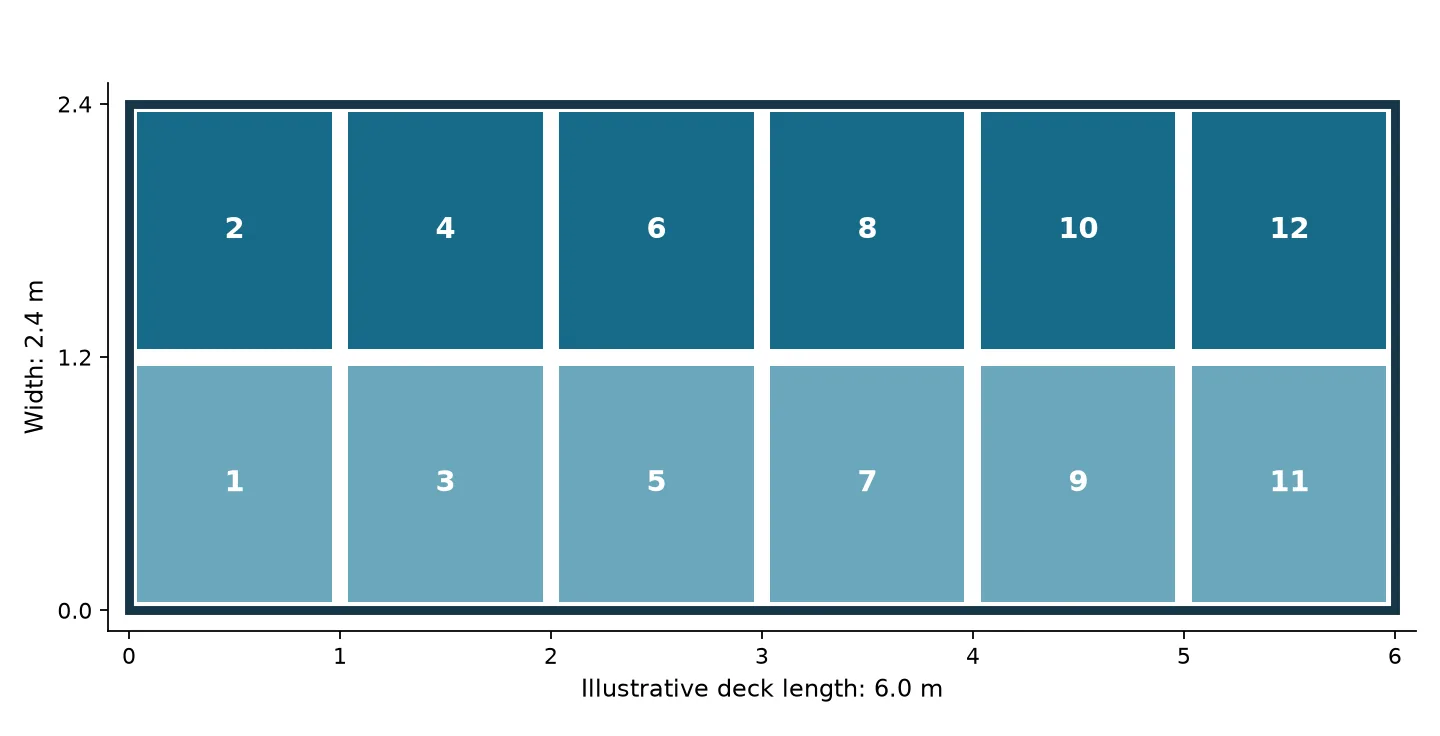
Illustrative geometry only. Assume a rectangular deck 6.0 m long by 2.4 m wide and loaded footprints exactly 1.0 m by 1.2 m. With the 1.2 m side across the vehicle, two units fit across and six rows fit along the length: 12 theoretical positions. The diagram has no securing gaps or clearance allowance.
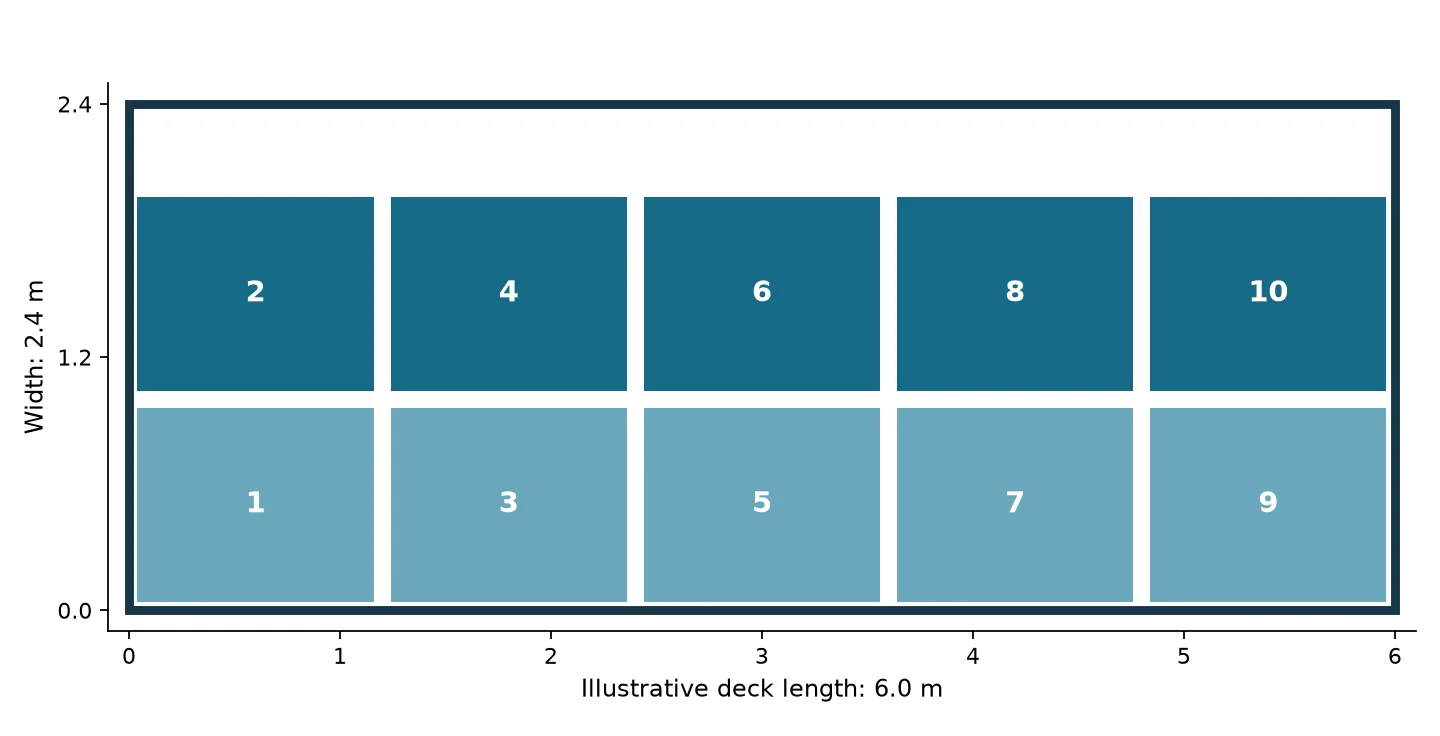
Rotate each unit so that its 1.0 m side lies across the vehicle. Two units occupy 2.0 m of width, leaving a 0.4 m strip. Along the length, five rows of 1.2 m fit into 6.0 m, giving 10 theoretical positions. The unused strip is too narrow for another of the assumed units.
| Assumed orientation | Across width | Along length | Theoretical positions |
|---|---|---|---|
| 1.2 m across × 1.0 m along | 2 units | 6 rows | 12 |
| 1.0 m across × 1.2 m along | 2 units | 5 rows | 10 |
Download this article’s main table (CSV)
Both layouts use the same package area. Dividing total deck area by pallet area can therefore hide a fit problem. This example compares two simple aligned orientations; it is not an optimisation claim that no mixed orientation could work. For a real load, model the actual shapes, obstructions and handling constraints.
Deduct space for the work that must happen
A zero-gap drawing is useful for arithmetic but poor evidence of a finished pallet loading plan. Show the space needed for securing and handling. Check doorway dimensions, wheel-arch or body obstructions, and access to lashing points. Confirm whether the receiving crew can remove the units in the planned order.
The IMO/ILO/UNECE CTU Code addresses packing, distribution and securing as connected tasks. Its guidance should not be reduced to a pallet-count formula. The code’s supply-chain functions also place emphasis on providing the cargo information needed by the packer and carrier. A scale drawing is only as reliable as its inputs.
For a Johannesburg delivery followed by a Pretoria stop, colour the units by destination. If the Pretoria pallet blocks access to the Johannesburg units, change the sequence or confirm an appropriate handling arrangement before loading. Do not assume the first receiver will unload and reload unrelated freight for free.
Put kilograms beside every rectangle
A footprint alone cannot distinguish lightweight cartons from a dense machine base. Put the unit identifier and gross package mass in the pallet loading plan worksheet. Ask the operator to check distribution on the actual combination, including each partial-load state. The axle weight distribution guide explains why a legal total does not answer that question.
If unit P07 is substituted after the pallet loading plan is approved, compare its dimensions and mass with the original. A replacement that is only slightly wider can remove a row. A replacement of the same size but much heavier can change distribution. Record the substitution and obtain the relevant approvals rather than editing the picture without telling the operator.
Use the body-selection guide to confirm side or rear access and the complete load planning guide for site constraints. This article solves a narrower question: whether the package footprint and loading order described in the booking are physically coherent.
A pallet-by-pallet worksheet
| Unit | Loaded dimensions | Gross mass | Stacking instruction | Delivery stop | Plan position |
|---|---|---|---|---|---|
| P01 onward | Length × width × height, with units | kg per loaded unit | Approved / not approved / unresolved | Named receiving point | Row and side |
| Exceptions | Overhang or unusual shape | Record changed mass | Special support or fragility | Handling restriction | Revised plan reference |
Keep a copy of the accepted pallet loading plan with the dispatch file and compare it with the actual loading. Photograph the arrangement where safe and useful, including unit identifiers and securing details. Record any departure from the plan and who authorised it. A pallet loading plan that is never checked against the truck is an illustration, not a control.
When the load is priced in capacity units rather than pallet positions, consult loading metres versus cubic metres. Ask the carrier how it calculates the chargeable quantity and which space it reserves. A nominal pallet count should not disguise the fact that a non-stackable unit consumes the height above it.
Questions shippers ask
Can I calculate pallet capacity from floor area alone?
No. The orientation and shape must fit the usable dimensions. Securing, access, overhang, mass and distribution can reduce the theoretical count. Model the actual units and obtain operator confirmation.
Can pallets be rotated to fit more?
Sometimes, provided handling, packaging orientation, stability and securing allow it. The two illustrated orientations are a geometry comparison, not an instruction to rotate cargo against its handling requirements.
Should I show the unloading order?
Yes. Identify each destination and the required access. A pallet loading plan that fits all units but blocks the first delivery may create unsafe handling or extra unloading work.
Continue in this learning cluster
Use the related guides when the next decision becomes specific:
- Truck Load Planning: Match Weight, Space and Site Access
- Axle Weight Distribution: Why Legal Total Mass Is Not Enough
- Loading Metres vs Cubic Metres: Which Capacity Measure Fits Your Freight?
Bring the completed worksheet and your actual shipment details to a freight conversation with Synesys. This guide helps prepare the decision; it does not promise an insurance outcome, legal approval or transport availability.
Sources and verification
- IMO/ILO/UNECE CTU Code, 2014 — checked 17 November 2026.
- CTU Code: supply-chain functions — checked 17 November 2026.
The examples and visuals are original Synesys teaching models. Illustrative figures are deliberately separated from sourced facts and must not be used as tariffs, actual claim settlements or legal vehicle capacities.
Continue with this topic
An EPAL pallet, photographed in July 2013. Product photograph; confirm the dimensions and condition of the pallets actually offered. Photo: Oliver Eltinger / CC BY-SA 4.0. Cropped and resized. This is documentary stock imagery, not a claim that Synesys owns the pictured facility, vehicle or shipment.