

Loading metres describe floor-length occupation under an agreed method; cubic metres describe volume. Neither measure alone proves a load will fit. For non-stackable or awkward freight, send the actual package dimensions and ask the carrier how it reserves and charges for space.
Last verified: 17 November 2026. South African shipper education; verify the actual shipment, contract, policy and destination requirements before dispatch.
In this guide
Loading metres vs cubic metres: two different questions
A quote for a Johannesburg-to-Durban part load may be based on pallets, mass, cubic metres, loading metres or another agreed basis. Ask which quantity is being priced. A number without its unit can make two quotes appear comparable when they reserve different amounts of capacity.
For this guide, a floor-equivalent loading metre means package footprint area divided by an explicitly assumed usable vehicle width. It is a teaching definition, not a universal tariff rule. Carriers may apply minimums, rounding, stacking assumptions or different allocation methods. Obtain the loading metres calculation method on the quote before using it to compare prices.
Calculate each measure with its assumptions visible
| Measure | Illustrative calculation | What it does not establish |
|---|---|---|
| Cubic metres | External length × width × height, all in metres | Door fit, permitted stacking or mass capacity |
| Floor area | External loaded length × width | Whether that shape fits the deck |
| Floor-equivalent loading metres | Footprint area ÷ agreed usable width | The carrier’s chargeable allocation or a safe load plan |
| Gross package mass | Goods plus packaging, stated in kg | Axle distribution or space occupation |
Download this article’s main table (CSV)
The IMO/ILO/UNECE CTU Code treats the physical packing and distribution problem in more detail than one volume figure. Its supply-chain guidance also highlights the package information that needs to reach the carrier. The original formulas and scenarios here are offered to organise that information, not to replace an operator’s capacity decision.
Equal cube, different floor occupation
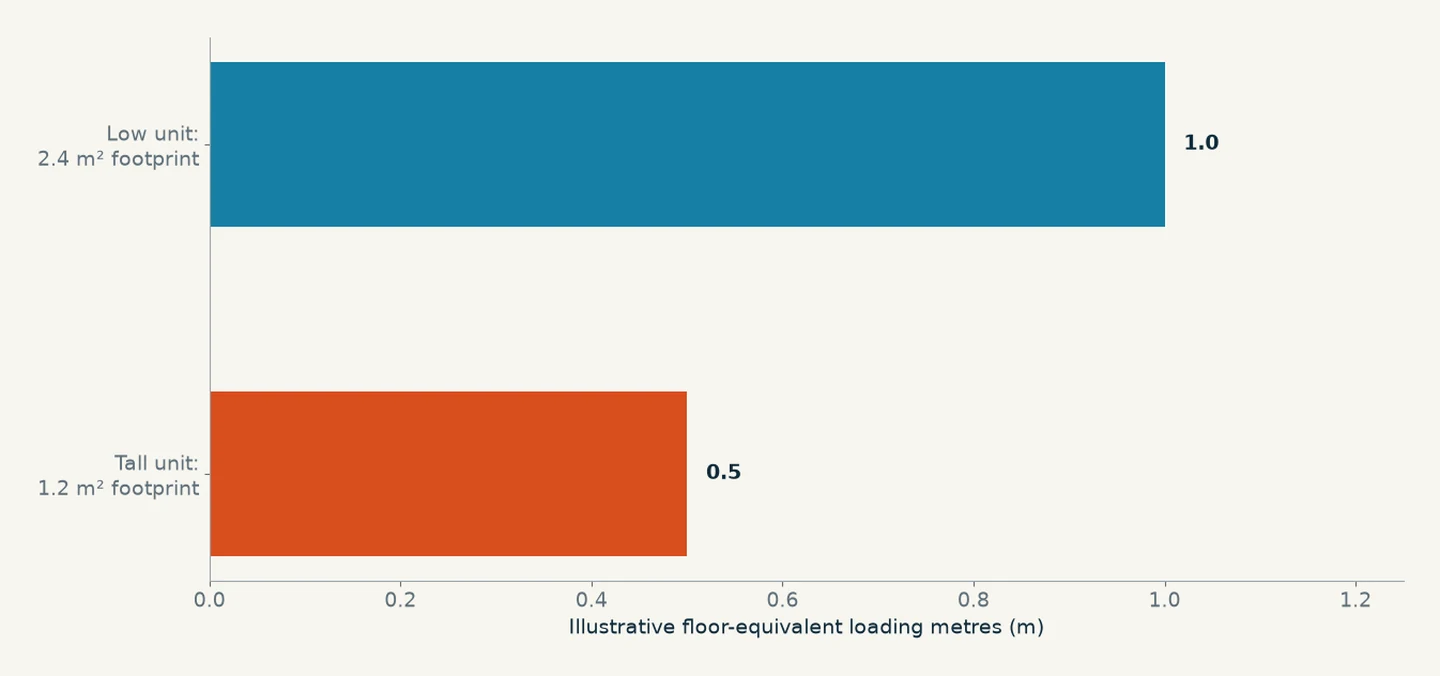
Illustrative example. Unit A has a 2.4 m² footprint and stands 1.0 m high. Unit B has a 1.2 m² footprint and stands 2.0 m high. Each has a volume of 2.4 m³. With an assumed usable width of 2.4 m, the floor-equivalent calculations are 2.4 ÷ 2.4 = 1.0 loading metre and 1.2 ÷ 2.4 = 0.5 loading metre.
| Unit | Footprint | Height | Volume | Floor-equivalent loading metres |
|---|---|---|---|---|
| Low unit | 2.4 m² | 1.0 m | 2.4 m³ | 1.0 m |
| Tall unit | 1.2 m² | 2.0 m | 2.4 m³ | 0.5 m |
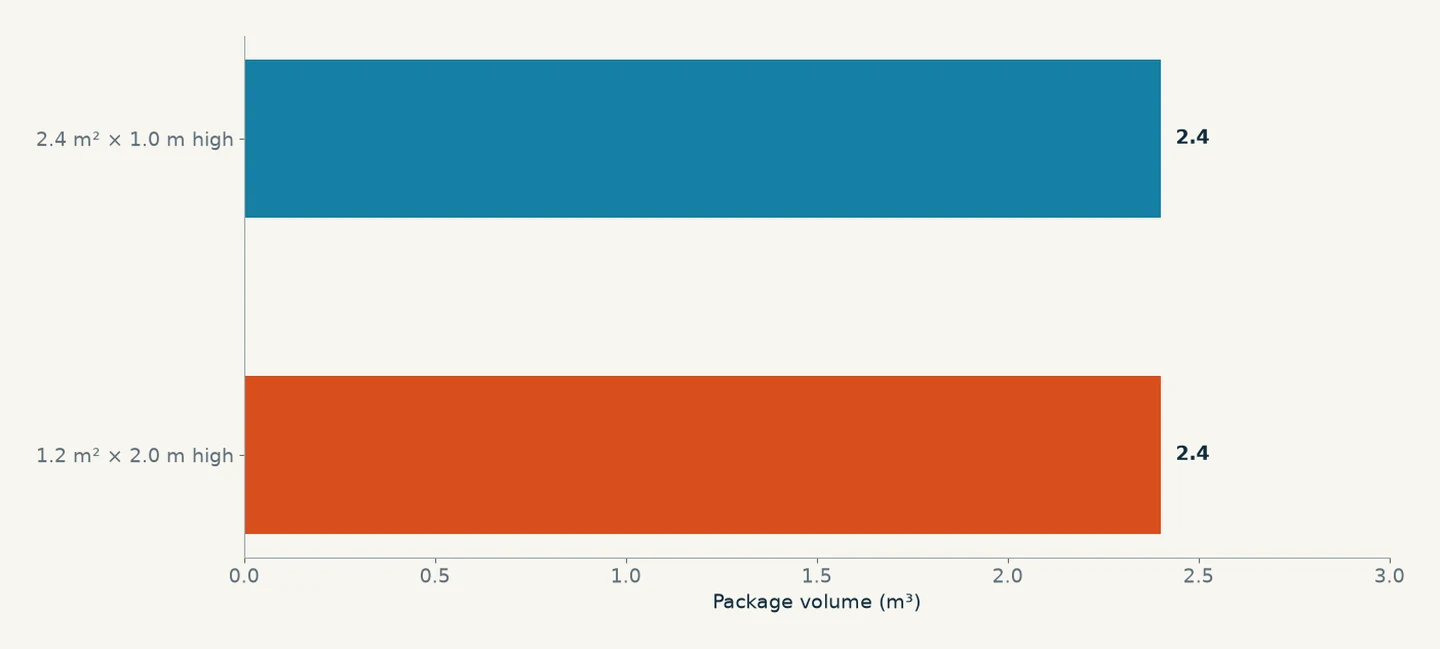
That does not make Unit B automatically easier to carry. Its height, centre of gravity and handling access may be more demanding. Unit A may prevent use of the space above it if it is non-stackable. The carrier must look at the shape, packaging strength and proposed arrangement rather than assuming a smaller floor-equivalent result is always better.
Do not multiply a loading-metre result by vehicle height and call the resulting space available to stack. Stacking needs explicit approval for the actual goods and packaging. A volume calculation is not evidence that a lower package can bear an upper one.
The shape can defeat an area calculation
Two rectangles can have the same area but fit a deck differently. A long narrow crate may need a full side of the vehicle, while compact units with the same total area can be arranged in rows. Use the pallet loading plan example to see why orientation changes the count even with unchanged package area.
Record external dimensions and any no-rotation instruction. If machinery has an offset centre of gravity, identify it for the operator rather than hiding it inside a volume total. Use the distribution guide for the mass-position problem and the body-selection guide for access and handling.
A mixed part load adds another question: can the proposed unit travel beside the other freight without incompatible handling, contamination or securing problems? A carrier’s space allocation is a commercial and operational decision. Your calculation helps the conversation; it does not bind the carrier to accept the load.
Compare chargeable quantities as well as rates
Suppose one quote reserves a floor strip and another assumes stackable cube. A lower rate per cubic metre may not be a lower delivered cost if the second quote’s stacking assumption is wrong. Ask both operators to price the same measured units and state the basis they used. Then compare the scope and handling requirements.
| Quote field | Question to resolve |
|---|---|
| Chargeable unit | Pallet, kg, m³, loading metre or another basis? |
| Calculation | Which dimensions, width, rounding and minimums were used? |
| Stackability | Who approved it and under what conditions? |
| Reserved capacity | Which floor footprint and height are committed? |
| Changes | What happens if dimensions or package count change? |
| Handling | Are loading, unloading and special access included? |
Attach the accepted loading metres calculation to the booking and send any revised measurements before collection. The road freight quote comparison guide helps check the remaining scope. The truck load planning pillar connects the commercial quantity to the actual vehicle checks.
A practical shipment brief includes all three basic measures: package dimensions, package mass and stackability conditions. Give the carrier enough information to select the relevant capacity measure rather than making the shipper guess which one produces the cheapest-looking number.
Questions shippers ask
Is one loading metre always 2.4 cubic metres?
No. Loading metres refer to floor-length occupation under an agreed method; cubic metres refer to volume. The assumed width and package height must be stated, and a carrier may use different charging rules.
Which measure should I use for non-stackable freight?
Send actual dimensions, mass and the non-stackable condition. Ask the carrier how it allocates the floor space and unusable space above. Do not choose a charging unit without agreeing the method.
Can a smaller cubic volume still cost more?
Yes, if its footprint, shape, height, handling or non-stackable condition reserves more useful capacity. Compare quotes using the same physical brief and stated charging assumptions.
Continue in this learning cluster
Use the related guides when the next decision becomes specific:
- Truck Load Planning: Match Weight, Space and Site Access
- Axle Weight Distribution: Why Legal Total Mass Is Not Enough
- Pallet Loading Plan: Test the Footprint Before Confirming Capacity
Bring the completed worksheet and your actual shipment details to a freight conversation with Synesys. This guide helps prepare the decision; it does not promise an insurance outcome, legal approval or transport availability.
Sources and verification
- IMO/ILO/UNECE CTU Code, 2014 — checked 17 November 2026.
- CTU Code: supply-chain functions — checked 17 November 2026.
The examples and visuals are original Synesys teaching models. Illustrative figures are deliberately separated from sourced facts and must not be used as tariffs, actual claim settlements or legal vehicle capacities.
Continue with this topic
Pallet-rack storage in a warehouse, December 2007. Illustrative archive photograph. Photo: Axisadman / CC BY-SA 3.0. Cropped and resized. This is documentary stock imagery, not a claim that Synesys owns the pictured facility, vehicle or shipment.