

Freight cost allocation assigns a shared delivery bill to the products or orders that caused it. Choose a driver that fits the charge—such as occupied space, mass, declared value or a dedicated task—and keep the allocation separate from the supplier’s actual invoice.
Last verified: 17 November 2026. Scope: South African shippers and their freight partners.
In this guide
Start with what caused the charge
A mixed truck from Durban to Boksburg can carry dense metal parts beside light cartons that occupy most of the floor. Allocating every rand by weight will place most freight cost on the metal. Allocating everything by invoice value may put it on the expensive carton instead. Neither result is automatically a faithful explanation of the vehicle resource used.
Freight cost allocation is an internal decision unless the sales contract or supplier agreement says otherwise. Document the purpose of the freight cost allocation method: pricing a customer order, estimating product margin, or preparing an inventory-cost review. Those are related uses, but they need not have identical treatments.
The IFRS Foundation: IAS 2 Inventories summary provides the accounting context for inventory cost and cost assignment. It does not prescribe the simple weight-versus-space method below for every business. Ask finance to approve the policy used in financial reporting. The examples here are management analysis.
Match freight cost allocation to the service
| Charge | Possible allocation driver | Why review it |
|---|---|---|
| Shared vehicle space | Pallet positions or occupied loading space | Light freight may consume most capacity |
| Mass-constrained movement | Actual mass, with relevant capacity checks | Dense cargo may constrain the truck |
| Cargo insurance premium | Insured value or the insurer’s charge basis | A space rule can hide value exposure |
| Dedicated unloading task | Direct assignment to the relevant order | Other orders did not cause the task |
| Customs or commodity-specific item | Direct assignment where identifiable | Do not spread a product-specific charge blindly |
| Shared administration | Documented management policy | Make the assumption visible and consistent |
Download this article’s main table (CSV)
Avoid adding a precise formula to unreliable measurements. If the pallet count is provisional or the cargo cannot stack, say so before calculating a space share. The footprint should describe the loaded condition, including relevant overhang or restrictions, rather than an optimistic catalogue dimension.
Worked example: two valid questions, two different shares
Illustrative shipment. Order A occupies 8 of 10 pallet positions and weighs 2,000 kg. Order B occupies 2 positions and weighs 8,000 kg. The assumed shared truck cost is R10,000. By pallet positions, A receives R8,000 and B R2,000. By mass, A receives R2,000 and B R8,000. The total stays R10,000; the margin story changes sharply.
| Illustrative method | Order A (ZAR) | Order B (ZAR) | Total (ZAR) |
|---|---|---|---|
| By pallet positions | 8000 | 2000 | 10000 |
| By mass | 2000 | 8000 | 10000 |
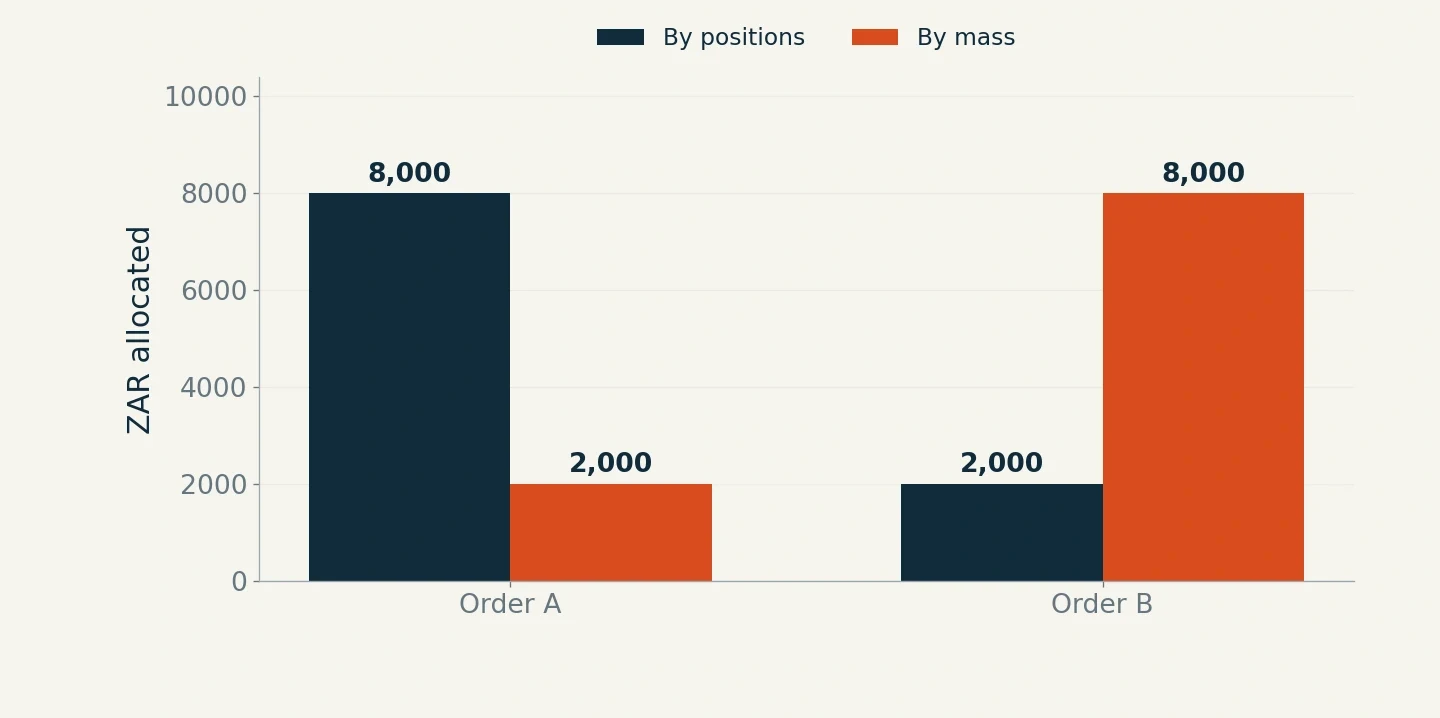
| Order | By positions (ZAR) | By mass (ZAR) |
|---|---|---|
| Order A | 8,000 | 2,000 |
| Order B | 2,000 | 8,000 |
Ask which resource constrained this particular truck. If floor space was the commercial basis, position allocation may explain the shared line better. If mass constrained the job, weight deserves attention. For awkward cargo, freight cost allocation may need a better measure of the dedicated resource. Record the judgement instead of pretending the spreadsheet chose it.
Use the result to ask a better pricing question. If Order A only works commercially when Order B absorbs nearly all the freight, the combined order may conceal a weak product margin. That is an analytical signal, not proof the customer has been charged incorrectly.
Direct costs should stay direct
Assume Order B alone needs an additional R1,500 unloading arrangement. A transparent model assigns that task to B before allocating the remaining shared R10,000. A flat split of the resulting R11,500 would charge A for a task it did not require. Keep the supplier’s invoice intact and record freight cost allocation in a separate schedule.
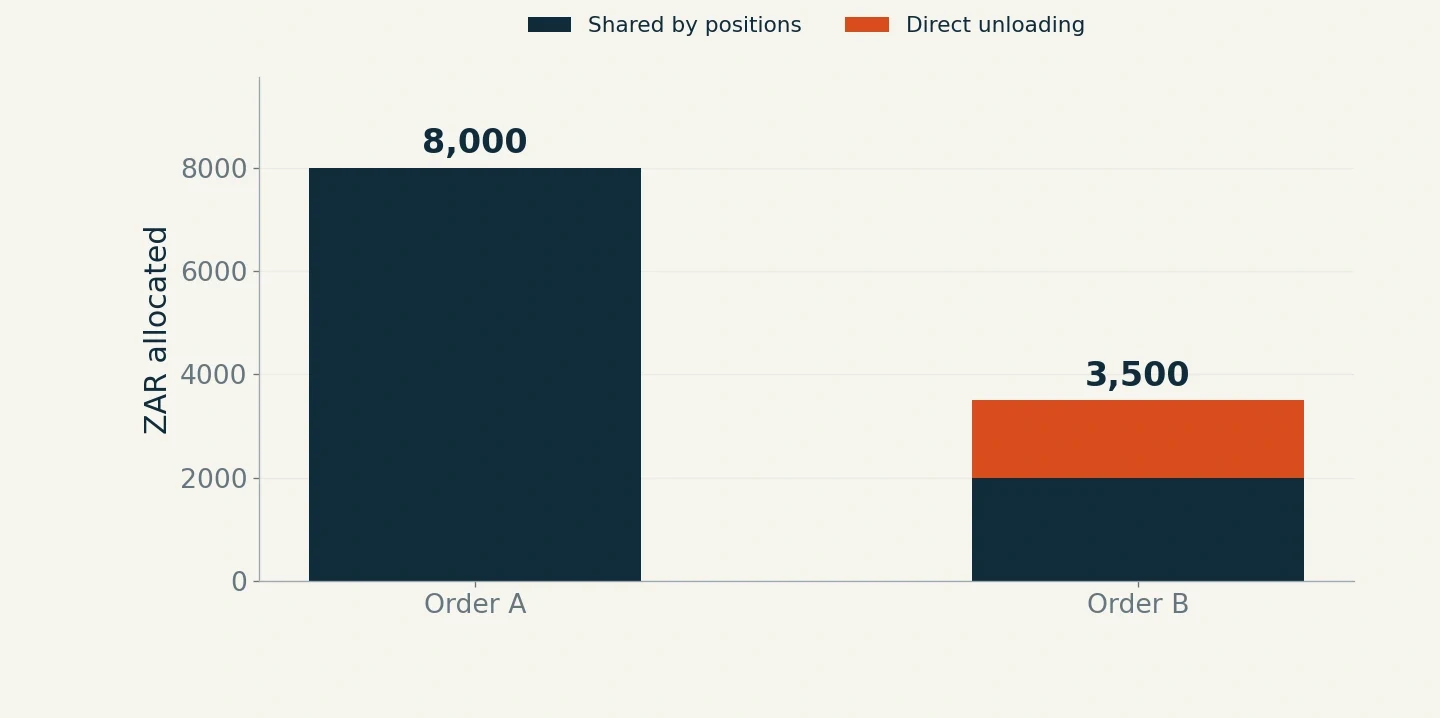
| Order | Shared by positions (ZAR) | Direct unloading (ZAR) | Total (ZAR) |
|---|---|---|---|
| Order A | 8,000 | 0 | 8,000 |
| Order B | 2,000 | 1,500 | 3,500 |
For import work, duty and tax need their own treatment. SARS: Duties and Taxes for Importers explains that classification, value and quantity can affect duties. Do not spread a product-specific assessment by pallet count just because that is how you allocated the truck. Finance and the declarant should preserve the actual tax basis.
The same principle applies to equipment time. Maersk: Terms for Detention and Demurrage sets out distinct container charging concepts. If one order’s handling delay caused an additional service, retain the evidence before deciding whether it should be assigned directly or absorbed under the business’s policy.
Keep the allocation reproducible
| Column | What to retain |
|---|---|
| Invoice reference | The actual supplier bill and total |
| Cost bucket | Shared transport, direct handling, tax or another item |
| Driver and unit | Positions, kilograms, value or direct assignment |
| Order quantities | Measured inputs and their source |
| Calculation | Order share × shared amount, plus direct items |
| Policy approval | Purpose, owner and effective date |
| Reconciliation | Allocated total agrees to the source amount |
Review freight cost allocation when the freight profile changes. A policy designed for identical pallets may be misleading after the business starts shipping non-stackable equipment. Apply changes prospectively with an explanation, rather than switching the driver whenever it makes a preferred product look more profitable.
The useful output is not merely a number per order. It is an explanation that purchasing, operations and finance can reproduce. If they disagree, compare the physical constraint and the charge evidence first. The formula can wait.
Questions shippers ask
Is weight always the fairest way to split freight?
No. It may fit a mass-constrained charge but can understate the cost of bulky, light freight. Match the driver to the service and explain the judgement.
Can allocation change the supplier’s invoice?
No. Keep the actual invoice intact. The internal schedule explains how the business assigns that total to orders or products.
Should I allocate customs duty by pallet count?
Do not replace the actual assessment basis with a convenient freight driver. Preserve product-specific duty and tax treatment with finance and the declarant.
Use this with the rest of the library
Follow the practical next step: Landed Cost in South Africa: Build a Complete Freight Budget; Freight Quote Exclusions: Find the Charges Outside the Headline Rate; Import VAT Cash Flow: Separate Tax Funding from Freight Cost.
For the operating handoff, also use How to compare freight rates per tonne; Pallet dimensions for a road freight quote. If you need help scoping a shipment, send Synesys the collection, delivery and cargo details.
Sources and method
The external sources below support the rules or carrier terms cited in this article. The worksheets, decision methods and labelled examples are original Synesys educational analysis. They are not measured customer outcomes or market price benchmarks. Confirm the actual declaration, contract and shipment dates before relying on a numerical example.
- IFRS Foundation: IAS 2 Inventories
- SARS: Duties and Taxes for Importers
- Maersk: Terms for Detention and Demurrage
Continue with this topic
A container truck in Senegal, April 2012. International archive freight photograph. Photo: Maersk Line / CC BY-SA 2.0. Cropped and resized. This is documentary stock imagery, not a claim that Synesys owns the pictured facility, vehicle or shipment.