

Freight quote exclusions are tasks, charges or conditions outside the supplier’s stated price. Before comparing rates, put each offer against the same collection, delivery, waiting, handling and return scope, then get unresolved items priced or explicitly marked as unknown.
Last verified: 17 November 2026. Scope: South African shippers and their freight partners.
In this guide
A lower number may stop at an earlier handoff
A rate for collecting a released container at Durban is different from a rate that also includes unloading arrangements and returning the empty equipment. Freight quote exclusions are not automatically unfair. The problem is an exclusion the buyer did not understand until the physical job made it unavoidable.
Start by writing the job in events: cargo ready, truck arrives, loading finishes, delivery begins, unloading ends and any return or closeout task is completed. Ask each bidder to mark the events covered by its rate and the freight quote exclusions. This makes the comparison concrete without assuming all carriers use the same commercial structure.
For an international shipment, keep the sales contract separate from the carrier quote. A sales term may allocate responsibility between buyer and seller; the transport supplier still needs a specific scope. A Boksburg delivery address does not, by itself, tell the bidder whether a forklift, crane or labour team is provided.
Freight quote exclusions to put on the comparison sheet
| Scope item | Question for each bidder | Evidence needed |
|---|---|---|
| Loading/unloading | Who provides equipment, people and site access? | Written method and named responsibility |
| Waiting | What triggers a charge and what time is allowed? | Rate, clock and acknowledgement process |
| Extra stop or failed delivery | What changes if the receiver cannot accept? | Condition and agreed variation process |
| Cargo changes | Does mass, footprint or handling alter the price? | Confirmed cargo schedule |
| Border/port work | Which clearing and handling tasks are included? | Named service and supplier |
| Container closure | Does the rate include the instructed empty return? | Depot, conditions and evidence |
| Taxes/surcharges | Which tax basis and surcharge revision rules apply? | Written quote and validity date |
Download this article’s main table (CSV)
Use a column for “included”, “excluded but priced”, “conditional” and “unresolved”. Do not compress them all into a yes/no tick. A waiting charge with a defined trigger is assessable; an unpriced extra “if required” cannot yet be compared reliably.
Worked example: calculate the cost of the missing task
Illustrative bids, not South African market rates. Quote A is R5,500 and excludes an assumed R1,200 return task and an assumed R800 unloading arrangement. Quote B is R7,000 and includes those same tasks. With the stated assumptions, A totals R7,500 and B totals R7,000. The apparent R1,500 saving on the headline disappears after scope is equalised.
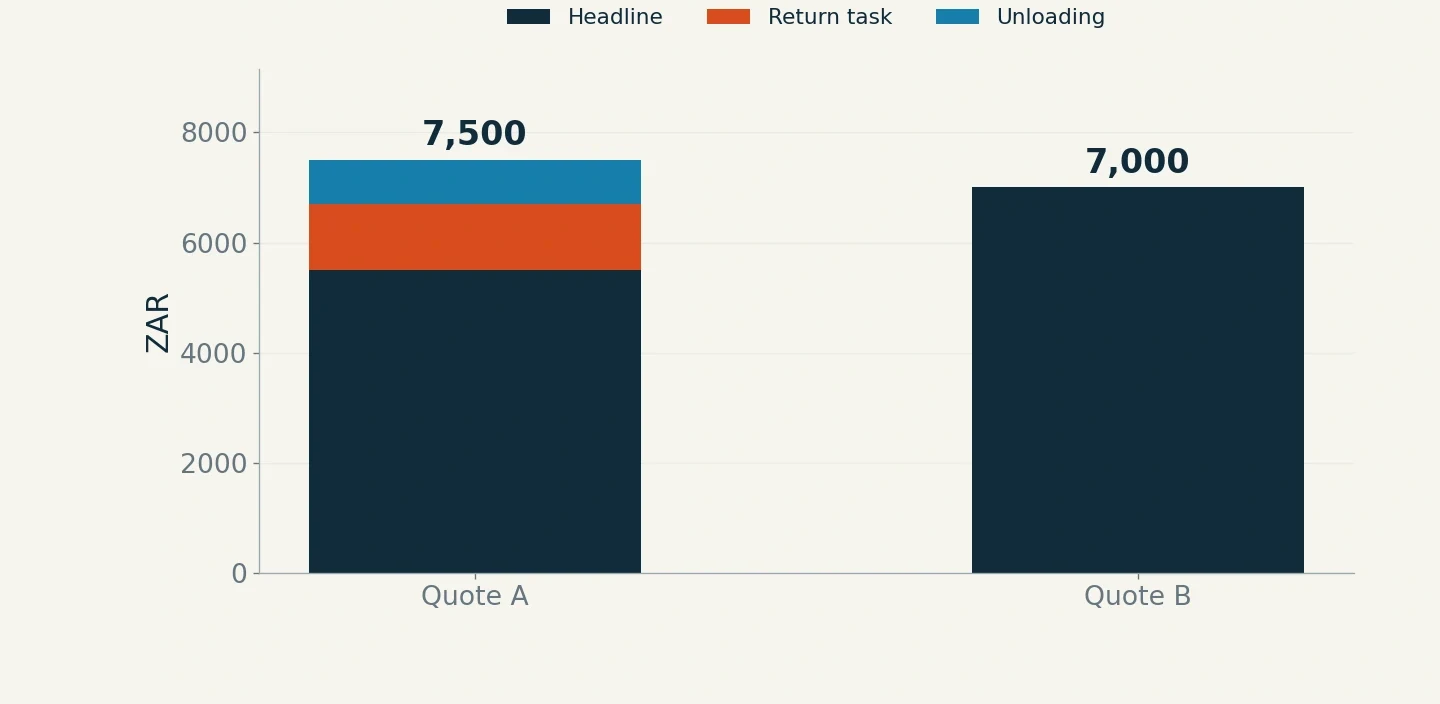
| Quote | Headline (ZAR) | Return task (ZAR) | Unloading (ZAR) | Total (ZAR) |
|---|---|---|---|---|
| Quote A | 5,500 | 1,200 | 800 | 7,500 |
| Quote B | 7,000 | included | included | 7,000 |
| Illustrative item | Quote A (ZAR) | Quote B (ZAR) |
|---|---|---|
| Headline rate | 5500 | 7000 |
| Assumed return task | 1200 | Included |
| Assumed unloading | 800 | Included |
| Equivalent total | 7500 | 7000 |
If the return task is not actually required, adding it to A would be wrong. The method depends on a true job definition. Ask the receiving and equipment owners first, then compare the price of the same outcome.
Put a boundary around conditional charges
A quote can be clear about normal service while still exposing the shipper to open-ended waiting. Ask what starts and stops the clock, whose timestamp is used, and how an exception will be acknowledged. A driver’s arrival time, check-in time and bay-entry time are different events. Choose the evidence before there is a disagreement.
A variation needs an approval trail
- Scope change and price + effect are recorded together.
- Approval is given.
- Execution + evidence follow.
For a container movement, Maersk: Terms for Detention and Demurrage explains that equipment time and storage can have their own charging structure. A road carrier’s price should not be assumed to include every amount another party may invoice. Conversely, do not add a carrier charge again if the supplier has expressly included it.
On imports, the SARS: Duties and Taxes for Importers guidance shows why duty and VAT are not interchangeable with road freight. Get the clearing assessment and transport quote into separate lines, then confirm who funds each one. This prevents a tax estimate being mistaken for a transport surcharge.
Resolve freight quote exclusions before choosing an offer
Ask a final question before award: which bidder has the least unresolved scope? A slightly higher confirmed rate can be easier to budget than a low rate that still lacks the unloading method, delivery window and return instruction. That is a commercial judgement, not a rule that the highest price is best.
| Before awarding | Record |
|---|---|
| Same endpoint? | Exact delivery and closeout tasks |
| Same cargo? | Mass, dimensions, equipment and handling |
| Same terms? | Tax basis, validity and payment |
| Known variations? | Trigger, rate and approving person |
| Unresolved items? | Owner and deadline for clarification |
After delivery, reconcile actual extras to the agreed freight quote exclusions, accepted scope and approval trail. If an excluded task became necessary because the shipper changed the job, record that honestly. If the supplier invoiced an item already included, attach the relevant quote line when asking for correction. The aim is a reliable next purchase, not a retrospective argument about who used the word “all-in”.
Questions shippers ask
Does all-in mean every possible charge is included?
Only the written scope can answer that. Ask the supplier to identify exclusions, conditional charges and third-party costs explicitly.
Should I reject a quote with exclusions?
No. A clear exclusion can be priced or assigned to the right party. Unclear or unpriced scope needs resolution before a meaningful comparison.
Can I compare a per-tonne rate with a truck price?
Only after confirming the actual cargo, minimum charges, capacity and equivalent tasks. Use a total for the defined shipment alongside the unit rate.
Use this with the rest of the library
Follow the practical next step: Landed Cost in South Africa: Build a Complete Freight Budget; Import VAT Cash Flow: Separate Tax Funding from Freight Cost; Freight Cost Allocation: Divide a Mixed Shipment Without Hiding Losses.
For the operating handoff, also use How to compare road freight quotes; Freight payment terms before dispatch. If you need help scoping a shipment, send Synesys the collection, delivery and cargo details.
Sources and method
The external sources below support the rules or carrier terms cited in this article. The worksheets, decision methods and labelled examples are original Synesys educational analysis. They are not measured customer outcomes or market price benchmarks. Confirm the actual declaration, contract and shipment dates before relying on a numerical example.
Continue with this topic
The Sainsbury’s Waltham Point distribution centre, United Kingdom, September 2008. Illustrative warehouse photograph, not a Synesys facility. Photo: Nick Saltmarsh / CC BY 2.0. Cropped and resized. This is documentary stock imagery, not a claim that Synesys owns the pictured facility, vehicle or shipment.