

Import VAT cash flow is the money a shipment needs for import tax before the business receives any qualifying input-tax benefit. Calculate the import amount correctly, confirm who must pay it, and keep deduction eligibility separate from the date cash is needed.
Last verified: 17 November 2026. Scope: South African shippers and their freight partners. The tax calculation is educational. Obtain shipment-specific customs valuation and tax advice before filing or paying.
In this guide
Start with the release payment, not an expected refund
A Gauteng importer can have a profitable order and still lack the cash needed to release it. The budget might show import VAT as potentially deductible, while the clearing instruction requires the money before the shipment moves. Import VAT cash flow connects those dates instead of treating the tax as an invisible accounting line.
The SARS VAT Connect 17: Import VAT and clearing agents explanation distinguishes the importer’s position from the clearing agent’s role in facilitating payment. Confirm the legal importing entity with finance. Do not assume that the name on a freight invoice identifies the person entitled to an input-tax deduction.
Use two separate approvals: the clearing owner verifies the import calculation and payment requirement; finance confirms whether the business meets the conditions for a deduction and what evidence it needs. A promise that “we can claim VAT” is not a payment plan.
Import VAT cash flow starts with the right tax base
SARS states a standard VAT rate of 15% and explains the added-tax-value calculation in SARS: Duties and Taxes for Importers and its SARS: Import VAT calculation. Where applicable, the base includes customs value, a 10% uplift of customs value and non-rebated duties. The BLNS-origin exception has specific conditions. These numerical rules are single-authority sourced to SARS; two SARS pages are corroborating guidance, not independent authorities.
| Illustrative input | Amount (ZAR) | Treatment in this example |
|---|---|---|
| Assumed customs value | 200000 | Given assumption, not invoice valuation advice |
| 10% uplift | 20000 | Assumed applicable |
| Assumed non-rebated duty | 12000 | Given assumption, not a product tariff |
| Added tax value | 232000 | 200,000 + 20,000 + 12,000 |
| Import VAT at 15% | 34800 | 232,000 × 0.15 |
Download this article’s main table (CSV)
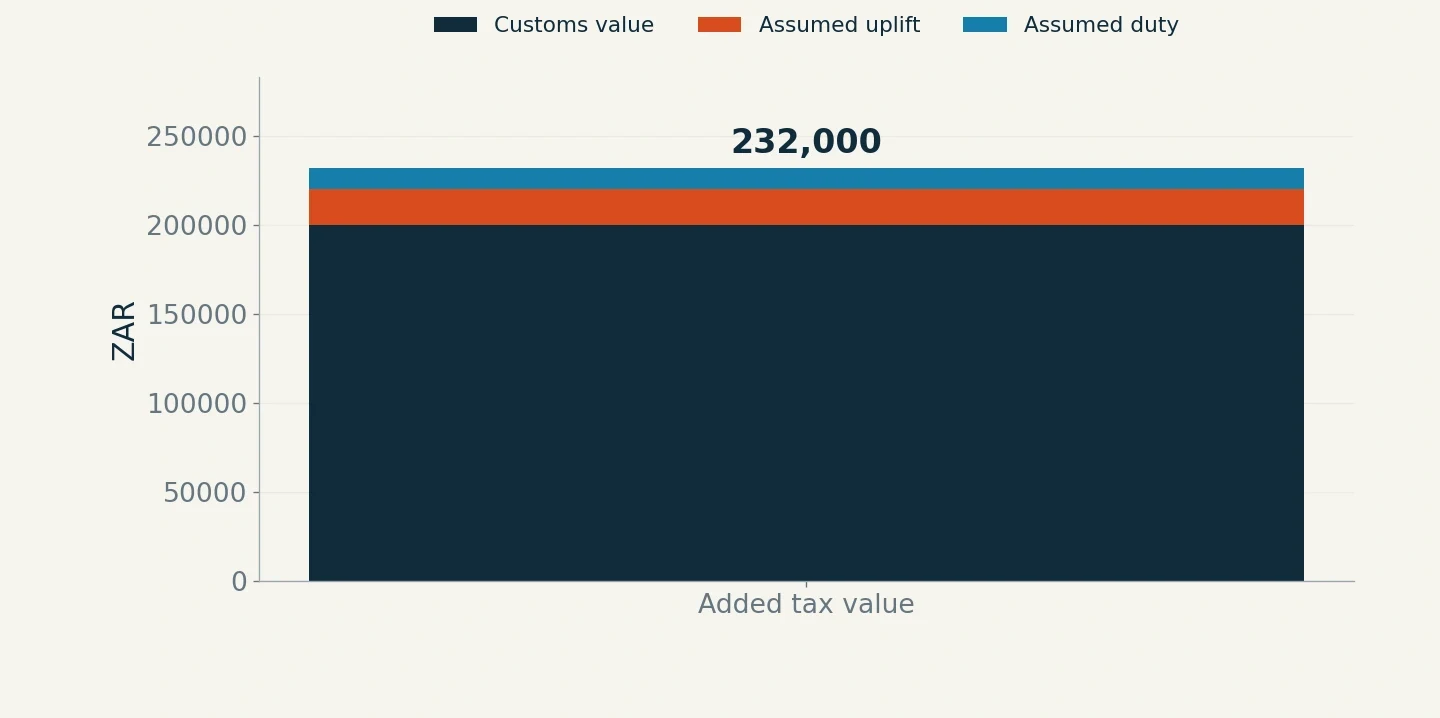
| Component | ZAR |
|---|---|
| Customs value | 200,000 |
| Assumed uplift | 20,000 |
| Assumed duty | 12,000 |
| Added tax value | 232,000 |
The uplift is often misread as another tax bill. In this example it increases the value on which VAT is calculated; it is not added as a separate R20,000 cash payment. Equally, R34,800 cannot be calculated by applying 15% to only the purchase price and ignoring the stated tax-base assumptions.
Worked funding timeline: an accounting benefit arrives later
Illustrative timing only. Suppose the importer needs R34,800 on Day 0 to meet the agreed payment requirement. Finance expects to assess the deduction when the relevant return and documents are ready. For a stress-test, show what happens if the cash benefit is not available until Day 30 or Day 60. Neither interval is a SARS refund promise; they are planning assumptions.
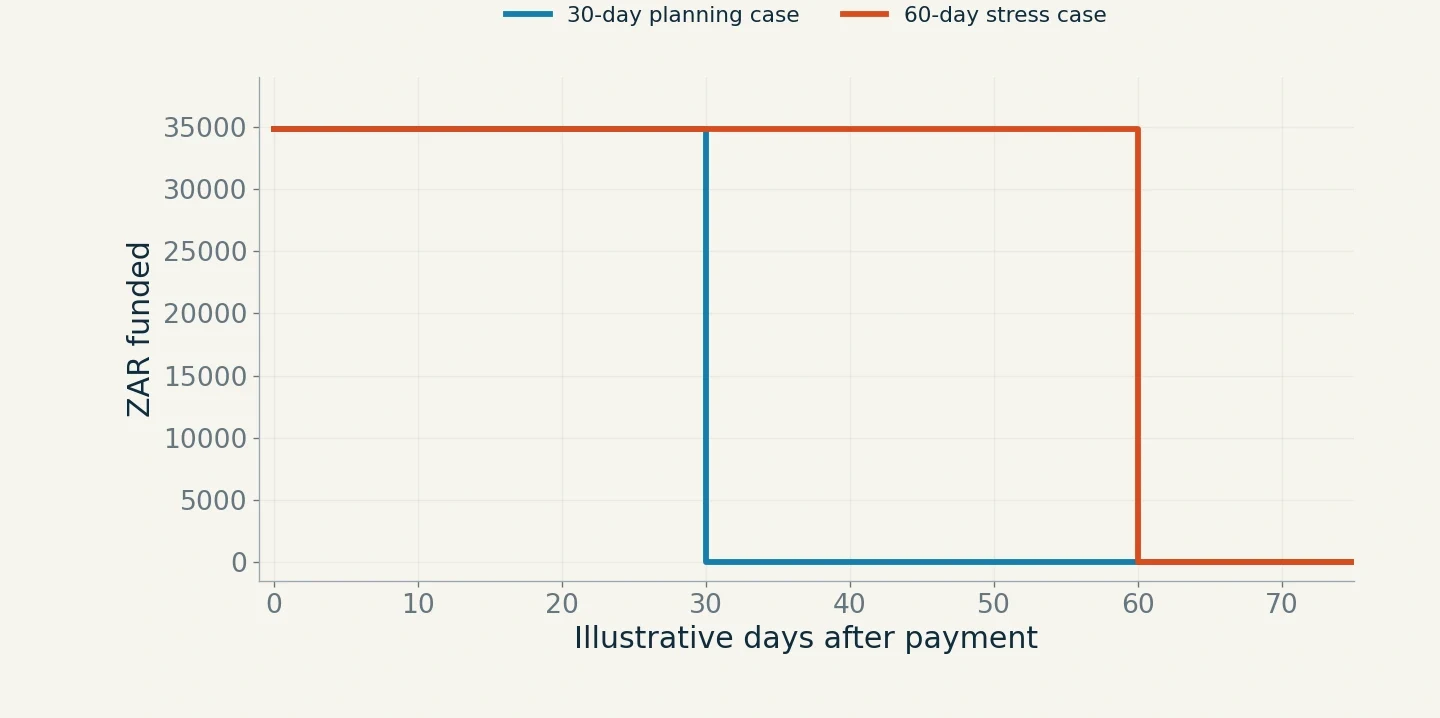
| Case | ZAR funded | Funded until (illustrative days after payment) |
|---|---|---|
| 30-day planning case | 34,800 | 30 |
| 60-day stress case | 34,800 | 60 |
The practical question is whether the business can carry the longer case without delaying payroll, the next import or the inland truck. If not, revise the purchasing and payment plan before the goods arrive. Do not make a freight booking depend on a speculative refund date.
Keep the import VAT cash flow model separate from the accounting journal. A deduction can reduce a VAT liability rather than produce a cash refund. Finance should model the actual tax position, while operations records the shipment payment deadlines.
Give finance the right evidence
SARS VAT 404 discusses documentary requirements and the Customs-release condition for input tax on imported goods. Use SARS VAT 404, Guide for Vendors, Issue 15 to confirm the actual requirements with your tax adviser. The shipper’s operational task is to collect the declaration, release and payment evidence and link it to the correct importing entity and consignment.
| Evidence/control | Why it belongs in the handoff |
|---|---|
| Importing entity | Finance knows whose tax position to assess |
| Declaration reference | Links the assessment to the shipment |
| Customs release evidence | Supports review of the applicable tax period |
| SARS payment evidence | Distinguishes an agent payment from tax paid over |
| Agent statement, where applicable | Connects the principal to the agent-held record |
| Reconciliation | Explains differences between estimate and final import amount |
When the clearing invoice differs from the estimate, ask for a reconciliation rather than replacing the budget silently. A changed exchange rate, customs value, duty assessment or duplicated instruction can alter the amount. Find the cause so the next funding request is better.
Turn import VAT cash flow into a funding instruction
State the amount, due date, payee and verification owner through the business’s approved payment process. Keep bank-detail verification separate from freight urgency. An email saying the truck is waiting does not justify bypassing the importer’s financial controls.
Import VAT cash flow is manageable when the responsible people see the same dates. Purchasing knows when the goods become ready, the clearing owner knows the assessment and release dependency, and finance knows the approved funding and deduction assumptions. If any one of those is missing, the model should show an open item instead of a reassuring zero.
Questions shippers ask
Is import VAT always recoverable?
No. Eligibility depends on the importer’s circumstances and statutory conditions. Have finance or a tax adviser confirm the treatment rather than building guaranteed recovery into the freight budget.
Is the 10% uplift another payment to SARS?
In the standard calculation illustrated here it is part of the added tax value, not a separate uplift payment. Confirm whether the uplift applies to the actual import.
Will a VAT deduction produce an immediate refund?
Not necessarily. It may offset output tax, and documentary, return and verification requirements affect the actual position. The chart’s timing is a planning scenario only.
Use this with the rest of the library
Follow the practical next step: Landed Cost in South Africa: Build a Complete Freight Budget; Freight Quote Exclusions: Find the Charges Outside the Headline Rate; Freight Cost Allocation: Divide a Mixed Shipment Without Hiding Losses.
For the operating handoff, also use Freight payment terms before dispatch; How to reconcile a road freight invoice. If you need help scoping a shipment, send Synesys the collection, delivery and cargo details.
Sources and method
The external sources below support the rules or carrier terms cited in this article. The worksheets, decision methods and labelled examples are original Synesys educational analysis. They are not measured customer outcomes or market price benchmarks. Confirm the actual declaration, contract and shipment dates before relying on a numerical example.
- SARS: Duties and Taxes for Importers
- SARS: Import VAT calculation
- SARS VAT 404, Guide for Vendors, Issue 15
- SARS VAT Connect 17: Import VAT and clearing agents
The tax calculation is educational. Obtain shipment-specific customs valuation and tax advice before filing or paying.
Continue with this topic
A Maersk truck on a South African road, April 2012. Archive photograph, not a Synesys shipment. Photo: Maersk Line / CC BY-SA 2.0. Cropped and resized. This is documentary stock imagery, not a claim that Synesys owns the pictured facility, vehicle or shipment.